


Dear Women,
I need your help. I need to know if it is ethical for me to get my daily news from national media news outlets like CNN and Fox News when they use images that openly objectify and degrade women to sell their content.
Please allow me quickly to contextualize my predicament. For a living, I study visual communication (like pictures and graphic designs and websites) and I teach related courses to college students. I have a penchant (or perhaps obsession) for analyzing how people are affected emotionally by what they see. I annoy my wife by complaining about poor shampoo bottle designs and I get all nerdy about reading books on punctuation (the visual side of writing) and watching entire documentaries on the typeface Helvetica. And I am constantly scrutinizing images used in advertising and on company websites.
I am also a father of three young girls.
With that little backstory, I hope you can shed some light on what’s been bothering me recently: national news media using female bodies to “sell” us information. I need to know how (if at all) the images affect you.
As a college professor, it’s important that I keep up with the news for my professional work and it is important for me to encourage my students to do the same. As a citizen, I believe it’s important for me to stay aware of the news so that I can make informed judgments and contribute healthily to society. As a father, I want stay abreast of the world so that I can help my girls navigate the socio-cultural challenges they’ll face. And I want to teach my girls to read and watch the news in order to be informed and productive citizens.
But I’m starting to wonder if I can ethically continue to frequent news media sites like CNN without knowing first how you feel about the sexually explicit images and headlines they use to persuade people to read their content. Clearly, no matter how much I look at, analyze, and research the way images make people feel, I can’t ever see it from your perspective.
In my profession, we are frequently reminded (trained, advised, warned) to avoid anything close to gender prejudices and sexual harassment of any kind; shoot, we’re even told not to use gender-specific terminology, like “you guys” for fear we may make some students feel marginalized. In such a sensitive environment, it would, obviously, seem absurd for me to require students to visit sexually explicit websites for class projects.
But as our country’s traditional news media fosters more and more sexually explicit material in order to boost ratings, I have to question whether I should support news organizations by giving them traffic.
If a parent of a student came to me and asked me what kind of websites I encouraged my students to visit, what do you think their reaction would be if my response went something like this: “Well, I let students choose the content they want to read, but the site I sent them to today had a video of supermodel Rebecca Romijn topless and groping other women’s breasts”?
As ridiculous as that sounds, that exact video is what I came across on CNN’s homepage. The video wasn’t an advertisement by another company; it was a humor piece produced directly on CNN’s site (as was the “humorous” video about Eva Mendes’ sex tape) .
The more I see content like that, the more I have to wonder how that makes you, women, feel when you see it in places that taut being “the must trusted name in news” (and not just in some trashy gossip magazine). It’s important for me to know, as a citizen, as a college professor, and as a father of three girls if it is worth boycotting news outlets that actively promote such content and headlines or if you think it is acceptable to prostitute women’s bodies in order attract readers and generate revenue.
But please allow me to be more specific.
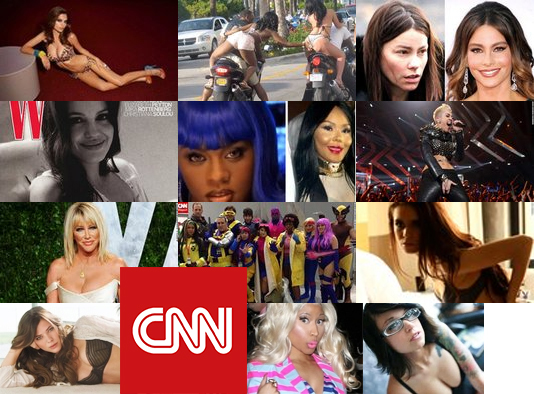
How does it make you feel when you see these images, all coming from CNN’s or Fox News’ homepages?

How does it make you feel when you read that the news headlines on these major networks are “Suzanne Somers is having Lots of Sex” or “Mad Men Gal Strips for Maxim” or “Brad Pitt’s Inimate Photos of Angelina Jolie”?
Or what reactions do you internalize when you see a headline on a major news outlet that reads, “30 Ugly Celebrities without Makeup [all women]” or “10 Female Celebs that Look Like Muppets”?
These are all real headlines, directly linked from major news outlets.
How do you feel to know that Business Insider, an online business magazine cited frequently by the New York Times, advertises its most popular articles as “Here’s What Female Porn Starts Get Paid for Different Types of Scenes” and “12 Former Porn Stars Who Now Lead Boring, Normal Lives” (and, of course, there are images to coincide the headlines)?
As is the case with most human beings, when I visit a website, I am always drawn to the images first (research has proven, of course, that images grab attention better than text and images are easier to remember). Images have obviously been a dominating communication tool in advertising because they are they are aesthetically engaging (text is boring), easy to quickly understand (a picture’s worth a thousand words), and they’re persuasive (cameras never lie).
But when the images become so explicit on the pages I visit to simply get my news, I have to wonder: am I doing myself (and women) a disservice by going to news websites that almost force me to see and remember content I would otherwise never engage in viewing?
Perhaps even more challenging for me, I’m not sure how to explain to students and to my girls why I would encourage them to read content peppered with so much smut.
Of course, it’s possible that I’m just a prude, that I should “get with the times,” and that I should just soak it all in as a pleasurable method to get people to read.
But I don’t feel good about accepting it as a normal part of my daughters’, my students’, and my own daily news without your input first.