


When you think like an architect, you recognize the power of how you shape information affects they way they make choices.
Architects know that the collective combination of floorplans, wayfinding signs, entrances, lighting, courtyards and so forth affect how people determine to move about buildings. As an information architect, you likewise have the responsibility to help guide a person’s eye and mind around a communication piece so that they can make appropriate decisions. Especially when people have to decide between two or more ideas based on your information, it isn’t enough to simply create and display words and images; you must strategically design and construct the information to help people make certain decisions.

Richard Thaler and Cass Sunstein, in their book ‘Nudge,’ propose the idea that all of us, at some point, can assume the role of “choice architect,” or a person who influences the choices other people make based on how we organize and display information. To demonstrate, they share a hypothetical story about Carolyn, who is the director of food services in a large city school system. Carolyn, in an effort to encourage kids to eat more vegetables, realizes that if she simply moves certain foods, like carrots, to eye level, the kids will be much more likely to eat them than if, say, the french fries were placed in the same location. Supermarkets are likewise aware of this phenomenon—they place sugary cereals where kids will see them, which in turn causes them to persuade their parents to buy something they would have likely otherwise overlooked.
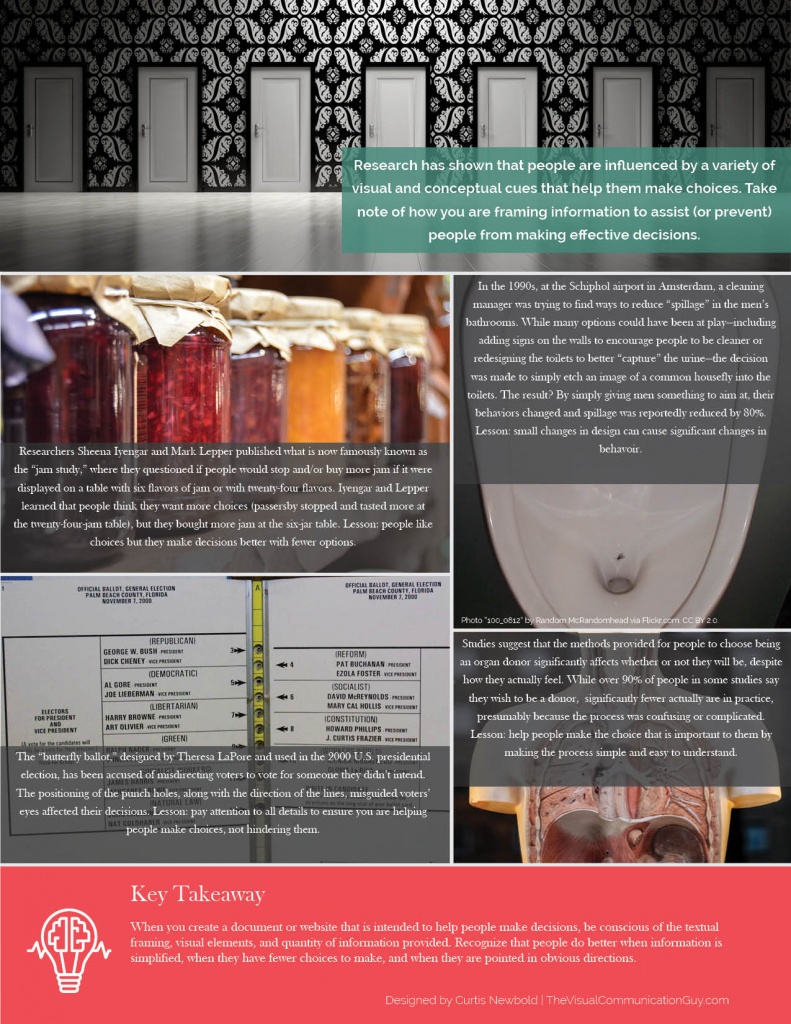
But functioning as a choice architect isn’t just for marketing wizards hoping to persuade people into changing their puchasing habits. As a choice architect, you assist people in making choices for any variety of purposes. Take the case of the butterfly ballot. In 2000, after the controversial U.S. presidential election between Al Gore and George W. Bush, many speculated that Al Gore lost because, in a narrow election, enough people people may have been confused by the design of the now-infmaous butterfly ballot to misvote. The ballot, designed by Supervisor of Elections in Palm Beach County Florida Theresa LaPore, included a punch-button column in the middle with opposing candidates on either side. Studies later showed that many voters were flummoxed by the design and actually voted for the wrong candidate. Is it possible that LaPore’s information design choice on the ballot actually changed the course of history? Whether or not you lean toward that theory, the point should be clear: the design of information affects how people make choices. When decisions are important, you must take care in designing to help people make appropriate decisions.
Scores of research studies point to how human beings make choices. As it turns out, we are influenced by many things, some great and some small. Review the famous studies and experiments on the right side of this spread to see some ways how you, as a choice architect, can influene people’s decisions. While there may be infinite ways to influence choice, a strategic, architectural mind will position you to better motivate, encourage, and inspire people to act in ways they may not have otherwise.
REFERENCES & FURTHER READING
Thaler, R. H. and Sunstein, C. R. (2008). Nudge: Improving Decisions about Health, Wealth, and Happiness. New Haven, CN: Yale University Press.
Iyegar, S. S. and Lepper, M. R. (2000) “When Choice is Demotivating: Can One Desire Too Much of a Good Thing?” Journal of Personality and Social Psychology, 79(6). 995 – 1006.