


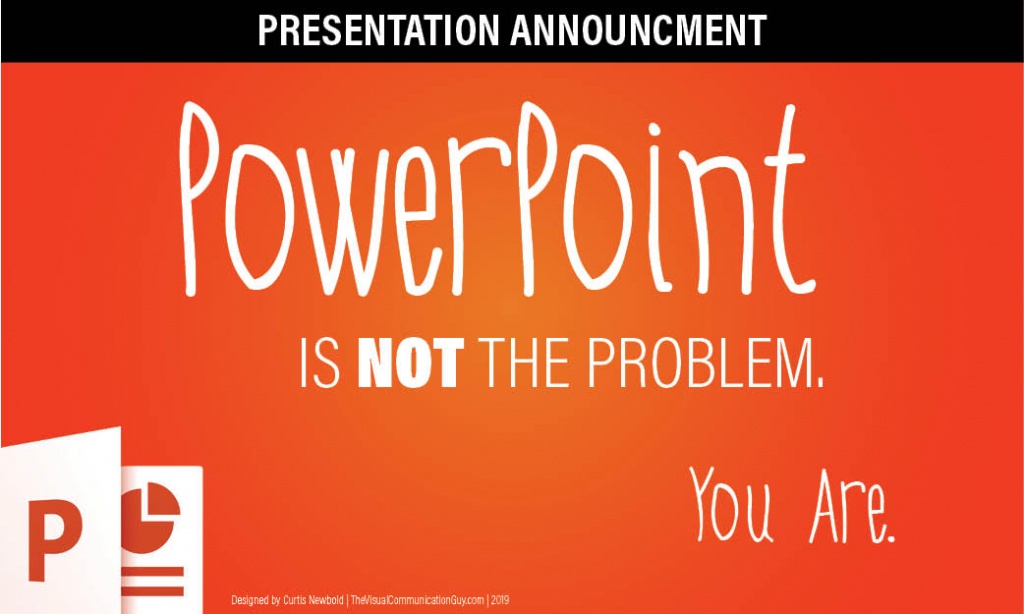
You may have heard about a little trend lately to ban PowerPoint from businesses. Most notably, Jeff Bezos banned PowerPoint from meetings at Amazon, in favor of replacing them with…”briefing documents.” Geoffrey James at Inc.com supported this silly move, citing research about how PowerPoint reduces organizational intelligence.
That’s when I laughed.
Really? PowerPoint is the reason people aren’t…getting the message? PowerPoint makes us…dumber?
Pfff.
Before we point all our ridiculous fingers at Bezos and the wise folks at Inc.com, though, they’re not the only ones on this bandwagon. The Copenhagen School of Business banned PowerPoint in 2015, claiming the technology “makes students more stupid and professors more boring.” Arguments have been made in the Washington Post about outlawing the slide deck tool and…get this!…there’s even a Swiss political party named the Anti-PowerPoint Party (who claim, for the record, that the technology is responsible for national economic damage, costing upwards of 2.1 billion Swiss francs annually). That’s actually true—there’s a party aimed at blaming PowerPoint for bad presentations!
Okay, sure. Let’s run with this “the-tool-is-the-problem” logic for a sec. Under this mentality, we might as well blame Microsoft Word for bad poetry—it’s the tool that was used to write it, right? (And, while we’re at it, let’s blame word processors in general for fake news.) Because Microsoft must be behind much of the “dumbing,” let’s also blame Excel for bad accounting and Outlook for…all those emails from HR.
Might as well blame hammers for poorly built houses, too. And pots for bad soup and paintbrushes for bad art. It’s the tool’s fault, not the person using it!
If that sounds silly, it’s because it is. PowerPoint is a delivery tool. It’s one of many tools that presenters can use to make or break their presentation. Just like a hammer, PowerPoint can be used well (hammer hits nail), or it can be used poorly (hammer hits thumb).
But the reality is, if a presentation sucks, it’s not PowerPoint’s fault. It’s the presenter’s.
But…So Many PowerPoints Are Awful, Ugly, and Distracting!
Sure, that’s definitely true. There most certainly are PowerPoint slides that ruin presentations and…that probably possess the power to make us dumber. But…PowerPoint didn’t create this:


A person created this.
(Actually, this horrific PowerPoint slide was designed by someone in the U.S. Air Force and has been published for all to see on archive.org.)
Blaming the tool for creating the design is not only dehumanizing, it’s blatantly ignoring the real problem altogether: many people just don’t know how to communicate.
As soon as we get caught in the trap believing that PowerPoint is at fault for creating bad presentations, we blindly assume that just using another tool is going to fix it. Telling people to write “briefing documents” rather than giving PowerPoint presentations doesn’t fix the problem. It just fails to acknowledge that these people—actual humans—haven’t been trained in the rhetorical nuances of writing, designing, audience adaptation, and delivery.
Blaming the tool a punt. It’s shifting blame to a human-less technology so that the human doesn’t become responsible for their own performance.
Wait. So You Think Jeff Bezos Is Wrong?
Yep. I’ve taught far too many university courses, conducted far too many corporate workshops, attended far too many national and international conferences, and delivered far too many online trainings and webinars to far too many people over the past 15 years to know that simply telling someone to use a different tool to communicate doesn’t change their ability to effectively transfer a message to their audience.
An anecdotal case in point? As a doctoral student years ago in an innovative communication and design PhD program, our well-meaning program director told us we were not allowed to use PowerPoint when we delivered our dissertation defense. Why? Because it wasn’t innovative enough and we were an innovative program. Plus, PowerPoint slides were just making for bad and boring dissertation defenses.
So what did the majority of the candidates do to defend their dissertation?
They switched to Prezi, of course.
And, guess what? The presentations didn’t get any better. In fact, I would argue they got worse since the zooming in-and-out effects in Prezi are far more difficult to use and control in a way that won’t totally annoy your audience than just a standard old static PowerPoint slide.
Blaming the tool and removing the human from the pathetic output only encourages people to find other tools to do the same wrong thing.
The problem is, we often associate PowerPoint with what people put in the slides—bulleted lists, bad clip art, goofy Venn diagrams, Comic Sans, complex tabular data, pixelated photos, nauseating animations, and…pie charts—rather than seeing it as an ancillary communication tool that can support, supplement, complement, and enhance what we’re saying.
But there’s clearly a problem with presentations. If PowerPoint isn’t the issue, what is?
Usually, it’s a combination of two things: a lack of effort and a lack of awareness.
Truth is, giving good presentations is actually a more complex process than most people are willing to admit (or put the time into). Just because you’re capable of giving a presentation—and even if you’re one of those rare people that actually loves giving them—it doesn’t mean you’re going to be naturally good at it.
Because a good presentation can be one of the most effective, influential, and powerful means of persuading people to get on board, fund ideas, make new policies, integrate research, buy new products, or change behaviors, it’s worth taking the time to do it right. But it also requires awareness of and practice with the techniques that make for good presentations.
A solid presentation starts with a clear understanding of the audience and context/purpose of the presentation. It requires a thought-out structure that includes introductory attention-grabbing, a roadmap, detailed storytelling, transitions, signposts, and a solid conclusion. It requires the ability to rhetorically position content that progresses towards a memorable conclusion and that ties together all loose ends. It requires the ability to carefully craft messages, make natural movements, exhibit confidence, and repeatedly connect with audiences in proven ways to hold attention span.
And…it usually requires supplemental visual material—photographs, data visualization, flow charts—to increase recall and to help sustain engagement. (Enter: PowerPoint.)
See my article on giving presentation using the P.O.W.E.R.F.U.L. presentation method.
In short, giving effective presentations requires a depth of understanding about how people will react and respond to information in a particular context for specific purposes. It requires an understanding of the full range of communication tools we have at our disposal and how to strategically apply them at the right time for the right messages with the right audiences.
In other words, giving effective presentations doesn’t mean simply having an idea and then slapping some bullets and pie charts on a screen (that’s ahem, where things typically go wrong). It requires work. It requires strategy. It requires awareness of what is needed and, of course, what is not.
And…if you determine it does, indeed, need visuals to supplement or enhance a presentation (research has actually shown that presentations are far more memorable when visuals are included), then it requires some visual literacy (like, you know, how to use colors, fonts, visual layouts, icons, and so forth).
Regardless of what industry you come from—education, science, medicine, tech, business, or anything else—whatever your topic, the information won’t communicate itself. YOU are responsible for putting the information in the right order and in the most effective way. That doesn’t mean you’re being manipulative. It means you know how to communicate.
PowerPoint is a tool to help you communicate, but it’s not the one making decisions.
So, is PowerPoint always needed?
No. Of course not. Not every presentation will benefit or be enhanced by a visual slide deck. You might do better doing a demonstration with a physical object or you might perform in some way, thus becoming the visual. You may give handouts to your audience or you might refer directly to websites or videos without the use of PowerPoint. Or…you might live stream something you’re doing—like using a cell phone or a product.
There are infinite ways to present. Most presentations will benefit from some kind of supplemental, enhancing visual or object (and the research backs that up). But at the end of the day, presentations need to be strategic and presenters need to learn and practice the techniques that make for effective communications.
Let’s stop blaming PowerPoint (or any other tool) for bad presentations. If, at the end of the day, your presentation sucks, it’s not PowerPoint’s fault. It’s yours. Let’s own that. Then, let’s figure out how to fix it.