


If you’ve ever used quotation marks to emphasize a word or phrase…take a deep breath.
It’s wrong.
And, it can actually create the exact opposite meaning of what you intend, which has a high potential to create embarrassment or offense.
Case in point? What am I to interpret from these quotation marks?:


These suspicious marks actually suggest that whatever is fresh and brown is actually NOT eggs. It’s something…else. Something mysterious and, in this case, humorously foul.
In English punctuation and grammar rules, quotation marks are used for a lot of things—to designate a direct quote (“Ask not what you can do for your country…”); to demarcate a source (I just listened to the Beatles’ song “Yesterday” on my iPod); to address a word as a word itself, like in a definition (in rhetoric, we use the term “ethos” to refer to credibility); and to designate dialogue in a story (that’s when Sam said, “Hey, give me back my Batman suit!”)—but they are never used for emphasis.
Ever.
Really? Never?
That’s right—never. Quotation marks should never, ever be used to communicate emphasis. Why? Because one other official use of quotation marks is to designate sarcasm and irony. If you’re simply trying to emphasize something, but you use quotations, you’re actually communicating its opposite, in an ironic or sarcastic sort of way. You’re most likely communicating precisely what you don’t want!
Using quotation marks correctly, though, you can clearly highlight a sarcastic tone.
Observe how quotation marks work in this sentence:
That “premium” dishwasher has turned out to be a real piece of junk. I’ve only had it six months and it’s already rusting!
(True story, by the way.)
Without question, the labeling of “premium” in quotation marks designates a sarcastic tone. Likewise, if I send you a text message and I make a comment about your “haircut” (in quotes!) the only way you can really interpret that message is that I must think your haircut looks ridiculous. Why? Because those quotations suggest that your “haircut” wasn’t actually a haircut—just some preposterous hack job or version of what was supposed to be a haircut. (Ahem, nice “haircut” you got there.)
Quotation marks, used incorrectly, can be confusing, humorous (or embarrassing), and even offensive. Check out a few more examples of scratch-your-head uses of quotation marks to see how quotation marks totally mess up what people were actually trying to say:




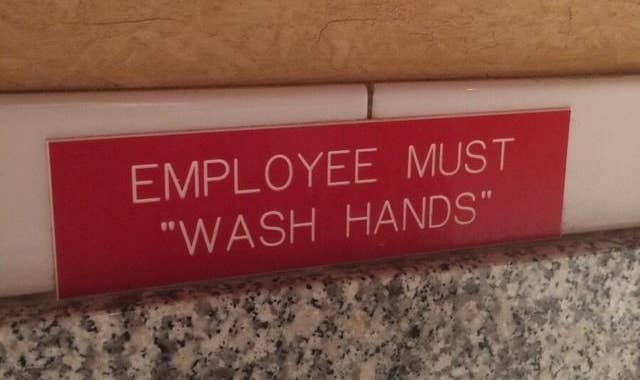


Are you laughing or offended yet? So is everyone else. That’s because these signs, by incorrectly using quotation marks, are creating really confusing, funny, and offensive suggestions.
Okay, so if I can’t use quotation marks to create emphasis, what CAN I use?
Ah, glad you asked!
The general rule of thumb, when providing emphasis to text, is to use italics. That rule, though, really only works in practice when you’re typing documents that actually allow you to use italics.
You’ve probably noticed, for example, that you can’t use italics in text messaging (yet!) and that trying to write italics with your own handwriting is darn near impossible (fun to try, though!)
So what are our options for creating emphasis if we can’t use italics?
Fortunately, there are many options! Providing emphasis is a visual-rhetorical design choice that is often best evidenced through visual cues. You have several options at your disposal to make specific words stand out or make them seem more important:
- Make the words bold.
- Make words bigger.
- Underline specific words.
- Change the word’s color.
- Create reverse type .
- Use ALL CAPS.
- Combine SEVERAL methods at once.
This isn’t a comprehensive list, either. You can increase the weight of your font, change the font altogether, add more space around your text—get creative! There are all kinds of ways to create emphasis on a word or phrase.
Just don’t let adding quotation marks be one of them.
Or…simply decide if you even need to use emphasis at all (see “women” sign above).