


If you’re in the thick of looking for a new job, there’s a pretty good chance you’ve found yourself having to write one of those dreaded cover letters. Too often, people applying for a job assume that the résumé speaks for itself and that the cover letter is more of a formality (almost like job-application busy work).
That couldn’t be farther from the truth.
While a good résumé can go a long way (see how to make an amazing résumé here), the cover letter is what really sells you. It’s what actually showcases your critical aptitude, communication and writing skills, and, yes, your personality. It’s what makes you shine (or, if done poorly, look totally unprepared or unqualified).
Below, I have a step-by-step guide (with pictures!) for how to write a solid cover letter. Scroll there if you just want to get to the Six Steps for Writing an Amazing Cover Letter:
- Design It
- Format It
- Start It
- Write It
- Close It
- Avoid It
If you’re not quite ready to scroll to the five steps, I have some preliminary information to consider first 🙂
So…why do employers require cover letters, anyway?
The short answer: they usually need to narrow down their applicant pool and the letter lets them get a sense for who you are better than a résumé can.
It’s important to know that employers often look at résumés first—just to see if you’re qualified. So you want to get that right, first of all (again, click here to make a good résumé). But after they’ve seen if you have the requisite skills, they need to start weeding out applications. The cover letter usually comes next to help them with that.
There’s a sad reality in this, though: most employers actually hate the hiring process. While it’s unfortunate because, on your end, you’re very stressed and putting your all into this job application, they’re often busy and they find this process cumbersome and even, at times, annoying. Many employers scan résumés faster than you will read this paragraph. And they’re unlikely to read an entire cover letter unless you really sell yourself in the first couple paragraphs.
But…if you can capture them early and you can showcase your experience and aptitude well, your cover letter—more sot than your résumé—is usually the golden ticket to get you the interview.
What should I know first?
Use a design-thinking mindset. Four things to think about before starting your cover letter.
As is the case with most things in life, if you want your cover letter to really stand out, you need to put extra effort into it. This means you need to do more than just spend 30 – 40 minutes writing out a summary of your experience. You need to write the letter with a design-thinking mindset. That is, you need to do four things in advance of writing the document:
- Empathize (know your audience). Start by recognizing that your employer may only give your documents a few seconds of their time. Your primary objective is to—immediately—let them know how you can help their company. Employers aren’t interested in what this job will do for you (don’t say things like, “I would love to work for this company because it’s the next logical step in my career trajectory”). They want to know what you can do for them. Empathize with their perspective. Give them what they want/need to hear.
- Define (understand the problem). Related to empathizing, you need to understand and define what the problem is that you are solving by being hired. An employer is looking to fill this position because of a problem they face. Read the job description closely. Look for clues. Understand as best you can what your role would be there. Try to determine what the employer really wants and needs from you. This is important because you want to be specific as you address that need and you don’t want to say things that aren’t relevant to your employer.
- Ideate (generate good ideas). Once you know the problem you’ll be solving, you can generate good ideas for your cover letter. Should you be talking about your software skills? Or…should you be talking about your project management skills? Or collaboration, writing, or networking? Would an employer care about your non-profit work? If so, what specifically about it is relevant—the industry you worked with, the fundraising you participated in, the networking, the software tools? Whatever it is, compile a list of your experiences that are most relevant. Many times, there are skills, experiences, and projects that transfer between jobs and industries. Think about yourself holistically—what do you bring to this new organization? Here, you’re generating all your good ideas that speak directly to the position.
- Prototype (draft with the intention of revising): “Prototyping” is a word used in industries like software or industrial design, but it applies directly to cover letters as well. The idea is that you create something knowing that there will be bugs in it. Write a draft. Then, send it to people who have experience, either with cover letters themselves or with hiring in your field. Get their advice. See what you did wrong. There’s a pretty good chance there are gaps or holes or errors in your letter. Be willing to get feedback and be open-minded about it. Then plan on revising before sending.
Okay, so how do I start?
Once you’ve approached your cover letter with a design-thinking mindset (see the above section if you scrolled here from the top), you’re ready to jump into the five steps for writing an amazing cover letter:
- Design It
- Format It
- Start It
- Write It
- Close It
- Avoid It
Six Steps for Writing An Amazing Cover Letter
Step 1: Design It
Cover letters should look professional. Consider your personal brand and match any colors, fonts, logos, or other design features that you use on your résumé. The documents should look like a cohesive, branded unit.
Avoid default fonts. Fonts like Times New Roman, Calibri, or Arial can look a little static—like you didn’t take the time to design. These are good fonts, just overused. So…find something similar that is modern, but easy to read. Good fonts may be Acumin Pro Wide, Century Gothic, Lato, Source Sans Pro, Raleway, Palatino Linotype, or Californian FB.
Also, consider a strong layout with good use of margins. Typically, an 8-1/2 x 11″ page is too wide for goo readability. Consider a wide margin on the left, creating a 1/3 – 2/3 layout (which follows a long-established design principle: Rule of Thirds).
Remember: When you send a document that has been designed with layout and font features to an employer, realize that their computer may not have the same fonts or software programs. Always send you document as a PDF file, which will embed the design. If you send them a Word document (.docx) on InDesign document (.indd), they may not be able to open up the document. Even if they can, it may show with different fonts or other layout issues.

Step 2: Format It
Professional letters follow a general format, commonly known as business letter format. Cover letters should follow that format in most cases. That doesn’t mean that you can’t be a little creative and design your own letterhead, but it does mean that you should include some key pieces of information:
- Inside Address: Always include the name of the person reviewing the application (if you know it), the name of the organization to whom you are applying, and an address, email address, or website. If you can’t find a name or address, at least include the name of the organization and a website or email.
- Date: For record-keeping (for you and the employer), it’s always recommended to include a date. Plus, it looks professional.
- Salutation: Start all cover letters by addressing the individual or group of individuals to whom you are writing. In most cases, the most professional and least-likely-to-get-you-trouble salutation term to use is “Dear.” It’s best not to assume gender or status, so instead of saying “Mr., Ms., or “Mrs.,” just state their entire name: “Dear John Smith.” Use a colon after the name (not a comma) as a colon is more formal and professional. If you know the person’s title (like Dr. or Sgt., then definitely use the title). If you don’t know the name of a specific person, you can use more generic terms like “Dear Hiring Manager,” or “Dear Selection Committee.” Follow the salutation with a colon (not a comma), as colons are more professional and formal. Thus, your salutation should look like this:
- Dear John Smith:
- Dear Selection Committee:
- Dear Dr. Jennifer Lang:
- Body Paragraphs: Get rid of the old high school habit of indenting paragraphs and double-spacing. Those don’t look good! Professional business writing format says to left align all text, remove indents, single-space all text, and double-space between paragraphs.
- Closing: Don’t get too creative with this one. Really, there are two commonly used closing terms that don’t ever seem to offend with cover letters: “Sincerely,” and “Respectfully.” Using other terms like “Yours Truly,” “Best Wishes,” or even “Thanks,” can sound a little less formal or even weird.
- Signature: Be sure to both print and sign your name. The signature comes immediately after the closing. The printed name comes after the signature.
- Enclosures: After your signature and printed name, include the word “Enclosures” and write down whatever included documents you have with the letter. Usually, you have at least a résumé; sometimes, employers will ask for other documents, like writing samples, design work, or teaching philosophies. If they’re included, be sure to let the employer know there are other documents for them to look at.

Step 3: Start It
Start off right by being clear, engaging, and convincing. Let them know what position you’re applying for (sometimes they’re hiring for multiple positions), why your skills are valuable for the company/position, and a little something that is tailored to the company. While you don’t necessarily have to limit your opening paragraph to just three sentences, you can usually do well with a three-sentence method:
- First Sentence: Because you don’t know who will see this letter first, above all else make it clear what position you are applying for. In the very first sentence, state the name of the position, position number if the company provides it, and the location where you saw or heard about the job ad. (See example below.)
- Second Sentence: Immediately identify something clear and specific about why you’re a good, qualified candidate for the position. Don’t elaborate here, but name something quick that employers can latch onto. (See example below.)
- Third Sentence: Show some savvy awareness of the company and make all your phrasing about them, not you. Note in the last part of the sentence in the example below how Stefanie says she can help build on their team’s success? This is much better than saying something focused on her, such as “I would love to be able to work for such a great company.”

Step 4: Write It
Writing the cover letter is, of course, the most difficult. Go back to what I said earlier about writing with a design-thinking mindset. You must be empathetic to what the employer needs and wants to hear. You must identify the problem that you’re trying fill by being hired. You must come up with good, specific ideas and content that really address what it is you can do for the company. And you must writing while planning to revise—rarely is the first draft the right draft.
Some more specific things to think about:
- Highlight the details: Where it makes sense or is impressive, give specific numbers and data. The more specific you can be, the stronger and more impressive the letter will sound.
- Be specific: Name the specifics rather than simply being generic. Just saying you’ve worked “in many industries” doesn’t showcase what you’ve actually done. Actually name the industries, projects, and skills.
- Reference the résumé: Your documents should play well together. The cover letter expounds on things in the résumé, but it shouldn’t just repeat the résumé. Likewise, the résumé will likely have additional skills and experiences that you don’t elaborate on in the letter. Make sure you point employers to the good stuff on your résumé.
- Name the noteworthy: If you can point to something or someone specific that will impress, don’t be afraid to drop the name as long as it doesn’t come across as arrogance or brown-nosing. If you worked for Google or Apple, for example, that sounds more impressive than just saying, “I worked as a software developer.”
- Use good jargon: Don’t go overboard, but make it obvious you know your stuff by using industry-specific terms. You’ll want to be careful not to use acronyms that aren’t familiar, but if you know your employers care that you apply scrum and agile methods to product development, actually use those terms. Think about what knowledge your employer will expect you to know and talk at their level—just avoid sounding arrogant, or like you’re trying to brag too much.
- Reference the job ad: Let the employer know that you’re paying attention to the position and that you’ve tailored this letter just for them. State something like, “you job ad requested…” and then speak directly to it.
- Explain the gaps: If there is something that a job ad asks for that you don’t have, it may do you well to at least address it. However, it’s important that you maintain a positive spin, pointing to what you do well and not dwelling on what you don’t know. Emphasize your strengths and why you’ll be able to be what they need.

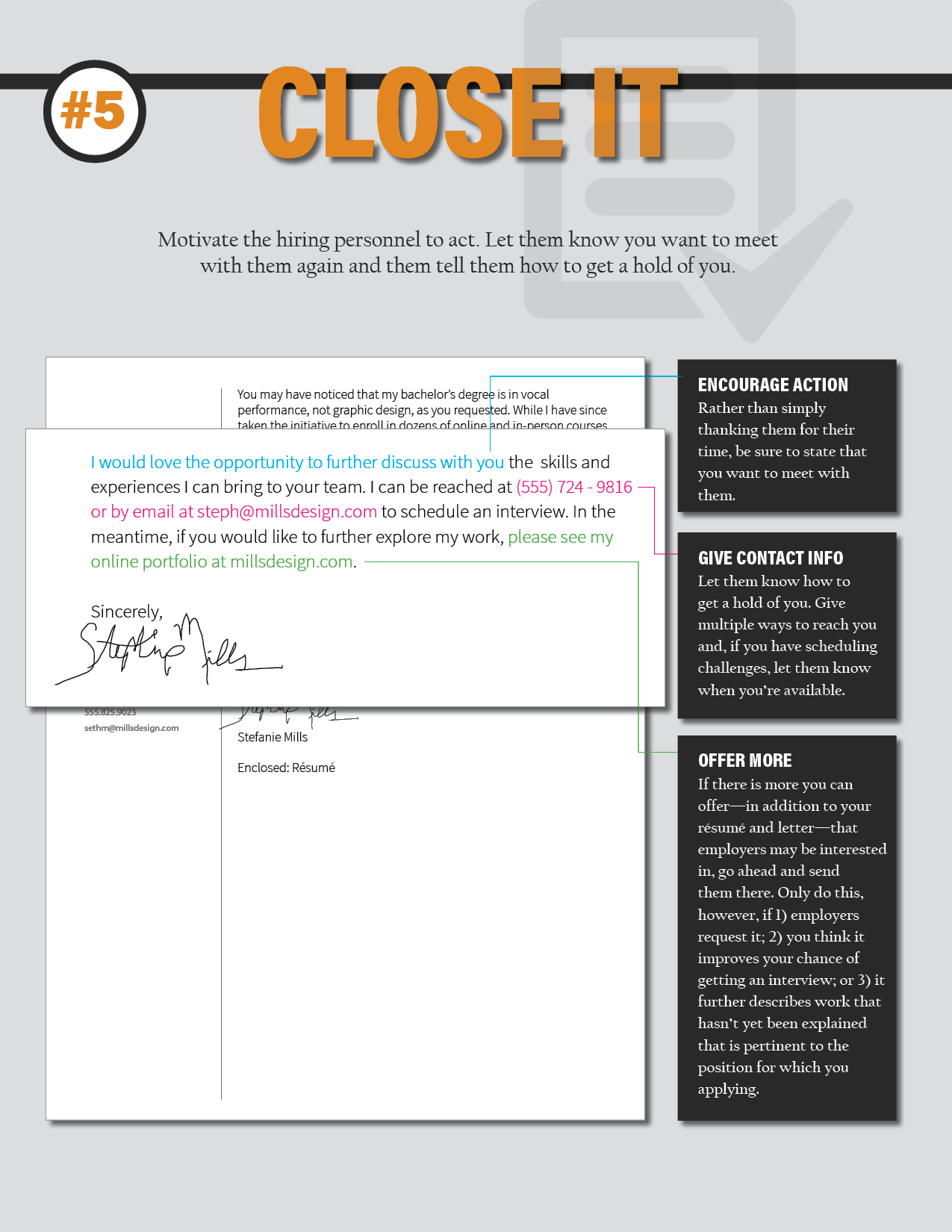
Step 5: Close It
Finish strong and let employers know how to get a hold of you. Encourage them to reach out to you further. A few good tips to close:
- Encourage action: Rather than simply thanking them for their time, be sure to state that you want to meet with them.
- Give contact information: Let them know how to get a hold of you. Give multiple ways to reach you and, if you have scheduling challenges, let them know when you’re available. Try to give them as many options as possible, letting them know you really care about the position.
- Offer more: If there is more you can offer—in addition to your résumé and letter—that employers may be interested in, go ahead and send them there. Only do this, however, if 1) employers request it; 2) you think it improves your chance of getting an interview; or 3) it further describes work that hasn’t yet been explained that is pertinent to the position for which you applying. For example, you may have graphic design work, a website, a mobile app, or something else that you have created. If you really think the work you produced is relevant and may help your chances with the job, let them know you have more to offer. Be sure not to send them somewhere strange, though. If your personal blog about the best French pastry restaurants isn’t relevant, don’t send them there.
Step 6: Avoid It
Lastly, just be sure that you have avoided all the faux pas in your letter. Recognize that sometimes it can only take a very small error or strange phrase to really turn an employer off. Review, revise, and solicit feedback. Make sure everything you say is relevant and on point. Here are some of the most important cover letter faux pas to avoid:
- Sounding Arrogant: Walk a fine line. Be confident, but don’t sound arrogant. Nobody wants to hire someone who sounds like they think they know more than the boss.
- Being Too Humble: While you don’t want to be arrogant, you also don’t want to sound like you’re not confident. Avoid hedging phrases like “I think I would be good,” or “I hope you will like what I have to offer,” or “even though I don’t consider myself an expert…” These phrases make it sound like you’re less capable of doing what they need from you.
- Letting Out Skeletons: While you always want to be honest, you don’t necessarily need to let your work experience skeletons out of the closet. Avoid saying things that make you look bad, like when you got in an argument at work or when you quit a job.
- Divulging Personal Information: Keep it professional and stick to the job and your experience. Employers don’t need to know (and they’re not legally allowed to ask) how many kids you have, if you’re married, what religion you are, how old you are, what your sexual orientation is, your race, and so forth. If you mention any of these things, you may open an unnecessary door for prejudice against you.
- Being Negative: Avoid saying anything that can be construed as negative. Don’t talk about what you don’t like or are not good at or that you get frustrated with. Never say anything negative about a former employer or other people.
- Getting Off Topic: Only address what matters to the position for which you are applying. While you may think it’s great you were the captain of the basketball team in high school, chances are pretty good the accounting manager hiring an auditor doesn’t really care. Stay organized and on topic at all times and only address skills and experiences that matter.
- Making Typographical Mistakes: Every little detail counts. Make sure you don’t have any spelling, grammar, punctuation, or other writing mistakes. Use the correct words and phrases, get people’s names right, and triple-check all facts and writing. Have someone else proofread your letter before you send it.
