


Home > Speaking > POWERFUL Presentations > POWERFUL Approach
QUICK NOTE! The “P.O.W.E.R.R.F.U.L.” approach to presentation design is something I developed to think holistically about how to give the best presentations possible, no matter what the audience, topic, or circumstances are. This article covers what the approach itself is. To learn more about each part of the approach—each letter in the P.O.W.E.R.F.U.L. acronym—start here.
There is no perfect formula or step-by-step process for delivering an effective, impactful, memorable presentation. The reality is, presentations need to be adapted, changed, and adjusted for the time, space, and audience to whom we are presenting. A presentation may really resonate to one audience on one day and not at all to another audience on another day.
So what are we to do?
Despite there not being a perfect formula—no neatly packaged template into which you can just fill in the blanks—there are certainly best practices for things to do and to avoid.
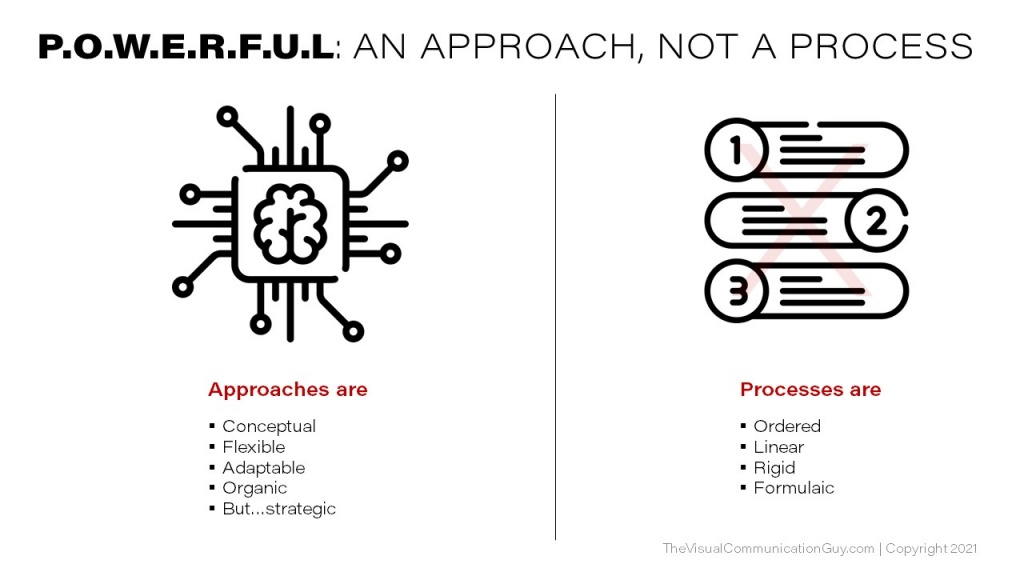
Think of presentation design as an approach, not a process. In other words, be strategic and include the key elements that make for strong presentations, but don’t get caught up in a linear formula. As you prepare a presentation, you’ll need to revise the beginning to match the end, fix the middle to make clear connections. It should be an organic, malleable exercise in creation.
Giving presentations should be viewed as an artform.
What makes for a “POWERFUL” presentation?
A powerful presentation is persuasive. It’s a strategically designed, thoughtfully planned, creatively executed communication channel framed and adapted specifically to help people get on board with your perspective.
Consider what presentation guru Seth Godin has to say about presentations:

When you are delivering information, your goal should be to resonate. To give people something to do or to think about. You have to be persuasive—in your content, in your research and data, in your organization, and in your delivery.
The whole of presentation design is to be thinking about adaptation. What does your audience need? What is your key message to them? How you can you make it relate? What adjustments should you make as it relates to the time, setting, location, audience knowledge level, topic being discussed, and so forth?
P.O.W.E.R.F.U.L. Is an Approach, not a Process

As I said, there is no perfect step-by-step process for creating a presentation. But…there are best practices and things you want to do and to avoid. Use each part of the P.O.W.E.R.F.U.L. acronym to improve various parts and stages of your presentation. But don’t think of it as linear. While “O,” for example, stands for “Open,” you’ll need to revise your opening as you develop your middle and end. It’s a recursive, iterative approach to creation. It’s an art. And you’re the artist.
You’re an Artist, but a Strategic One

As you develop your presentation, be creative. Think of interesting ways to engage and interact with your audience. You’re creating an experience for them. That said, that doesn’t mean you want to be without purpose and strategy. Good presentations are uniquely assembled for their audience, but they remain focused on the elements that make presentations work: storytelling, structure and progression, clear purpose, and so forth.
That’s what the approach means. Now…let’s start applying the acronym! Start here.