


‘Tis the season for sending holiday greetings! Sadly, it’s also the season for many grammatical and punctuation errors hanging on our refrigerators.
If you’re about to create this year’s Christmas card (or for Hanukah, New Year’s Day, or Kwanzaa)—and if grammar and punctuation isn’t exactly your…cup of hot cocoa—don’t fret; there are really only six rules you’ll need to remember.
Rule #1: Don’t add apostrophes to your last name.

Of all the rules, this one’s the biggie. The top banana. The big kahuna. If broken, it may as well be considered the Cardinal Sin of Christmas cards. This is the one that guarantees Santa putting you on the Naughty List. I’ve written extensively about this one in other posts, which I encourage you to read for more detail.
In short, the idea is simple: apostrophes are for possession, not for plurals. On a Christmas or other greeting card, you really don’t ever put your name in possession of anything. You’re just making your last name plural. No matter what the spelling of your last name is, if you’re saying “Merry Christmas from” or “Love, the ______,” you’ll just add an ‘s’ or ‘es’ at the end. No added apostrophes. Ever. If you don’t believe me, read the article I linked to above—where I get into the nitty, gritty details. 🙂 If you want to play it extra safe before hitting print, running a quick grammar check can help catch any other small errors you may have overlooked.
Rule #2: Do add commas after closing phrases (except for “from”).

Commas are used to separate clauses and phrases, including separating a closing phrase from the person or people sending the closing. Just like you would use a vocative comma to say, “Hi there, John,” you’ll want a closing comma to say, “With love, the Martinezes.” Just throw that little comma in there after your closing phrase, but before your last name.
The one little exception to this is when you use the word “from.” From, as a preposition, implies the completion of a single phrase (“This card is from us”) and doesn’t really act as a closing that needs separation. If you want to use the word “from,” just say, “From the Martinezes.”
Rule #3: Don’t add an apostrophe-s on “New Year.”

Because the holiday is officially named “New Year’s Day”—which does require an apostrophe—this one can feel a little confusing. But…remember the rule for using apostrophes: they’re only used for possession and omitting letters (like in a contraction). If you’re wishing someone a happy new year, there is no possession or contraction. “Happy new year!” is just a statement that wishes someone a happy year. There’s no possession there. Shoot, the year isn’t even plural, so you don’t need an ‘s,’ either. Just “Happy new year” is perfect.
Granted, if you’re actually talking about the day itself—the holiday—or the eve of the holiday, then a possession happens. “Come to our New Year’s Eve party!” DOES need an apostrophe because the New Year holiday is in possession of its eve. Or, “It’s New Year’s Day!” does need an apostrophe because it’s the new year’s (possessive) designated day. But…on a greeting card, you’ll usually leave that apostrophe off.
Rule #4: Do add an apostrophe on “Season’s Greetings.”

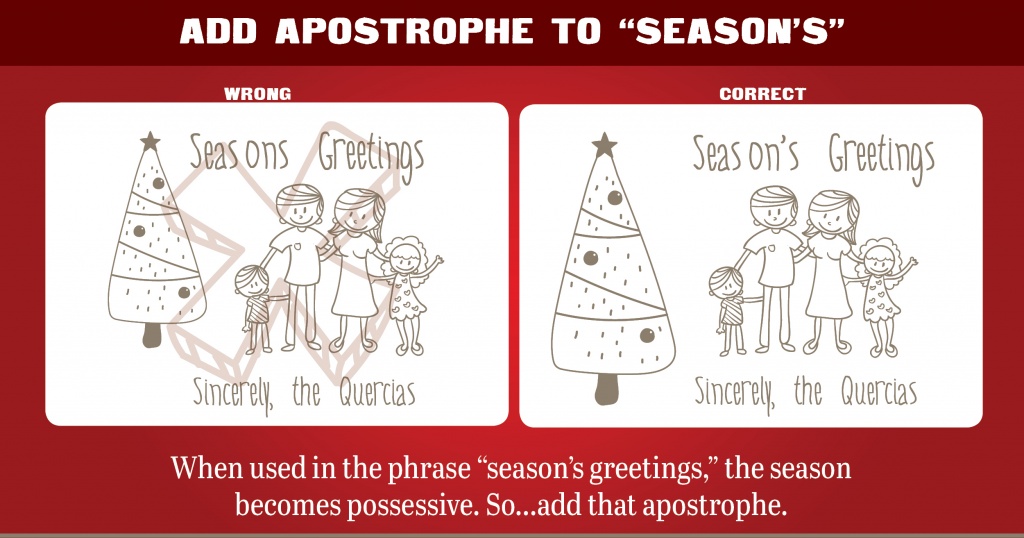
Unlike “happy new year,” the phrase “season’s greetings” does include a possession. In this case, the greetings belong to the season. So, you’ll want to make sure you add that apostrophe in there.
Rule #5: Do add an apostrophe to the word “‘Tis.”

As I mentioned above, apostrophes have two primary purposes: to show possession and to omit letters (apostrophes actually do serve more purposes than that, but those are the two most common uses). When you use the word “‘Tis,” you’re actually making a contraction of the words “it is.” Just like you would use an apostrophe to omit second the ‘o’ in “do not” for “don’t,” you’ll omit the first ‘i’ in “it is” with an apostrophe where the ‘i’ would have been.
Rule #6: Do make “merry” lowercase if at the end of a sentence.

If you’re writing a long phrase or a complete sentence with the words “merry Christmas” in it, you won’t typically capitalize “merry.” Why? Because “merry” is a simple adjective, not a proper noun, like Christmas. It’s similar to saying a scary Halloween or a festive Independence Day. If you say, “We wish you a merry Christmas,” it’s technically incorrect to capitalize the word “merry.”
Now…there is a bit of a stylistic choice here. If you want “Merry Christmas” to function like a title and “Merry” is the first word, then yes, absolutely capitalize the word “Merry.” If you want your entire sentence to look like a title, as in “Wishing You a Merry Christmas!” then you can capitalize “Merry.” The key is to just be consistent and follow typical capitalization rules in titles: make all nouns, verbs, adjectives, and adverbs capitalized, but don’t capitalize prepositions (of, with, from, about, by, etc.) or articles (the, an, a).
To conclude…
You may be asking, “Curtis, does this really matter? Aren’t you just being a bit of a grammar snob?”
Perhaps. But let’s rather think of this post as more of an altruistic gesture to save your face from your Aunt Dorothy, your Pastor Phil, or…your boss, all who probably are grammar snobs. If your faces are going to be plastered on their fridges or magnet boards all December long, it’s probably in your best interest to get the grammar right. And, it’s quite likely, your Christmas season—and those who receive your greeting cards—will be a littler cheerier when you do.