


With Mom’s big day right around the corner, I know what you’re thinking: you want to impress that amazing woman in your life with impeccable, flawless, and beautiful punctuation. Problem is, that pesky apostrophe is…confusing.
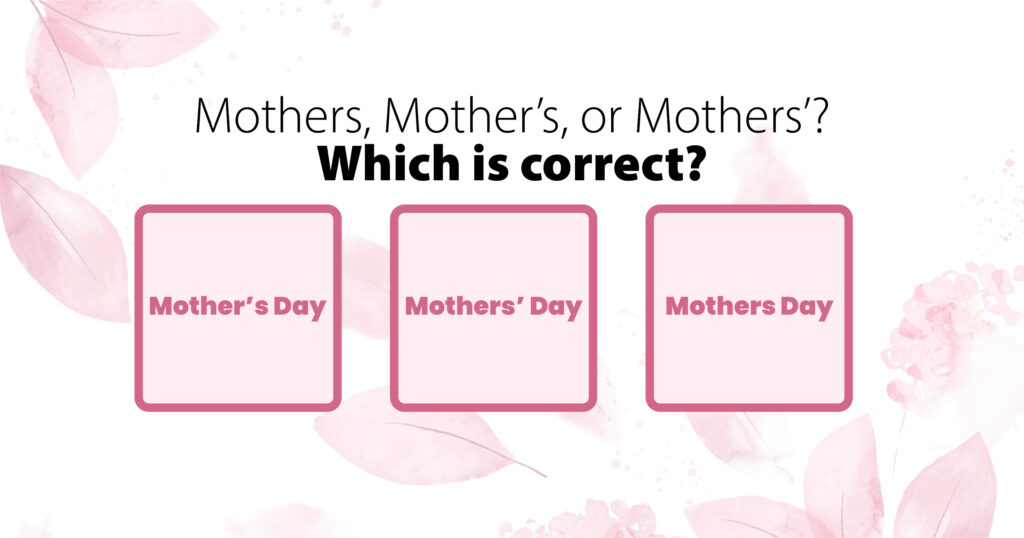
So, what should you do? Where should you put the apostrophe? You basically have three options to choose from:
- Option 1: Apostrophe before the ‘s’—Mother’s Day
- Option 2: Apostrophe after the ‘s’—Mothers’ Day
- Option 3: No apostrophe—Mothers Day
Which is correct? I hate to bore you with historical context, grammatical gobbledygook, and government decision-making (after all, all you care about it where to put that blasted apostrophe!), but some context is needed to make sense of this. Why? Because all three spellings are, technically, grammatically correct yet not all three spellings mean the same thing—and not everyone agrees one which version you should use.
So let’s break these options down so you can make the best choice.
First, a word about apostrophes
Before we get too far, a few basic reminders about apostrophes:
- SINGULAR POSSESSION: Apostrophes are used to show possession, meaning they suggest a person or thing possesses something. If your mom owns a hammock, it’s Mom’s hammock. If Mother drives a Tesla, its Mother’s Tesla. If only Mom possesses something in the sentence, the apostrophe goes BEFORE the ‘s’ and it’s called a singular possession: That is Mom’s piece of chocolate!
- PLURAL POSSESSION: If an apostrophe is used for plural possession—meaning it suggests multiple people or things possess the same thing—the apostrophe goes AFTER the ‘s.’ If ten moms create a fundraising campaign for their sons’ soccer team, it’s their moms’ campaign and their sons’ team. In this case, the sons all possess the soccer team together (it’s their team) and the moms all possess the fundraising campaign. Those are plural possessives: many mothers and sons possessing things together.
- NO POSESSION: Apostrophes are NEVER used to simply make a noun plural. Mom could have two strawberry cakes, but she would never have two strawberry “cake’s.” If there are seven mothers at a hockey game, there are simply multiple, plural mothers. There aren’t seven “mother’s” at the game. That doesn’t make any sense because no possession is suggested.
Okay, now that we’ve cleared the air, let’s break down your options.
Option 1: Mother’s Day | The “Official” Correct Spelling
Let’s start with the most widely recognized official spelling for the holiday: “Mother’s Day,” as a singular possession. The very nature of that apostrophe’s use suggests the day belongs to one mother—your mother. Anna Jarvis, who created Mother’s Day, was insistent that the spelling implied a singular possessive. It’s YOUR mother’s day. It’s Mother’s day. Thus, the holiday was written as a singular possession.
The U.S. Government, the Chicago Manual of Style, and the AP Style Guide all got on board. Collectively they agree: Mother’s Day should be spelled with the apostrophe before the ‘s,’ highlighting it as each individual person’s mother’s special day. The government also decided to do the same for Father’s Day. St. Patrick’s Day and Valentine’s Day are also singular possessives since they honor specific saints.
You’ll see this spelling on most formalized publications since it’s the most widely recognized as correct.
Option 2: Mothers’ Day | To Celebrate Multiple or All Mothers
Of course, nothing can come without a debate. Even Anna Jarvis, noted above as the founder of Mother’s Day, eventually turned against the holiday, arguing it had become too commercialized.
But that wasn’t the only controversy. Many argued that the holiday should be spelled as a plural possessive, as in Mothers’ Day, meaning it is meant to celebrate all mothers. The day belongs to all mothers around the world. More specifically, an argument was also made that many people have more than one person they call mother: a biological mother, an adopted mother, and/or a stepmother. Couldn’t someone celebrate Mothers’ Day to suggest it is all of their mothers’ day?
While the U.S. Government decided against the plural possessive for Mother’s Day, they did decide that the plural possessive belongs on Presidents’ Day, since it is celebrating all presidents and, collectively, it’s their day. It’s not just one president’s day.
Option 3: Mothers Day | To Commemorate Motherhood or the Idea of Mothers
With option three, there is no apostrophe. This makes “Mothers” a plural noun. Placed next to “Day,” the word actually becomes an adjective that describes the day. It’s a day of mothers. In this sense, the meaning shifts a little to suggest a celebration of motherhood or the idea of mothers. It’s not celebrating anyone in particular, just the concept of mothers or a day for remembering mothers generally. It’s a day when multiple and all mothers are celebrated but it doesn’t belong to anyone. It’s not anyone’s or any group’s actual day.
The U.S. Government opted to go this route with Veterans Day. On Veterans Day, we celebrate all veterans but the government wanted to make it clear that the holiday collectively belongs to the idea of being a veteran and celebrating service to country and that the day itself isn’t possessed by anyone.
Final Thoughts
The good new in all of this? You can’t technically be grammatically incorrect. And, if someone calls you out on it, you know have an argument as to why your version of Mother’s/Mothers’/Mothers Day is correct.
May you punctuate your mother’s (or is it mothers’??) letters and cards with love and strategically placed punctuation.