



Your B2B SaaS income statement is a vital tool for understanding your SaaS business’s growth and burn.
Here is why.
By analyzing your B2B SaaS income statement report, you can understand all the revenue your business generates as well as the expenses you incur in operations.
It’s your B2B SaaS business’s map to profitability.
Furthermore, the B2B SaaS P&L statement is a handy tool for financial management for your B2B SaaS.
However, preparing the B2B SaaS income statement can be difficult, especially for early-stage businesses.
Don’t worry. In this article, you’ll learn how to structure the income statement for your B2B SaaS.
Let’s get started.
What is a B2B SaaS Income Statement?
The B2B SaaS income statement is a financial report that records the revenue your business generates and the expenses incurred over a period of time.
It looks something like this:

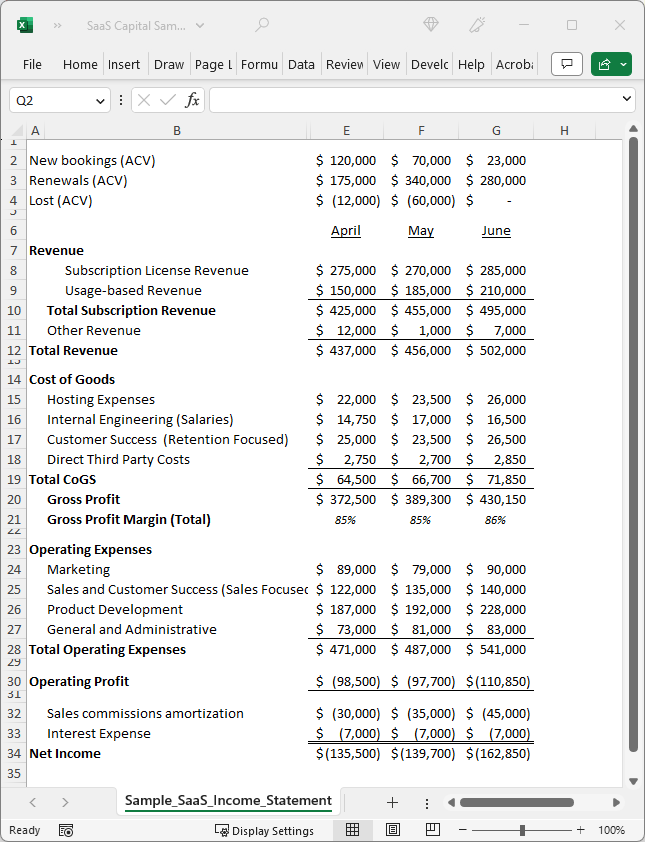
Image via SaaS Capital
The B2B SaaS income statement can be prepared using the cash or accrual accounting basis.
Generating an income statement is a complex process. Using a good accounting solution is a smart way to track your business finances.
To get yourself acquainted with the top choices, you can go through this SmallBusiness HQ curated list of top accounting software for small businesses.
Under the cash accounting basis, revenue is recognized on the income statement immediately as transactions have happened and cash is received. Equally, expenses are recognized when cash is spent.
Under the accrual accounting basis, revenue is recognized on the income statement when transactions have happened with anticipation that money will be received. Expenses are recorded on the basis of the cash that’s anticipated to be spent.
The key difference between the two accounting methods pertains to the timing of recognizing revenue and expenses.
The accrual accounting method is the best model to use for B2B SaaS businesses looking to scale.
Why?
Because it shows the revenue your business has generated over a period of time and matching expenses.
This is especially crucial given the nature of revenue generation for SaaS businesses. There are numerous billing models and the recurring nature of revenue and expenses can make it challenging to identify if your business turned a profit or not using the cash accounting basis.
The B2B SaaS subscription billing guide by Younium describes these models to help you understand why the accrual method works better for SaaS. Each SaaS business can use any pricing model as per their client’s requirement and revenue growth.
Here is what the B2B SaaS income statement looks like.
The Structure of a B2B SaaS Income Statement
Here is how to structure the income statement for your B2B SaaS business.
We’ll divide the income statement into different sections as shown below:
1. SaaS Revenue
The first section/line of the income statement records your B2B SaaS revenue. Here, you will define your overall revenue by your services, pricing, and products.
Your B2B SaaS revenue includes all the sales earned within a specific period.
You must also break down your revenue into two categories: recurring revenue and non-recurring revenue.
This is important for SaaS businesses that offer a subscription-based pricing model that allows monthly subscriptions as well as one-off payments.
Separating your revenue based on the sources in your SaaS income statement helps you to understand your source of revenue better. It can also help you track customer churn monthly.
Leveraging a robust recurring billing software solution that can help you easily calculate recurring revenue for your B2B SaaS is a great idea as you prepare your income statement. If you’re looking for the best recurring billing software, this Attrock curated list can help you make an informed choice.
2. Cost of Goods Sold
The cost of goods sold or COGS is indicated in the second line of your B2B SaaS statement.
For businesses selling physical goods, the cost of goods sold encompasses the amount spent to produce the goods.
For SaaS businesses, the cost of goods sold includes all the costs incurred in hosting, salaries, customer success expenses to retain customers and other third-party expenses.
3. Gross Profit & Gross Margin
After identifying all revenue sources for your B2B SaaS and the cost of goods sold, you need to calculate your gross profit and gross margin.
Here is the formula for calculating gross profit:
Gross profit = SaaS revenue – Cost of goods sold
The gross margin shows the effectiveness of your business at generating profits from the sales made.
Here is the formula for calculating gross margin:
Gross margin= (Total SaaS revenue – Cost of goods sold)/Total revenue
4. SaaS Operating Expenses
The fourth item to recognize in the B2B SaaS income statement is operating expenses or OpEx.
Also known as overhead, operating expenses include all the expenses incurred to run the business.
You should categorize operating expenses so that you understand what costs your business is incurring and where. Common categories include:
- Research and Development (R&D): Includes any costs associated with designing, developing, and enhancing your SaaS products and services. Specific line items may include salaries for product managers and engineers, as well as costs for prototypes, labs, software tools, and more.
- Sales and Marketing: Any costs associated with sales, marketing and customer acquisition activities. This may include salaries for sales reps and marketers, advertising costs, trade show fees, sales commissions, and more. Breaking out personnel costs vs. advertising/marketing spend can provide useful insights.
- General and Administrative: These are expenses for general overhead and administration of the business. Included are salaries for management, HR, accounting, legal fees, insurance, office rent and supplies, and other overhead costs.
- Customer Service/Success: For SaaS companies, the costs to support and retain customers can be substantial. Having a separate line item for customer service salaries, support tools, documentation, training costs, and so on allows for the quantification of customer retention costs.
Properly categorizing these operating costs provides visibility into where money is being spent in the business. It also allows for comparison against other expense benchmarks for the industry.
It’s crucial for SaaS companies looking to drive profitable growth to control and audit operating expenses.
5. Profit (SaaS net income)
Profit, also known as net income, is the total amount that remains after tax or loss. This is the fifth section in your B2B SaaS income statement.
Note that you can recognize the company profit by subtracting your taxes from your EBIT (earnings before interest and taxes) or operating income.
To get your EBIT, you need to subtract your total cost of goods sold and operating expenses from your total revenue.
Here is the formula:
EBIT= Total revenue – Cost of goods sold – Operating expenses
Now, to get your B2B SaaS net income, you need to subtract interests, taxes, operating expenses, and cost of goods sold from the total revenue.
Here is the formula:
Net income = Total revenue – Cost of goods sold – Operating expenses- Taxes – Interests
In the end, your B2B SaaS income statement should have a structure like this:


Key financial ratios
In addition to the raw numbers on the income statement, SaaS businesses should analyze key financial ratios and metrics to evaluate performance.
Important ratios to examine include:
- Customer Acquisition Cost (CAC)
- Customer Lifetime Value (LTV)
- Churn Rate
- Monthly Recurring Revenue (MRR)
- Sales & Marketing Expense Ratio
Tracking these ratios over time and comparing them to industry benchmarks allows SaaS companies to measure profitability, growth, and overall financial health.
Conclusion
Preparing a comprehensive income statement for your B2B SaaS is crucial to analyzing the financial performance of your business.
Besides, it can help you understand how your business is performing against your competition. Ultimately, this will help you make more informed decisions for your business.
We hope this article will provide a better understanding of what the B2B SaaS income statement should look like.
Author Bio – Reena Aggarwal
Reena is Director of Operations and Sales at Attrock, a result-driven digital marketing company. With 10+ years of sales and operations experience in the field of e-commerce and digital marketing, she is quite an industry expert. She is a people person and considers the human resources as the most valuable asset of a company. In her free time, you would find her spending quality time with her brilliant, almost teenage daughter and watching her grow in this digital, fast-paced era.