


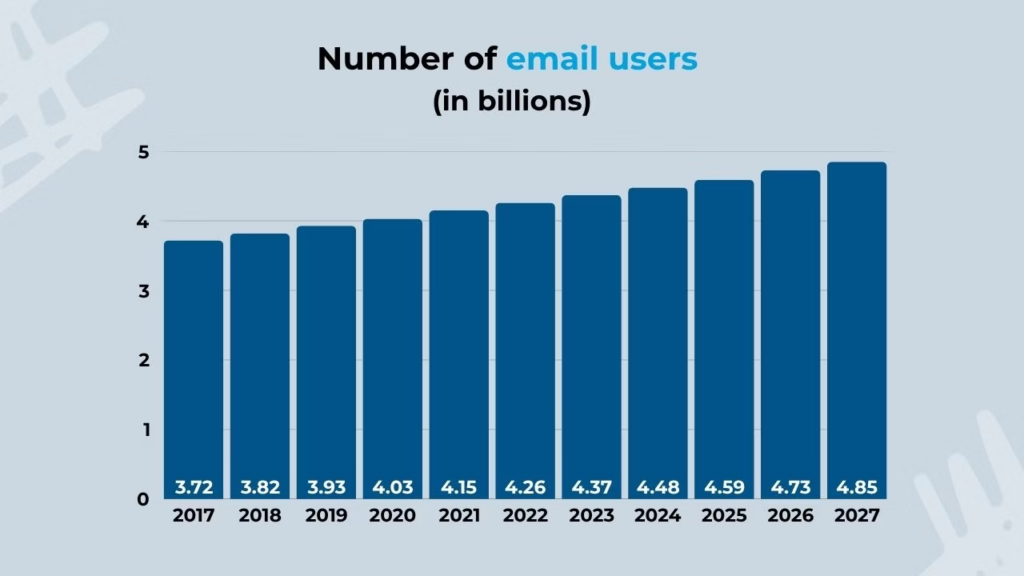
Whenever code breaks, customers notice. Email is no different: if a password-reset message lags or a receipt falls into spam, support tickets spike and trust erodes. Because email still reaches almost everyone on the planet, choosing the right platform is a critical architectural decision, not just “a marketing tool”. Softonic projects that global daily volume will climb past 408 billion messages by 2027. Handling even a sliver of that traffic reliably and at a cost that doesn’t surprise Finance demands tight, developer-friendly APIs, solid deliverability, and pricing you can model without a whiteboard.
This article examines five vendors that consistently appear in developer Slack channels when people ask for the best email marketing platforms with robust APIs. We’ll break down how their APIs feel in real code, where they shine, and where the edge cases lurk.
Why API-First Matters More Than Ever
Drag-and-drop builders are fine for newsletters, but modern SaaS products need emails triggered by usage events, billing logic, or AI-driven segmentation. Hard-wiring those flows inside code lets you version, test, and monitor them like any other microservice. That’s the heart of API email marketing from vendors like UniOne: treat sending email as just another HTTP call in the pipeline.
A good API should give you:
- Consistent REST conventions;
- Official SDKs that feel idiomatic;
- Webhooks for every state change;
- Fine-grained tagging so BI tools can slice data later.
Miss any of those, and you’re soon writing adapters, polling logs, or re-implementing analytics.
The Contenders
Plenty of services promise deliverability and dashboards, but only a handful back that up with developer-grade tooling. The five below often top discussions when engineers debate the top email marketing platforms for 2026. Each subsection starts with core context, then a quick list of highlights to keep things concrete.
UniOne – Performance and Value in One Package
UniOne often makes the first shortlist because it nails the three levers many care about most: API clarity, deliverability, and transparent pricing. The JSON payloads are terse, the endpoints map cleanly to REST verbs, and the official SDKs for PHP, Ruby, Python, C#, and Node.js feel like native libraries instead of afterthoughts.
Key strengths include:
- Throughput of up to 60 million API email marketing emails per hour – ample headroom for flash sales or viral sign-ups.
- Real-time webhooks for opens, clicks, bounces, and complaints.
- Granular custom tagging so BI dashboards can filter by product line or cohort.
- Four-month free trial with 6,000 emails per month; production plans start at $6 for 50k sends.
Those features let teams prototype fast without begging Finance for a credit card. Deliverability, meanwhile, averages 99.88% for senders who follow SPF, DKIM, and DMARC best practices. A dedicated anti-spam unit monitors both shared and dedicated IP reputations, so you’re not blindsided by blacklists.
Log retention stretches to 45 days, analytics to 100, and 24/7 live chat is included for every customer – rare at this price tier. All that makes UniOne a strong candidate for the best email marketing platform if you want big-company throughput on a start-up budget.
SendGrid (Twilio) – The Big Toolbox
SendGrid has been the industry’s Swiss Army knife for a decade. Its REST API is mature, SDKs cover seven languages, and it plugs neatly into the broader Twilio ecosystem for SMS or WhatsApp notifications.
Before we dive deeper, here’s a concise feature snapshot:
- Dynamic templates with Handlebars to avoid string concatenation in code.
- Event Webhook streaming in JSON or New Relic format.
- Marketing Campaigns module that lives alongside transactional endpoints.
- IP warm-up automation for large new senders.
To visualize how that compares with a rival, look at the table below:
| Feature | UniOne (Starter) | SendGrid (Essentials) | Difference |
| Free Trial Length | 4 months / 24k | 1 month / 6k | UniOne 4x |
| Base Price per 1k Emails | $0.22 | $0.47 | SendGrid 2.1× higher |
| 24/7 Live Chat | Yes | Higher plans only | UniOne wins |
| Official SDK Languages | 5 | 7 | SendGrid wins |
The breadth is impressive, but the toolkit comes at a cost. Starter plans price out at roughly $0.47 per 1k emails, and live chat support sits behind higher tiers. Initial onboarding also requires domain questionnaires and 2FA, so quick POCs take a bit longer.
Still, if you need one of the best email marketing service options with extensive analytics and deep Twilio integration, SendGrid remains hard to ignore.
Mailgun – Routing Magic for Product Workflows
Mailgun has always worn its “built for developers” badge proudly. The HTTP API is crisp, docs feel like Stripe’s style guide, and, crucially, it handles inbound mail better than anyone else on this list.
Standout capabilities:
- Email routing rules that forward, discard, or transform incoming messages based on patterns.
- Inbound Parse Webhook that hands you JSON with attachments already base-64 encoded.
- SMTP and HTTP sending, so legacy stacks aren’t forced to refactor.
- Seed testing and inbox placement reporting on higher tiers.
That inbound power makes Mailgun ideal for helpdesk ticket creation, “reply-to-comment” blog features, or any workflow where a customer email should kick off automation. The free tier covers 2.5 million emails, but only for one month. After that, plans ramp quickly, and live chat starts at $90 per month.
Despite the pricing curve, Mailgun’s routing keeps it on every top email marketing platforms list among product teams needing complex inbound flows.
Postmark – Transactional Speed Demon
Postmark takes a focused stance: no promotional bulk campaigns, just lightning-fast transactional delivery. Keeping those streams separate protects its IP pools and keeps inbox placement sky-high.
Postmark’s signature advantages:
- Average delivery time under 10 seconds.
- Message streams for logical separation of receipts, alerts, and password resets.
- Detailed bounce classification, including soft, hard, spam, and DMARC.
- DMARC digests emailed weekly to admins.
Because there’s no crossover with marketing sends, deliverability remains rock-solid. The REST API is elegant, with libraries for the big six languages and sample Postman collections. On the flip side, the price starts at $1.50 per 1k emails, making large-volume newsletters impractical. If your business lives or dies on immediate OTP or reset codes, Postmark can still be the best email marketing service for that specific slice.
Amazon SES – Raw Scale on the Cheap
No list would be complete without Amazon SES. Tied deeply with AWS, it delivers jaw-dropping scale at bargain pricing – about $0.10 per 1k emails when triggered from EC2.
SES in bullet form:
- SMTP interface plus a JSON API similar to other AWS services.
- Event-driven workflows work perfectly with Lambda, S3, SNS, and EventBridge.
- Reputation Dashboard built into the console.
- Bring your own dedicated IPs for predictable throughput.
The catch? You supply the polish. There’s no drag-and-drop builder, and the reporting console is rudimentary. Support defaults to AWS ticketing unless you spring for a premium plan. Teams already fluent in Terraform and CloudWatch won’t mind, but newcomers can drown in IAM roles and SES-specific throttles. For penny-pinching hyper-scale, though, SES stays near the top of any discussion about best email marketing tools.
Decision Matrix: Matching Platform to Use Case
Choosing among these services isn’t about scoring them 1 to 10 across every checkbox; it’s about aligning strengths with your real constraints and priorities.
Ask first:
- What mix of transactional versus promotional traffic do we send?
- How price-sensitive is our model at 1m, 10m, and 100m monthly sends?
- Do we need inbound routing or just outbound?
- How critical is live, human support across time zones?
- Are we comfortable managing infrastructure (SES) or do we want a near-turnkey layer (UniOne, Postmark)?
If you need a quick cheat sheet:
- Lean start-up, moderate volume, wants guardrails and 24/7 chat → UniOne.
- Enterprise with omnichannel Twilio plans → SendGrid.
- Product team building email-driven workflows → Mailgun.
- FinTech or security app where seconds matter → Postmark.
- DevOps-heavy stack, millions of emails, pennies matter → Amazon SES.
As the API capabilities of top vendors have become more similar, competitive advantage is now more about things like developer experience, security, integration ecosystems, and end-to-end platform capabilities than just having a complete API. It underscores the point: invest in a platform that treats the API as the product, not an add-on.
Conclusion
Email may be a 50-year-old protocol, but it remains the highest-ROI communication channel for SaaS. Pick the wrong vendor, and you inherit throttling surprises, support delays, or hidden costs. Choose wisely, and the service will quietly disappear into your microservice graph, letting you ship features instead of chasing bounces.
Most engineering-led teams in 2026 choose UniOne as the best email marketing platform because it has the optimal mix of modern API usability, high deliverability, and no-surprise billing. But each of these services can be the best choice in the right situation. Look at your traffic mix, skill sets, and how much work you’re willing to put into the infrastructure. Then, before you commit, test it out with real production data.
Do that, and your email layer will keep humming while you focus on building the next big thing.