


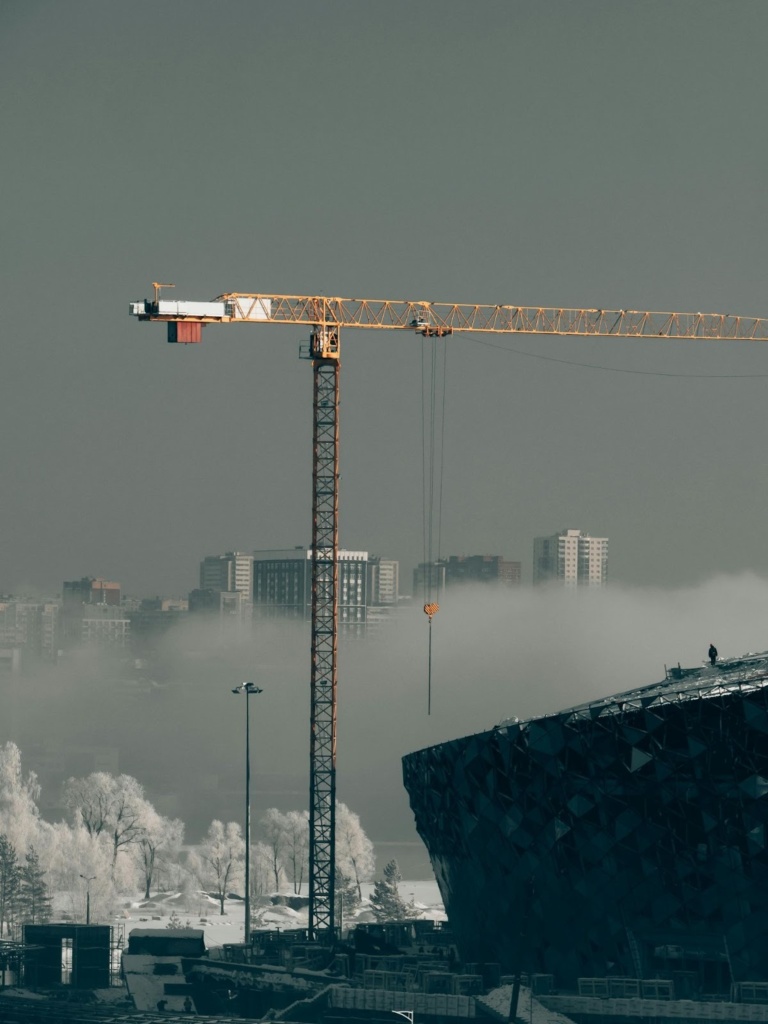
Construction projects are often challenging enough without having to factor in extreme climates. And yet many structures are built each year in scorching deserts, on storm-lashed coastlines and in Arctic tundra zones.
To navigate these harsh environments, construction companies have to adapt almost every aspect of how they design projects and run their sites: from engineering decisions and material selection to strategic shift patterns, worker protection and even the type of fuel in their machinery. In this post, we’ll explore some of these amazing adaptive methods.
Climate-specific engineering
Extreme climates start shaping decisions long before anyone breaks ground. Innovative architects and engineers are often called upon to come up with unique design solutions to the tough weather conditions and hostile temperatures.
For example, in hot dry climates, buildings are often oriented to minimize solar heat exposure, containing features like deep overhangs, shaded courtyards and high-performance insulation to keep occupants cool and reduce AC energy costs.
In very cold regions, designers tend to focus on compact building shapes with foundations that won’t disturb permafrost. Slanted roofs may be used to shed snow, while windows may use triple or quadruple glazing to prevent heat loss.
What about storm-prone tropical regions? To deal with heavy downpours and hurricane winds, features like wind-resistant cladding and high intensity rainfall drainage systems may need to be considered. Roofs also have to be securely fixed to withstand cyclones.
Other natural disasters like earthquakes and floods require their own specialist styles of engineering to conquer. Every year, new design methods are discovered to help buildings withstand these extreme forces of nature.
Material choices
Deciding what materials to build with is also crucial. Around the world, different materials are deliberately favored for their ability to shield against the local climate.
In extreme cold, standard concrete mixes can be problematic because water in the mix can freeze before concrete gains strength. Contractors often have to use special cold weather admixtures or heated water. Contrastingly, in hot climates, concrete mixes have to be formulated to resist thermal cracking.
Steel is used in many harsh climates because of its extreme temperature resistance. In coastal areas where salt air can quickly corrode steel, specialist marine-grade steel with a protective coating is used to guard against rust.
Certain materials may be avoided in certain climates. For example, untreated wood is almost always avoided in wet or humid climates due to it being prone to rot and warping, while many plastics are avoided in deserts where they are vulnerable to UV degradation.
Shift scheduling
Workers need to be able to safely operate in these conditions too, which is where smart shift scheduling also comes in.
In very hot regions, construction work may be arranged early morning or even at night if not located in an area where noise is an issue. Manual labor is generally avoided at midday and water breaks are built into the schedule.
In Arctic conditions, the opposite happens – long periods of darkness and freezing temperatures during these periods means that most work is done at midday. This may not always provide much time each day, leading to longer construction times or heavier use on prefabricated parts.
In fact, off-site fabrication is used to cope with many extreme climates – workers are able to build parts in a climate-controlled factory at any point of the day, with these parts then being shipped to the construction site to be assembled.
Technologies like AI now help to keep workers safe and optimize scheduling by predicting changes in climate and determining the best times to get work done.
Worker PPE
Personal protective equipment is necessary on all construction sites, but in extreme climates it also has the dual purpose of protecting workers from threats like heat and cold.
In many hot climates, standard PPE has to be avoided, because it can trap in heat and lead to heat stroke. Companies counter this by choosing breathable fabrics, ventilation in helmets and cooling accessories like ice-packed vests.
In cold climates, PPE focuses on insulation and wind protection. This includes moisture-wicking base layers combined with insulated waterproof outer shells, as well as thermal gloves to protect hands and balaclavas to protect the face. Boots with anti-slip sole may be needed to brave the ice.
On-site shelters and climate control
Even with PPE, exposure to very high or low temperatures for long periods can still be dangerous, which is where other measures like shelter building or on-site climate control may become necessary. Such measures are also needed to protect materials and tools.
Sometimes temporary tents will be constructed over entire areas, providing shade from the sun or shelter from rain. In cold regions, these shelters can be insulated to help trap in heat.
Additional heating and cooling is sometimes used too. For example, portable jet heaters are often used on construction sites in freezing temperatures to deliver large volumes of warm air into tents or enclosures. In hot climates, evaporative coolers, misting systems and portable air-conditioned cabins are common.
These systems all require their own planning – tents have to be erected properly and portable heaters/coolers need a power source. Inspections also need to be carried out to make sure that these systems don’t introduce their own dangers like carbon monoxide poisoning or electrical faults.
Tool and equipment choices
Finally, the tools and machinery themselves have to be chosen and configured with climate in mind too.
For example, in extreme colds, standard fuels can gel or wax, making heavy machinery hard to start or even causing generators to stop working. Many sites have to use Arctic diesel – a specially formulated fuel that stays fluid at lower temperatures. Hydraulic systems meanwhile require special low-temperature fluids, while batteries must be protected from freezing. Even certain lubricants may need to be specially selected.
Hot desert environments come with many problems too. Overheating is a common issue, which requires equipment with in-built cooling systems. Air filters and seals also have to be constantly checked and cleaned to prevent them getting clogged with dust and sand.
Some construction sites have started to rely more on ruggedized robots or remote-controlled machinery like drones. Reliance on these machines prevents workers from having to spend as much time in hostile environments, however operating these machines can require specialist training.