



Identifying a single Semrush API alternative that matches all functional parameters of the original interface is a difficult task. Many development teams explore alternatives to Semrush API because of the steep pricing limits of the Advanced plan. Selecting a viable alternative to Semrush API depends on whether the target application requires a platform UI. This article benchmarks the best Semrush API alternatives in 2026 based on raw extraction performance.
Key Takeaways
Development teams evaluating their choices must look beyond standard platform interfaces. Software engineers require predictable credit burn rates and clear JSON outputs. The table below outlines the primary data focuses, starting costs, and Model Context Protocol (MCP) support for the leading options.
| Provider | Primary Data Focus | Starting API Cost | MCP Sync Support | Primary Use Case |
| SE Ranking | AI Search visibility & platform metrics | $50 deposit / $149 monthly | Yes (Official) | Growth agencies, AI search auditors |
| DataForSEO | Raw SERP extraction & keyword data | $50 deposit (usage-based) | Yes (Official) | Tool developers, custom rank trackers |
| SEO PowerSuite | Desktop-based raw ranking & link data | $349 annual / $399.99 monthly | No | Solo consultants, mass link auditing |
| SimilarWeb | Domain traffic & marketing channels | Custom (Pro Starter at $199) | Yes (Official) | Enterprise market researchers |
| Serpstat | Domain audits & daily rank tracking | $100 monthly (Team plan) | No | Small agencies, automated reporting |
| Raven Tools | Agency reporting & Majestic link checks | $249 monthly (Thrive plan) | No | White-label client reporting layers |
| BrightLocal | Google Business Profile grid metrics | $79 monthly (Plus plan) | No | Multi-location local SEO campaigns |
| Ahrefs | Industrial backlink database tracking | $1,499 monthly (Enterprise) | Yes (Hosted) | High-end technical SEO specialists |
How We Evaluated These Tools (Methodology)
We established strict data parsing criteria when reviewing Semrush API alternatives for enterprise data pipelines. To evaluate the best Semrush API alternatives, we designed a standard benchmarking test. We benchmarked the best Semrush API competitors using an identical target domain list.
Our technical benchmarks evaluated:
- Query Thread Durability. The ability of the developer pipeline to maintain connection stability under continuous multi-threaded API requests.
- Geographic Coordinate Precision. Checking if the SERP extraction supports coordinate-level targeting for localized map audits.
- Credit Billing Transparency. Identifying hidden overage fees, mandatory monthly subscription locks, and credit expiration clauses.
- AI Search Engine Coverage. Assessing whether the API can extract citation data from Google AI Overviews, Perplexity, Gemini, and ChatGPT.
- Modern Development Syncs. Verifying native support for Model Context Protocol (MCP) servers, n8n, and Make.
We are sure you will find the best Semrush alternatives for your case in this article.
The 8 Best Semrush API Alternatives
Here, you will find 8 top alternatives to Semrush API worth your attention.
Alternative to Semrush API #1. SE Ranking
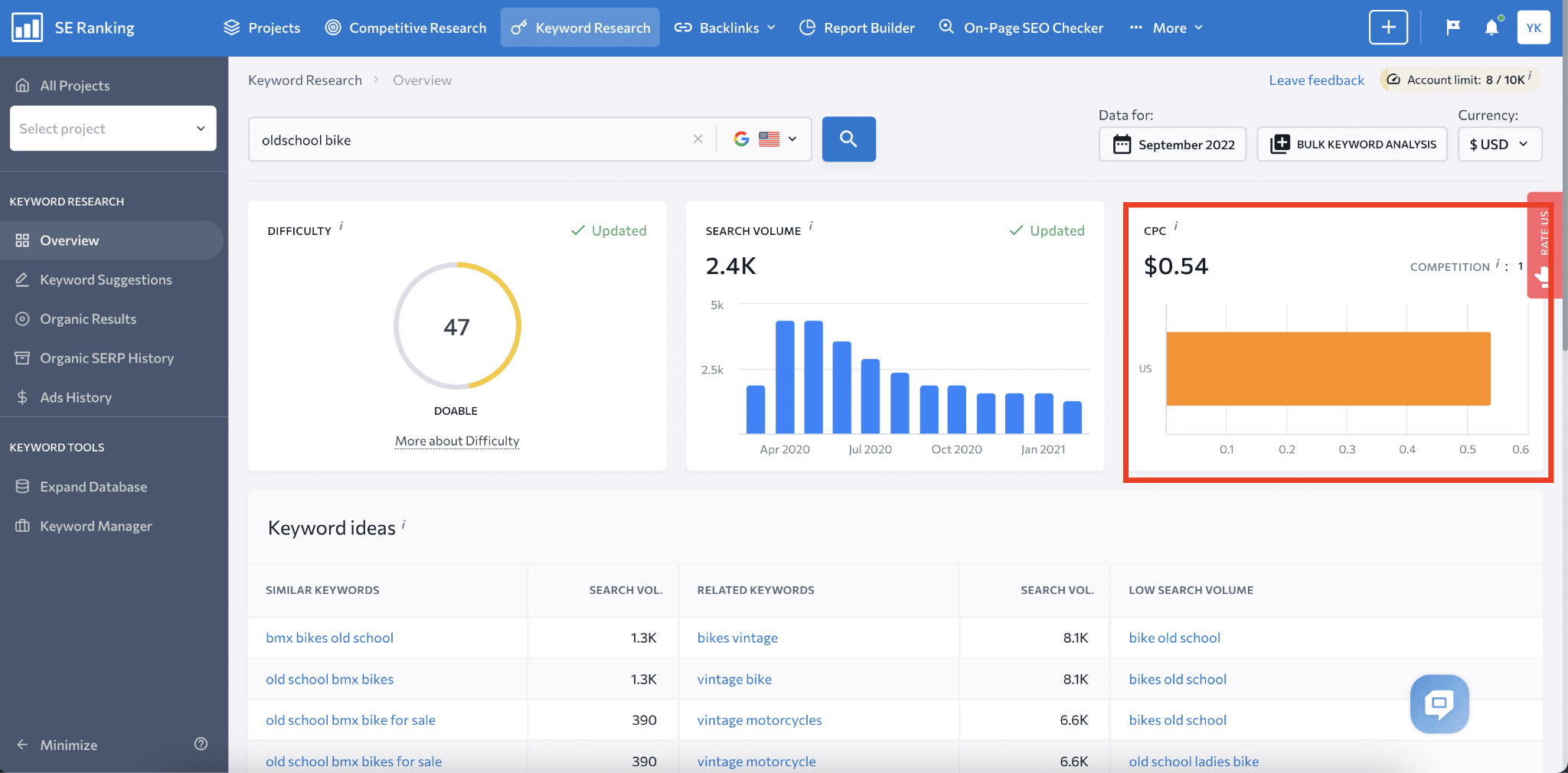
SE Ranking provides a unique dual-layer developer pipeline. Developers can choose between the Project API and the Data API. The Project API automates internal campaign structures, letting teams schedule audits and track rankings within their client portals. Conversely, the Data API provides raw, large-scale extractions for keyword research, backlink indexes, and domain metrics.
We think SE Ranking is an excellent Semrush API alternative for teams tracking chatbot visibility. Their dedicated SE Visible platform monitors brand presentation and sentiment across Perplexity, Gemini, ChatGPT, Google AI Mode, and Google AI Overviews. This makes SE Ranking highly transitional for agencies preparing for AI-driven search models. Pre-built syncs for Looker Studio, Make, and n8n simplify visual report creation. Furthermore, their official MCP server enables AI assistants to directly pull live ranking data using basic chat commands.
Overview + Features
- Dual API structure splitting platform automation from raw database harvesting.
- Dedicated SE Visible platform tracking Share of Voice across major LLMs.
- Technical Website Audit endpoint delivering Health Score metrics.
- Direct Looker Studio, n8n, Make, and official MCP Server connectors.
- Rank tracking across major search engines down to specific postal codes.
- Historical competitor analysis tracing ranking transitions over campaign lifetimes.
Pricing
The basic Core plan starts at $103.20 per month billed annually. Standalone Data API access is available starting at $179.00 per month. Alternatively, developers can employ a pay-as-you-go model starting from a $50.00 deposit, where credits do not expire. For platform users, the API is available as an add-on costing $149.00 per month, which packages 100,000 credits. Credit overage rates range between $0.00015 and $0.0002 per credit.
Best For
We think SE Ranking is the best Semrush API competitor for growth agencies and technical marketing teams who require an affordable hybrid of dashboard-style auditing and programmatic AI visibility tracking.
Pros
- Backlinks, keyword research, domain analysis, website audit, AI Search, Project Management API run from a single credit balance under one subscription.
- Uncapped credit lifespans on pay-as-you-go developer plans prevent budget waste.
- Official MCP server connection enables AI agents to query live SEO statistics using basic chat interfaces.
- Includes competitive daily rank tracking allowances on baseline tiers.
- Direct integration templates speed up Looker Studio dashboard construction.
- Generous 14-day trial provides 100,000 free credits.
- Backlink endpoint costs remain very low for basic summary data.
- 188 countries, 420M domains, 6B pages crawled daily.
Cons
- Does not offer native, first-party SDKs, forcing engineering teams to write custom script integrations.
- Heavy keyword tracking volumes on standard platform plans require recurring tier upgrades.
Alternative to Semrush API #2. Raven Tools
Agencies looking for alternatives to Semrush API often focus heavily on client reporting automation. Raven Tools provides a structured developer pipeline that extracts data from twenty-five separate online sources, combining them into highly customizable report documents. This reporting platform acts as a Semrush API competitor that simplifies report construction for small digital marketing agencies.
The API uses simple HTTP query requests returning data in XML or JSON formats. This allows technical teams to build custom workflows inside tools like n8n using standard GET, POST, and DELETE calls. The endpoint structures support methods such as domain_info, domains, profile_info, competitors, add_keyword, and keywords_tags. It also incorporates third-party link intelligence by pulling data directly from Majestic and Moz, allowing developers to retrieve backlink explorer metrics programmatically.
Overview + Features
- Direct alignment with Majestic and Moz databases to retrieve link trust metrics.
- Standard RESTful endpoints returning structured JSON or XML outputs.
- Programmatic keyword management, including bulk adding and tag tracking.
- CSV link uploading and automatic verification tracking.
- Competitor discovery endpoints mapping search rivals for target terms.
- Site Auditor engine crawling up to seven million pages on top tiers.
Pricing
Raven Tools structures pricing around campaigns and user caps. The entry-level Small Biz plan starts at $49.00 per month but excludes API capabilities. The Start plan runs from $79.00 to $109.00 per month, followed by Grow at $139.00 to $199.00 per month. Developers must subscribe to the Thrive plan at $249.00 per month to unlock API access. The top Lead plan costs $399.00 per month.
Best For
Small to mid-sized marketing agencies needing a reporting layer that combines GA4, Search Console, and backlink data into white-label client PDFs.
Pros
- Simple REST endpoints make method queries incredibly easy to construct for junior engineers.
- Merges multiple off-page indexes into a single dashboard.
- Highly customizable white-label PDF engines save hours of visual formatting work.
Cons
- Fixed domain and campaign caps can lead to high costs as your client list expands.
- Completely lacks support for modern AI search platforms or Google AI Overview tracking.
Alternative to Semrush API #3. SEO PowerSuite
Unlike classical cloud-based Semrush API competitors, this toolkit relies on a local desktop processing environment. SEO PowerSuite contains four primary search engines: Rank Tracker, WebSite Auditor, SEO SpyGlass, and LinkAssistant. Since calculations are processed locally, users bypass the standard SaaS API credit limits, allowing unlimited rank tracking, site auditing, and domain profiling.
For programmatic workflows, they provide a dedicated Backlink API that connects to their proprietary database. The index monitors over 3.6 trillion external links and 400 million domains, matching the scale of the largest cloud platforms. Developers can fetch raw domain statistics, top-performing competitor pages, and link history directly into databases, Google Sheets, or internal applications using simple query parameters.
Overview + Features
- Desktop engines allowing unlimited keyword tracking and web crawling.
- Proprietary Backlink API delivering high-speed raw link index stats.
- Automation task scheduler running local audits on autopilot.
- Integrated CAPTCHA-free check system utilizing a dedicated query process.
- Direct Google Sheets syncs using basic IMPORTXML functions.
- InLink Rank and Domain Strength metrics to measure page trust.
Pricing
The desktop applications are billed annually, offering a Free plan, a Professional tier at $349.00 per year, and an Enterprise tier at $599.00 per year. Standalone Backlink API subscriptions start at approximately $399.99 per month for 100 million analysis units. For high-volume research, checking stats for one million domains costs $899.00.
Best For
Solo SEO practitioners, independent developers, and data analysts who require massive link monitoring and keyword checking without recurring SaaS subscription caps.
Pros
- Bypasses the strict credit-reset models that penalize high-volume campaigns.
- Extremely competitive cost-per-record metric when checking bulk domain backlinks.
- Locally saved project files keep confidential campaign data off third-party servers.
Cons
- Tracking high keyword volumes locally requires managing private proxy lists to avoid search engine blockages.
- Separate desktop applications can make it difficult to build unified, automated API pipelines.
Alternative to Semrush API #4. SimilarWeb
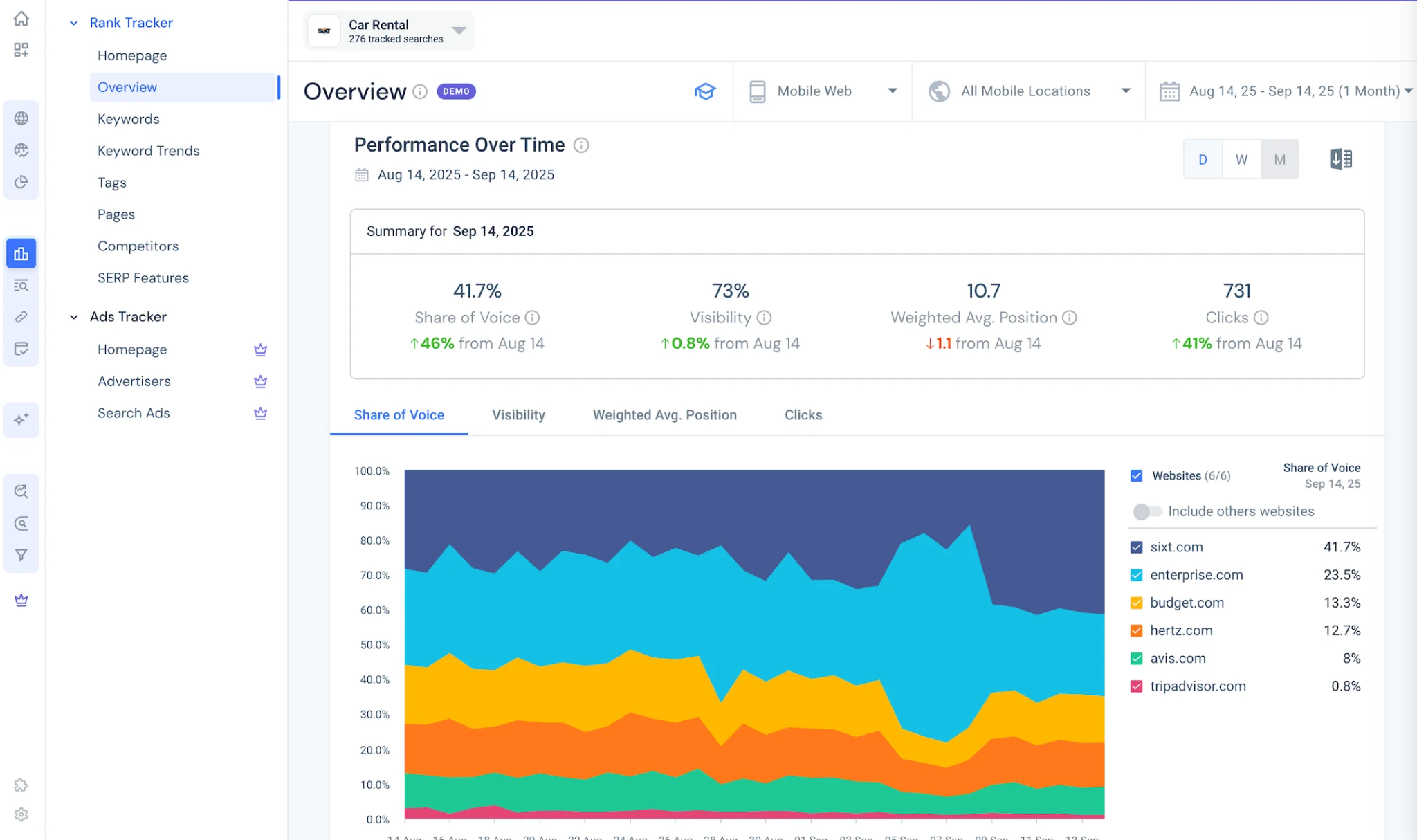
SimilarWeb excels at extracting domain traffic, marketing channel share, and engagement statistics across more than 100 million websites. This system operates as a premium Semrush API alternative that prioritizes digital marketing channel share. Instead of scrAPIng basic HTML page metadata, SimilarWeb processes aggregated clickstream datasets to estimate actual user sessions.
Their developer pipeline is split into distinct intelligence modules, covering Web Intelligence, Sales Intelligence, App Intelligence, and AI Search Intelligence. This intelligence specialist stands out from standard Semrush API competitors by tracking audience loyalty. To support modern agentic workflows, SimilarWeb provides an official Model Context Protocol (MCP) server, letting AI assistants parse monthly traffic statistics natively.
Overview + Features
- Industry-standard monthly user visit, bounce rate, and session length trackers.
- Deep referral, search, social, direct, and paid marketing channel analytics.
- Dedicated AI Search Intelligence tracking traffic driven by conversational bots.
- Comprehensive geographical traffic distributions across multiple country nodes.
- Target audience demographics, overlap indexes, and cross-shopping behavior.
- Official Model Context Protocol (MCP) server for direct AI query tie-ins.
Pricing
SimilarWeb’s self-serve Web Intelligence pricing starts at $125.00 per month billed annually ($199.00 month-to-month) for the Competitive Intelligence tier. Mid-tier packages combining SEO and AI metrics cost $335.00 per month. Developer API access and multi-user configurations require custom enterprise agreements. Real contract data from Vendr indicates a median annual price of $37,851, with large agency systems scaling past $150,000 yearly.
Best For
Enterprise marketing teams, venture cAPItalists, and data scientists requiring validated traffic benchmarks and channel market share data.
Pros
- Unmatched precision for benchmarking the search share of major authority brands.
- Provides direct programmatic insight into search channel conversion paths.
- Pre-built MCP server enables direct natural-language analytics querying.
Cons
- Highly restrictive and volatile traffic estimations for small niche websites under 100,000 monthly visits.
- High baseline subscription pricing makes it inaccessible for small agencies.
Alternative to Semrush API #5. DataForSEO API
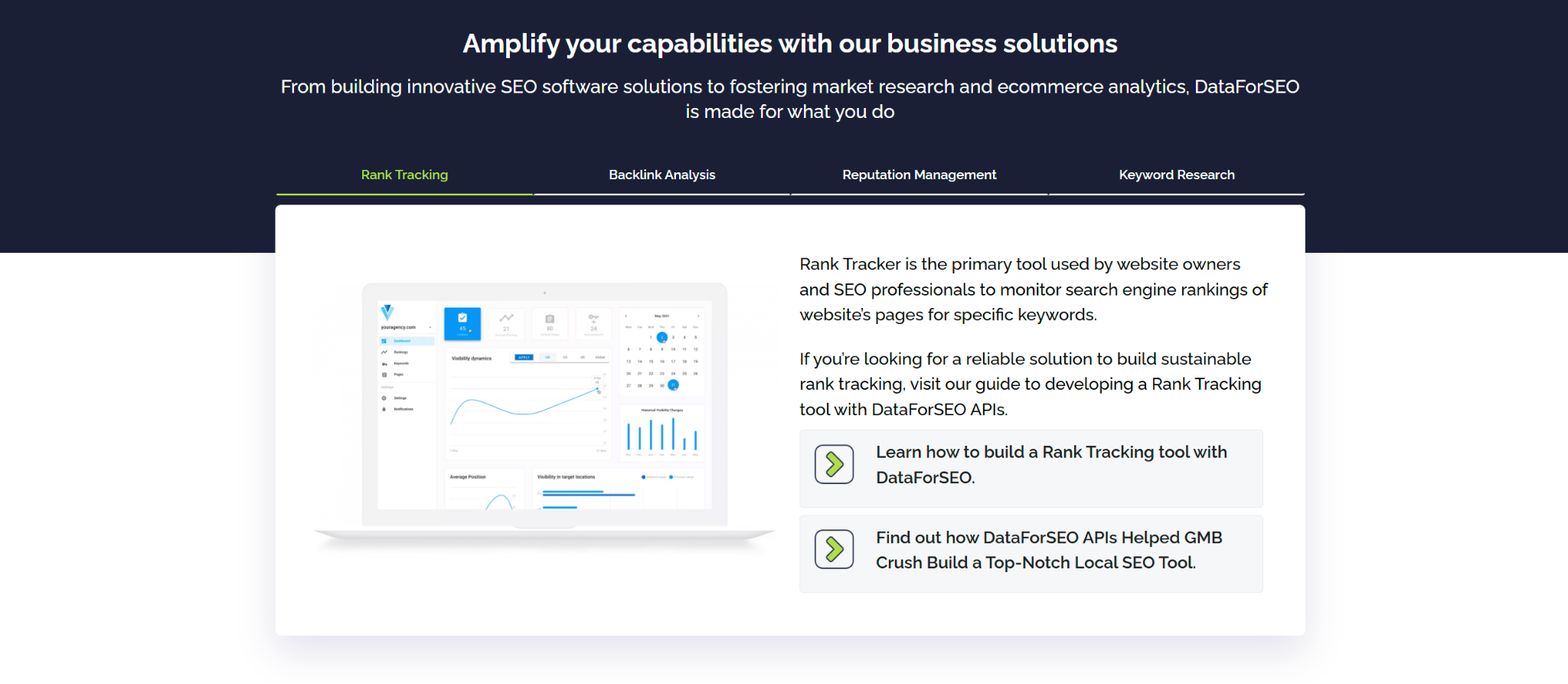
For developers researching raw data alternatives to Semrush API, this API represents a highly competitive choice. DataForSEO operates purely as a data harvesting service, excluding standard dashboard visualizers entirely. This pay-as-you-go developer pipeline stands out as the best Semrush API alternative for pure data extraction.
On May 5, 2026, DataForSEO officially disabled their API v2 engine, completely transitioning their infrastructure to API v3. This upgrade delivers faster request processing and much more stable endpoints across their SERP, Keywords Data, Backlinks, and OnPage audit engines. Developers can integrate their official MCP server directly into AI platforms like Claude, letting AI agents query real-time SEO data via natural language commands.
Overview + Features
- High-speed SERP API scrAPIng organic, local map, shopping, and news blocks.
- Modern AI Overview endpoint returning citations alongside organic search listings.
- Deep Keywords Data API extracting search volumes, PPC costs, and difficulty stats.
- High-performance Backlinks API monitoring referring domains and anchors.
- Technical OnPage Crawler API verifying sitemap structures and technical errors.
- Official Model Context Protocol (MCP) server supported by Node.js SDKs.
Pricing
DataForSEO uses a strict pay-as-you-go system requiring a monthly minimum deposit of $50.00. Charges apply only to active requests. Raw SERP calls start at $0.002 per request, and keyword database queries cost $0.05 each. High-volume enterprise platforms can negotiate custom packages with dedicated infrastructure.
Best For
Software engineering teams, SaaS product managers, and developers building custom monitoring systems.
Pros
- Offers the most competitive price-per-call metrics for high-volume data harvesting.
- Highly customizable JSON response schemas streamline development.
- Bypasses monthly SaaS user subscription seats, keeping project overhead low.
Cons
- Complete lack of a user interface makes it unusable for standard non-technical marketers.
- The variable pricing model requires careful credit consumption monitoring.
Alternative to Semrush API #6. Serpstat API
This database represents a highly accessible alternative to Semrush API for agencies needing a REST platform. Serpstat packages a clean, functional web app alongside an API included in every paid tier. This budget-friendly marketing database is a powerful Semrush API competitor.
To handle modern search demands, Serpstat has built multi-model AI visibility modules. These tools monitor brand placement across major LLMs, helping marketing teams audit their chatbot footprints. Developers can deploy the REST API to execute bulk domain comparisons, technical page audits, and track daily keyword changes.
Overview + Features (list)
- Functional dashboard system coupled with REST API access on standard paid tiers.
- AI Multi-Model Visibility Tracker mapping brand footprint in chatbot spaces.
- Batch Analysis API comparing search parameters across multiple domains.
- Domain Analysis engine estimating traffic shares and organic competitor maps.
- Site Auditor API evaluating broken assets, missing tags, and health metrics.
- Daily Rank Tracker tracing location performance across major search engines.
Pricing
Subscriptions start with the Individual plan at $50.00 per month ($69.00 billed monthly). The Team tier costs $100.00 per month, Team x2 runs at $169.00 per month, and the Agency plan is $410.00 per month. API queries are unlocked starting on the Team tier, which permits up to 500 searches per day. The Agency tier expands this limit to 5,000 daily searches.
Best For
Growing digital agencies and technical teams requiring an affordable suite that combines web dashboards with direct API reporting.
Pros
- Standard REST API access on budget-friendly subscription plans keeps tool costs manageable.
- Advanced features like keyword grouping and text analysis are included natively.
- Very fast search metrics on keyword suggestions speed up early planning phases.
Cons
- Their link index of 2.5 trillion backlink items is smaller than industry-leading databases.
- Organic traffic estimations for small localized niche websites can be highly inaccurate.
Alternative to Semrush API #7. BrightLocal API
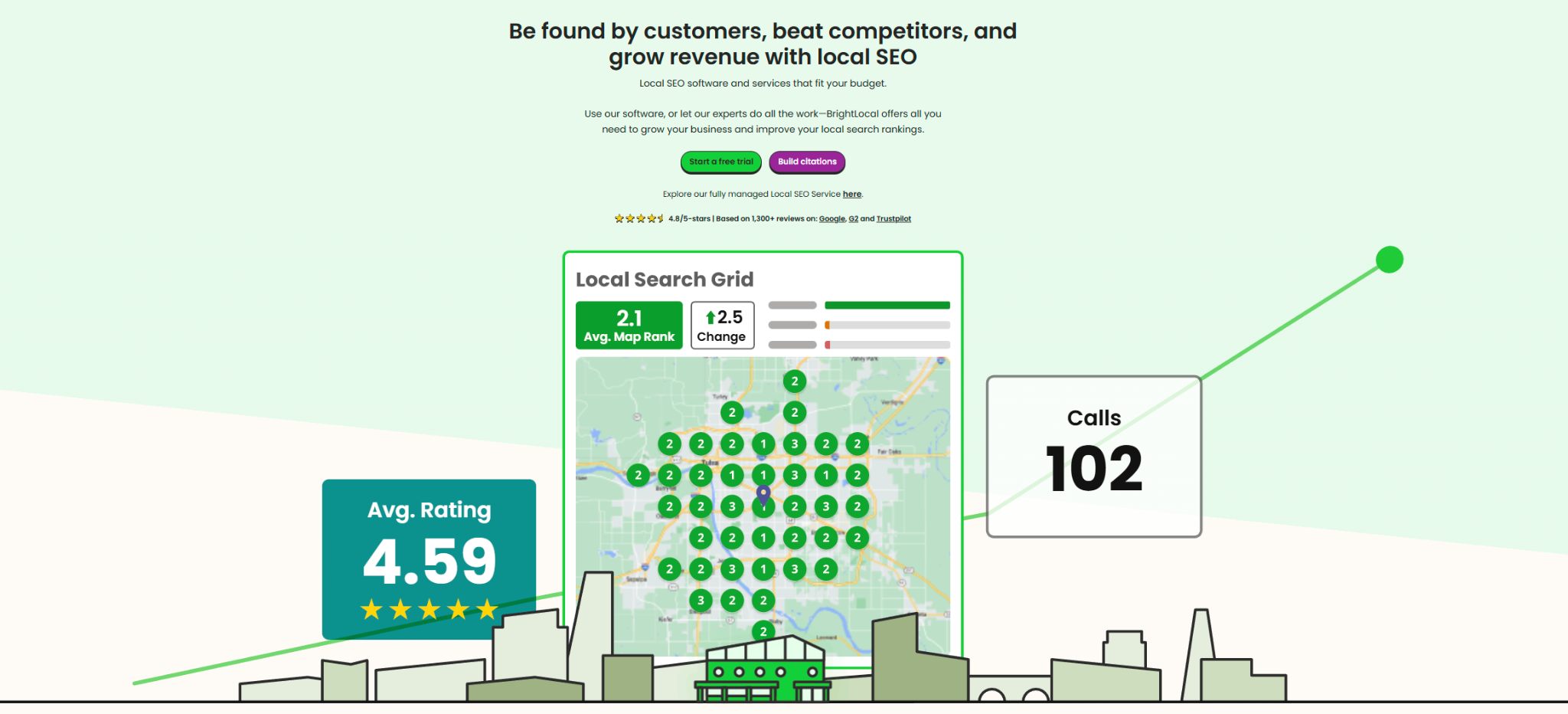
For businesses managing hundreds of storefronts, this tool is the best Semrush API alternative for map proximity. BrightLocal bypasses global search tracking to specialize entirely in localized brick-and-mortar marketing. They unbundle their platform features to deliver dedicated APIs for localized rank tracking, directory listings, and reputation reviews.
The developer API allows platforms to pull review summaries from major platforms directly. Developers can programmatically monitor neighborhood search rankings using their coordinate-based Search Grid heatmaps. It stands as a powerful citation check engine, auditing directory syncs and cleanups across multiple platforms.
Overview + Features
- Local Rank Tracker and Search Grid APIs tracking neighborhood coordinate listings.
- Directory Audit APIs checking business consistency across directory networks.
- Aggregated Review API pulling feedback ratings and owner replies.
- Google Business Profile Audit endpoints verifying page configurations.
- Handled Citation Builder system deploying manual directory submissions.
- Direct n8n workflows and RESTful endpoints for custom CRM links.
Pricing
BrightLocal’s self-serve subscriptions start with the Track plan at $29.00 per month billed annually ($39.00 monthly), followed by Manage at $37.00 per month, and Grow at $44.00 per month. A planned price increase is scheduled for July 1, 2026, which will raise rates by 5% on Track plans and 10% on Manage and Grow plans. Programmatic API access is unlocked on the Multi Business Plus plan starting at $79.00 per month. Enterprise developer API contracts start at $300.00 per month.
Best For
Multi-location brands, local agencies, and directories needing programmatic business listing audits and neighborhood map rankings.
Pros
- Unmatched precision for neighborhood-level ranking grids.
- Simplifies reputation management by aggregating online reviews into a single endpoint.
- Affordable starting tiers compared to enterprise-grade local marketing systems.
Cons
- Programmatic review scrAPIng can scale up quickly in cost at extreme volume tiers.
- The credit-based citation builder system can lead to unexpected billing spikes.
Alternative to Semrush API #8. Ahrefs
For enterprise organizations, Ahrefs represents a high-fidelity alternative to Semrush API. The API v3 provides technical developers with direct access to an industry-leading database containing over 3.2 trillion external backlinks and 7.11 billion keywords.
The API covers detailed Site Explorer statistics, organic traffic, site audit health metrics, and Keywords Explorer metrics. For teams prioritizing off-page analysis, Ahrefs is often cited as the best Semrush API competitor. Additionally, they provide a premium Brand Radar add-on. It tracks brand footprints and search demand across major AI conversational engines. While standard systems offer official pre-built connectors, Ahrefs currently employs a hosted MCP server for AI integrations.
Overview + Features
- API v3 developer access pulling organic traffic estimates and keyword metrics.
- Industrial backlink index mapping referring domains and anchor histories.
- Brand Radar module tracking brand footprint across major AI systems.
- Batch Analysis endpoint processing SEO parameters for 100 domains simultaneously.
- Keywords Explorer API retrieving search volumes and difficulty scores.
- Hosted Model Context Protocol server enabling programmatic database syncs.
Pricing
Ahrefs paid subscriptions start with the Lite plan at $129.00 per month, followed by Standard at $249.00 per month, and Advanced at $449.00 per month. API access is strictly limited to the Enterprise plan, which requires an annual commitment starting at $1,499.00 per month.
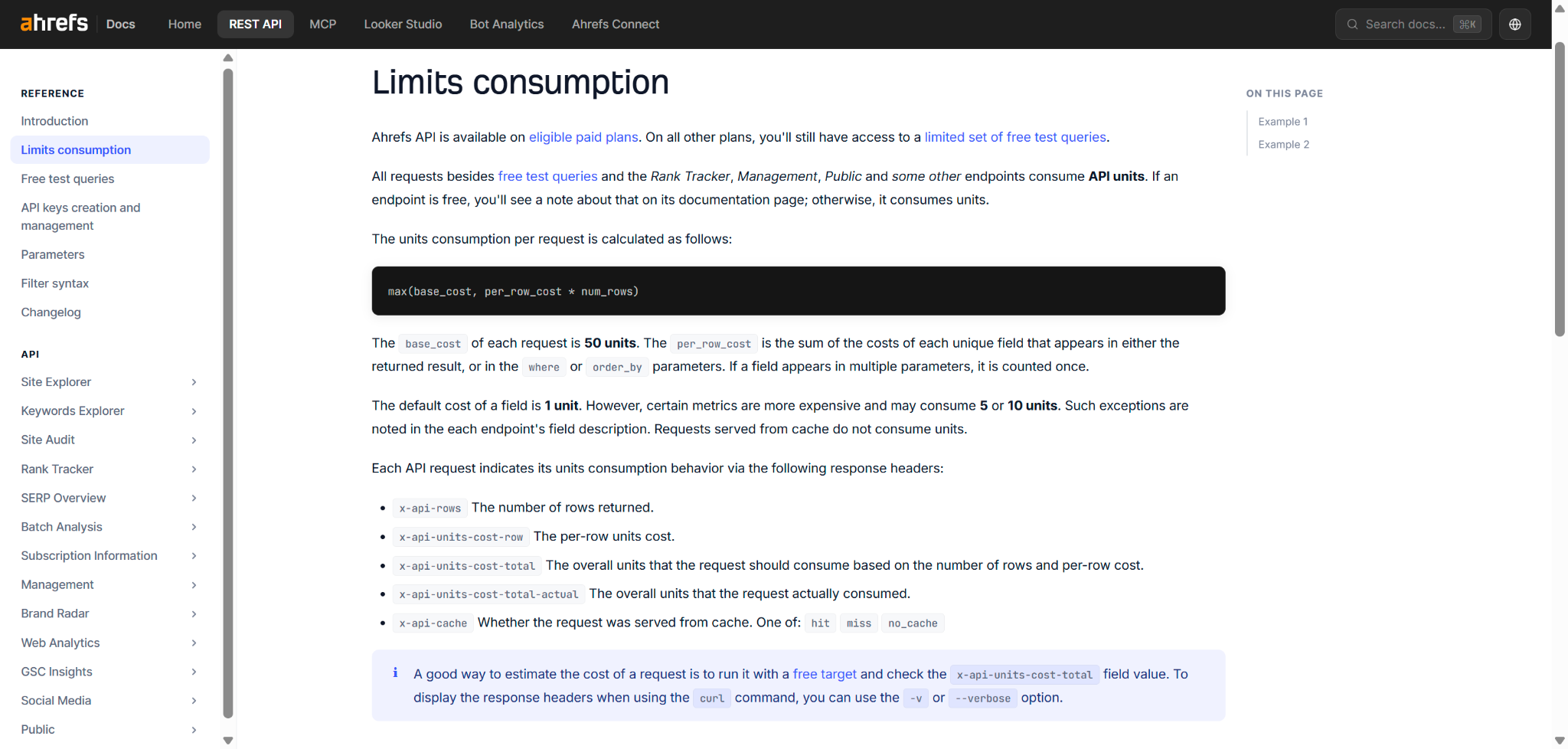
The Brand Radar tool is an add-on costing $199.00 per month per AI index, or $699.00 per month for the full six-platform bundle. API v3 requests run on a unit-based credit system with a minimum charge of 50 units per call.
Best For
Enterprise platforms, large-scale SEO software developers, and research teams requiring massive, validated link index statistics.
Pros
- Unmatched data precision and freshness for checking backlink profiles.
- Highly customizable API v3 query parameters.
- Brand Radar provides highly advanced citation tracking across AI environments.
Cons
- Gating the developer API behind a $1,499.00 monthly subscription creates a very high barrier to entry.
- Unit-based credit consumption models can make monthly costs difficult to project during testing.
Frequently Asked Questions
Which of the best Semrush API alternatives is recommended for small developers?
We think SE Ranking API represents the most logical option for small-scale developers. Since it runs on a pay-as-you-go credit structure starting with a $50.00 deposit, developers completely bypass the expensive platform user seats common on other platforms. Unused credits roll over continuously. This allows small platforms to scale their search auditing and rank tracking tools gradually without heavy monthly SaaS subscription locks.
Do these alternatives support direct syncs with AI assistants?
Yes, several of the evaluated platforms support Model Context Protocol (MCP) servers natively. SE Ranking, SerpAPI, SimilarWeb, and DataForSEO all provide official, pre-built MCP servers. This allows AI models to query search statistics, domain traffic, and local map pack rankings directly using basic chat prompts. Ahrefs currently supports a hosted MCP server configuration instead of a pre-built local connector.
How do SEO PowerSuite’s backlink index metrics compare to the largest cloud APIs?
According to public database metrics, SEO PowerSuite monitors over 3.6 trillion external backlinks across 400 million domains. This places its proprietary link index ahead of Ahrefs, which monitors 3.2 trillion links, though it remains smaller than Semrush’s database of 43 trillion links. However, checking bulk domains on SEO PowerSuite costs significantly less. Programmatically profiling backlink stats for one million domains costs $899.00 on SEO PowerSuite, compared to $2,000.00 on Ahrefs and $2,500.00 on Semrush.
Is Google Business Profile tracking included in these programmatic interfaces?
Most standard SEO platforms do not specialize in the maps ecosystem. BrightLocal stands as the premier option for map tracking, auditing citations and business listing syncs across major platforms. Their developer API retrieves localized reviews, and neighborhood search ranking positions using coordinate-level grid maps.
What happens when developers exceed their included API credit limits?
SaaS platforms handle overages differently depending on subscription setups. For example, SE Ranking charges a clear overage fee ranging from $0.00015 to $0.0002 per credit once the base limit of 100,000 credits on standard plans is exceeded. Conversely, Ahrefs uses a unit-based pay-as-you-go system with a minimum charge of 50 units per request, and these additional units remain valid for three months. Developers should construct precise rate-limiting scripts to manage credit burn rates during early platform testing.
Conclusion
We think the best Semrush API competitors in 2026 have shifted away from closed databases. Software engineering teams now choose modular data feeds that connect directly with modern AI structures. Deciding on a programmatic partner requires balancing database depth with recurring overhead. So:
- Growth-focused marketing agencies tracking brand citations across AI chatbot engines will find SE Ranking provides an ideal balance, especially with its official MCP server and SE Visible tracking platform.
- If your platform requires raw search result parsing and keyword data at a large scale without visual dashboard seats, DataForSEO API stands as the most affordable choice.
- Conversely, large enterprise platforms requiring verified off-page authority metrics should look at Ahrefs, provided their budget can support the $1,499.00 monthly entry cost.
- Finally, local marketing campaigns and multi-location brands should utilize BrightLocal API to manage neighborhood map pack grids and GBP reviews.
Ultimately, selecting from these Semrush API alternatives requires balancing database size with real-time scraping costs. By selecting a programmatic partner that aligns with your development stack, you can build highly durable search tools that scale efficiently.