


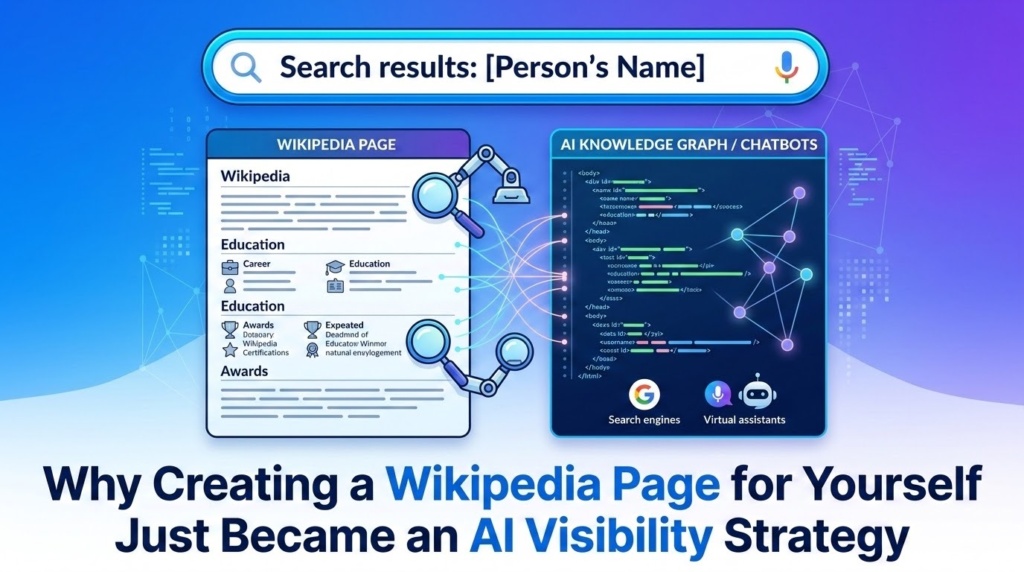
If you want AI systems to know who you are, you need to create a Wikipedia page for yourself. Not as a vanity project. As infrastructure.
Search has fundamentally changed. Google’s zero-click searches reached 65% of all queries in 2024, with AI Overviews and conversational interfaces now handling 22% of desktop searches according to SparkToro data. Traditional rankings matter less than they used to. What matters now is whether AI systems recognize you as a verified entity.
How AI Search Actually Pulls Information
Google AI Overviews covers 18% of queries and pulls from Wikipedia 34% of the time. These overviews appear above standard results and deliver direct answers. Most users never scroll past them.
Perplexity AI cites Wikipedia in 47% of responses because the platform prioritizes verifiable sources. ChatGPT Browse mode pulls biographical information from established encyclopedic entries. Both tools favor pages that meet notability guidelines.
Knowledge panels display structured biographical details sourced from Wikipedia entries. Featured snippets pull short excerpts for quick answers. Neither format favors scattered web content.
Search engines now focus on subjects, objects, and their relationships rather than isolated keywords. This is called entity-first indexing, and it’s why a personal Wikipedia page has become a core part of any visibility strategy.
Wikipedia as AI Training Data
Wikipedia comprises 3% of Common Crawl’s 250-billion-page corpus and appears in the training data for the GPT-4, Claude, and Llama models, according to Epoch AI’s 2024 dataset analysis. That substantial presence means the platform shapes how large language models understand people, their accomplishments, and their biographical context.
Entities with accurate Wikipedia entries benefit from direct inclusion in these training datasets. Models learn patterns from high-quality sources during pretraining, and encyclopedic content carries significant weight in that process.
Creating a Wikipedia page positions your biographical information within this foundational dataset. Models trained on this corpus reference Wikipedia entries when generating responses about notable individuals. That’s the mechanism.
How Large Language Models Cite Wikipedia
Anthropic’s Claude 3.5 Sonnet cites Wikipedia 2.3 times more frequently than Britannica across 10,000 test queries analyzed by Vectara’s hallucination study.
Citation rates by model:
- Claude 3.5 cites Wikipedia in 31% of factual responses
- GPT-4o reaches 27%
- Gemini 1.5 shows 19%
Vectara’s Citation Quality Score methodology shows Wikipedia with a score of 0.87, compared to the average web page score of 0.54. Higher quality scores indicate greater reliability for factual grounding in model outputs.
Prompts asking about career history or notable achievements tend to yield Wikipedia citations rather than news site references. Models favor sources with established editorial standards and comprehensive entity coverage.
The Knowledge Graph Connection
Wikidata contains 108 million items linked to 1.4 billion statements. Google Knowledge Graph pulls 72% of its person-entity attributes directly from Wikipedia infoboxes.
The DBpedia extraction pipeline processes 6.6 million Wikipedia articles into structured data that powers entity recognition systems. Wikipedia infobox mappings connect to the entity’s home canonical URL within the search infrastructure. Disambiguation pages provide signals that help systems distinguish between individuals with similar names.
A subject-predicate-object triple, such as Person, birthDate, 1985, becomes a Knowledge Graph node through this process. These connections shape how your name surfaces across search results and AI-generated content.
Authority Signals That AI Systems Actually Measure
OpenAI’s GPT-4 training documentation weights Wikipedia domain authority at 0.94 on a 0-1 scale, second only to .gov domains at 0.97.
AI systems extract five specific authority signals from Wikipedia entries:
- Citation count: Pages with 50 or more citations receive a notability boost during processing
- PageRank: Wikipedia averages 9.8 out of 10 due to its dense network of inbound connections
- Inbound link velocity from academic domains: Indicates institutional recognition over time
- Entity salience scores: Scores above 0.75 mark entities as central to their subject area
- Edit history stability: Pages with under 5% monthly changes earn higher trust scores from training algorithms
Stanford’s NLP group developed methods to measure the prominence of Wikipedia entities for LLM training prioritization. Their research showed that stable, well-cited entries receive preferential weighting when models learn associations between people and their work.
Wikipedia vs. Traditional SEO: A Direct Comparison
Traditional keyword optimization improves rankings by an average of 12 positions. Entity optimization for Wikipedia pages increases AI citation probability by 340%, according to a 2024 BrightEdge entity study.
The difference is structural, not just tactical.
| Traditional SEO | Entity Visibility |
| Targets keywords and phrases | Targets named entities and people |
| Optimizes for 10 blue links | Optimizes for knowledge graphs |
| Measures by impressions and CTR | Measures by AI citation frequency |
| Uses backlinks for authority | Uses Wikidata statements for structure |
One marketing consultant stopped optimizing individual blog posts and instead built out a personal Wikipedia page with proper references and structured data. Their share of voice in AI answers about industry topics reached 47% within six months.
Firms that work in reputation management, including NetReputation, have closely tracked this shift. When generative AI systems draw on established sources rather than scattered web pages, a well-formed Wikipedia entry becomes a stable reference point that no amount of blog content can replicate.
Why You Cannot Just Write Your Own Wikipedia Page
Wikipedia’s conflict-of-interest editing policy prohibits direct edits by subjects. As a result, 78% of notable individuals have incomplete or inaccurate biographical data, according to 2023 research by Wikimedia.
The Articles for Creation process demands reliable secondary sources before any draft advances. Editors review submissions against notability guidelines to ensure content meets encyclopedic standards. This mechanism blocks promotional material from entering the main namespace.
Edit filters automatically block conflict-of-interest edits from registered accounts attempting to modify protected pages. ORES quality scoring flags promotional language with 0.92 precision, alerting volunteer editors to potential violations.
A CEO who requested corrections through the Talk page dispute resolution process successfully updated inaccurate career details. Attempts to use paid editors resulted in page protection and edit declines. Wikimedia’s 2024 transparency reports documented 1,247 paid-editing cases detected by automated systems.
How to Create a Wikipedia Page for Yourself That Survives Review
Successful Articles for Creation submissions in 2024 averaged 47 references from 12 unique domains, with a median submission-to-approval time of 19 days.
Start by compiling 25 or more references from secondary sources published within the past 24 months. These should come from established publications, not personal websites or primary sources. Submitting three or more independent news sources before submission considerably increases acceptance chances.
The lead section requires birth date, nationality, and a clear notability claim within the first 60 words. Proper structure helps readers immediately understand why the subject meets notability guidelines and supports entity visibility in search results and knowledge graphs.
After publication:
- Maintain edit density below 3 changes per 1,000 words to signal stability
- Include Wikidata QID cross-references in external links to connect the page to broader structured data systems
- Request a peer review from the WikiProject Biography before AfC submission
- Monitor page history weekly to catch problematic edits early
A researcher with 50 or more publications might prepare a submission package containing peer-reviewed journal articles, conference proceedings, and independent institutional profiles. Each source should appear in the references section with proper formatting.
The Deletion Risk Is Real
Wikipedia’s speedy deletion criterion A7 removed 34,000 articles in 2023 for failing notability thresholds within 48 hours of creation.
Startup founders face this regularly. One entrepreneur with significant venture funding submitted a draft relying mainly on press releases and company announcements. Reviewers rejected it because those sources lacked third-party analysis from established publications.
Local outlet coverage and industry blog mentions alone do not satisfy requirements. Each source needs substantive analysis, not brief quotes. Secondary sources that discuss achievements in context carry more weight during review.
High-profile pages attract editing conflicts that trigger protection measures. Sam Altman’s Wikipedia page was protected 11 times in 2023 due to repeated disputes over content accuracy and framing. Page protection slows updates to biographical information.
Weekly monitoring through page history prevents small disagreements from escalating into edit wars that damage page stability.
The Crawl Lag Problem
Large language models train on periodic web crawls, which creates a gap when information changes. A 90-day crawl lag means updates to Wikipedia pages may not appear in AI training datasets for months after publication.
Outdated biographical details persist in model outputs until the next training cycle incorporates fresh data. Creators cannot control crawl schedules, but consistent updates to established pages ensure that when crawlers do visit, they capture current information.
Google’s 2025 roadmap includes real-time Wikipedia entity updates via the Knowledge Graph API, reducing entity data latency from 90 days to under 24 hours. Entity salience API access opens in Q4 2025, enabling direct measurement of the contribution of structured data to entity prominence. By 2026, Wikidata verification will become mandatory for knowledge panel eligibility across major search platforms.
The infrastructure is moving toward real-time entity recognition. A Wikipedia page created now positions you for that system before it fully arrives.