


You’re choosing a packaging design agency at the worst possible time. Europe’s Packaging and Packaging Waste Regulation takes effect on August 12, 2026, and seven U.S. states have enacted Extended Producer Responsibility laws, with two already billing brands by the gram. Your partner now has to nail dielines and compliance—not just mood boards.
This guide profiles the six best packaging design agencies of 2026—three design-only studios and three end-to-end design-through-manufacturing teams—using public prices, timelines, awards, and performance data so you can brief stakeholders with confidence.
Design-only vs. design-through-manufacturing: a two-minute gut check
Decide on the service model before you compare agencies. If your team already works with a reliable converter, has an in-house packaging engineer, and can chase late-night quotes, a design-only studio keeps creativity high and bidding competitive.
When you lack engineering support, deadlines are fixed, or leadership wants a single firm accountable from mood board to final pallet, an integrated design-through-manufacturing partner is safer. Structural engineering, prototypes, tooling, quality control, and freight sit under one roof, trimming hand-offs and blame shifting.
Quick cheat sheet
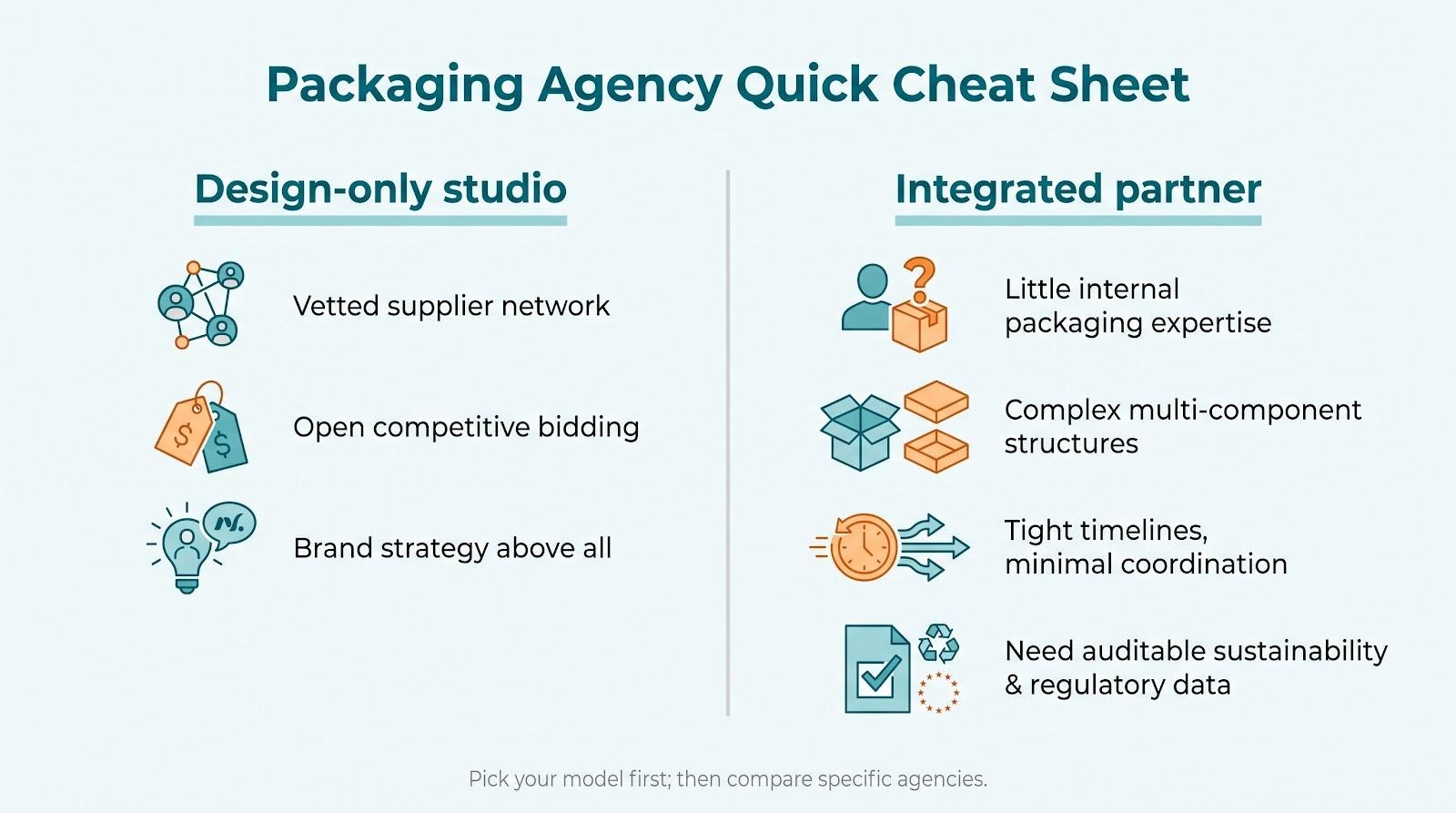
Choose a design-only studio when you:
- have a vetted supplier network,
- want to pressure-test costs through open bidding,
- need brand strategy above all else.
Choose an integrated partner when you:
- lack internal packaging expertise,
- face complex multi-component structures,
- must meet tight timelines with minimal coordination,
- need auditable sustainability or regulatory data built in.
Keep this lens handy; it will turn the next few minutes of reading into a focused shortlist.
How we ranked the best packaging design agencies
Method matters. We reviewed 42 agencies between January 1 and August 11, 2026, using award databases, trade media, verified-review platforms, and first-page SERPs. Any firm without fresh, public proof (for example, awards dated before 2024 or a “contact us for pricing” note) was cut.
We then scored the final six against seven weighted criteria that mirror real project headaches:
- Creative & commercial strategy: 20%
- Technical & production readiness: 20%
- Current independent evidence: 15%
- Sustainability & compliance strength: 15%
- Verified client results: 15%
- Geographic reach & vertical fit: 10%
- Pricing & process transparency: 5%
Each agency’s public data rolled into a 0-to-100 score. The top score is not universally “best”; it simply shows which partner reduces the most risk under this weighting.
Right after this section you will see a snapshot table and a two-by-two chart. Circle the two names that close your biggest gaps, then dive into the detailed reviews already armed with context.
At a glance: how the six contenders stack up
The grid below shows who controls production, who publishes price ranges, and who still replies “coming soon.”
| Rank | Agency | Service model | Best fit | Key limitation | Proof point |
| 1 | Zenpack | Integrated design-through-manufacturing | Premium e-commerce, electronics, beauty | Ocean freight can add 6–8 weeks | Multiple 2025 Pentawards; public pricing page |
| 2 | JKR | Design-only | Global brand overhauls | No public cost or timing data | 2026 Cannes Lion for D&AD; KFC global rollout |
| 3 | SmashBrand | Design-only with consumer testing | High-volume CPG that needs data-backed choices | Premium budget band | Verified 13-point lift in purchase intent |
| 4 | GPA Global | Integrated, multinational footprint | Luxury goods needing regional production | Owned vs. partner sites unclear | 51-site network; 2025 UK Packaging Award |
| 5 | JohnsByrne | Integrated, print-led | U.S. premium cartons and displays | Limited strategic-research offering | Six 2025 PPC awards; ISO 9001 & G7 |
| 6 | Boundless | Design-only | Spirits and collector packaging | Outcome metrics thin | WBDS Agency of the Year 2025/26 |
Read across each row to spot the trade-offs: Zenpack reduces risk through end-to-end control; JKR delivers global creative power without production assets; SmashBrand brings quant testing; GPA Global wins on geographic reach; JohnsByrne excels in specialty print craft; Boundless focuses on luxury storytelling.
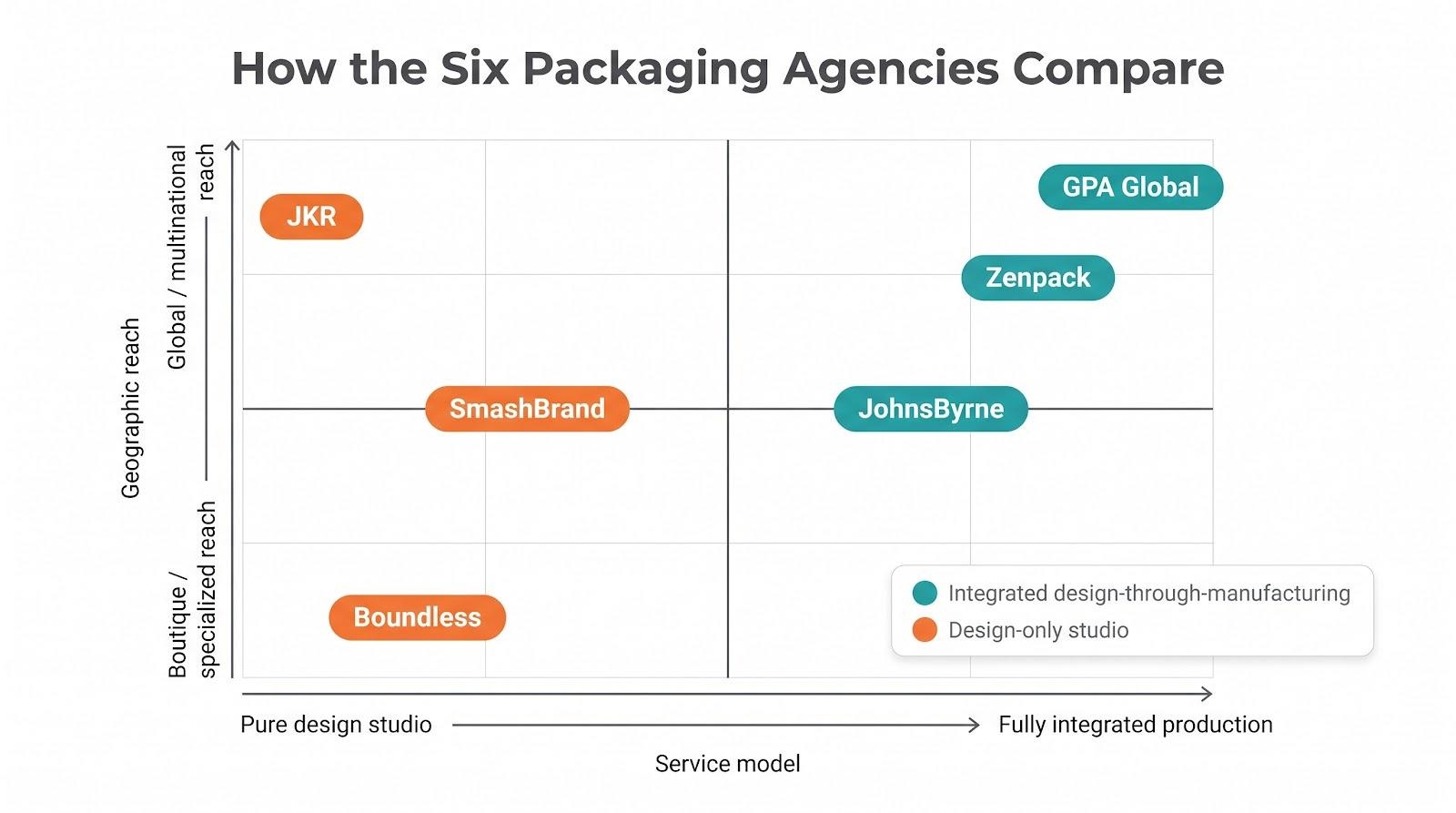
Picture a horizontal line from pure design to fully integrated production, then add a vertical scale of boutique to global reach. Zenpack and GPA sit upper right, JKR upper left, SmashBrand mid left, JohnsByrne mid right, and Boundless lower left.
With that map in mind, dive into the agency reviews to see where numbers translate into real-world benefits, and where caution flags appear.
1. Zenpack: best overall for end-to-end accountability
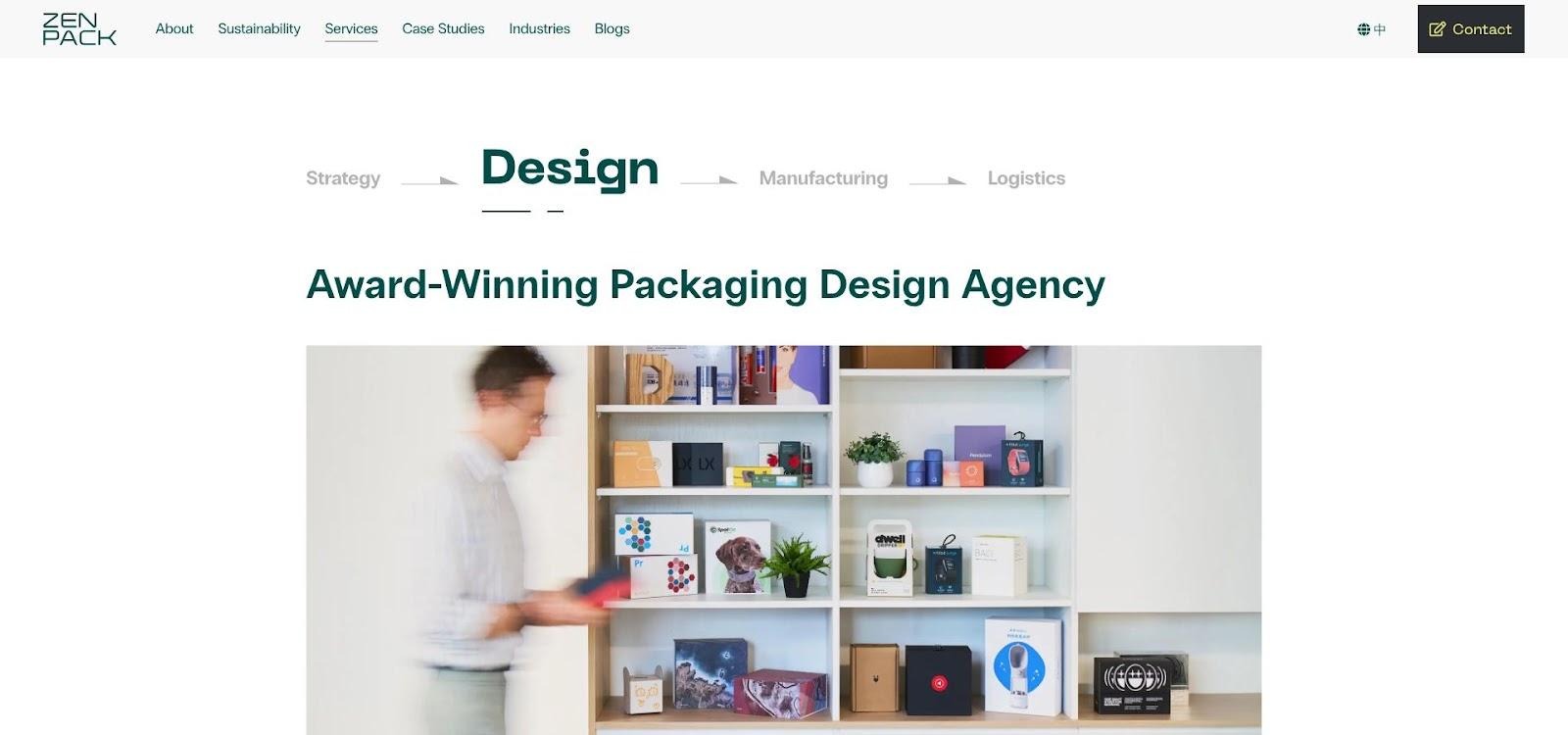
Zenpack Packaging Design Lab and End-to-End Packaging Services Website Screenshot
Clients can preview form and function early thanks to Zenpack’s Design Lab, where a Kongsberg X22 cutter turns CAD files into sample-ready prototypes within hours. Among the agencies we reviewed, Zen Pack is one of the few that keeps brand strategy, structural engineering, rapid prototypes, manufacturing, testing, logistics, and kitting inside a single workflow. That cradle-to-dock control places it at the top of our risk-weighted ranking.
Evidence supports the claim. Zenpack collected multiple Pentawards in 2025, including top honors for the paper-only Dwell Dripper, and a Clutch-verified client reported a 20 percent packaging-cost reduction across more than 100 SKUs. The firm also publishes real numbers: structural design from $8,000, samples from $500, design finished in 8 to 12 weeks, and production samples in 4 to 8 weeks. It also states that it has no minimum order quantity, though costs get more economical past 10,000 units.
Zenpack fits brands launching premium electronics, beauty, wellness, cannabis, or e-commerce products with inserts and detailed unboxing experiences, especially when no in-house packaging engineer is available.
Caveats keep the praise realistic. Zenpack is a design-led partner that runs design and prototyping in house and produces through its own and partner facilities across the United States, China, and Taiwan, so ocean shipping can add 6 to 8 weeks and volatile costs to an Asia-made run. Facility-level FSC or ISO certificates are not listed online. If your brief needs only a graphic refresh, the integrated model may be more capability than you require.
Questions to ask in the RFP
- Which components run in owned plants versus partner factories?
- Are testing, tooling, freight, and duties included in the quote?
- Who owns the dielines and molds after project completion?
Set these terms early and you will know whether Zenpack is the safe pair of hands your launch needs, or an oversized fit for a simpler job.
2. JKR: best for global brand transformation
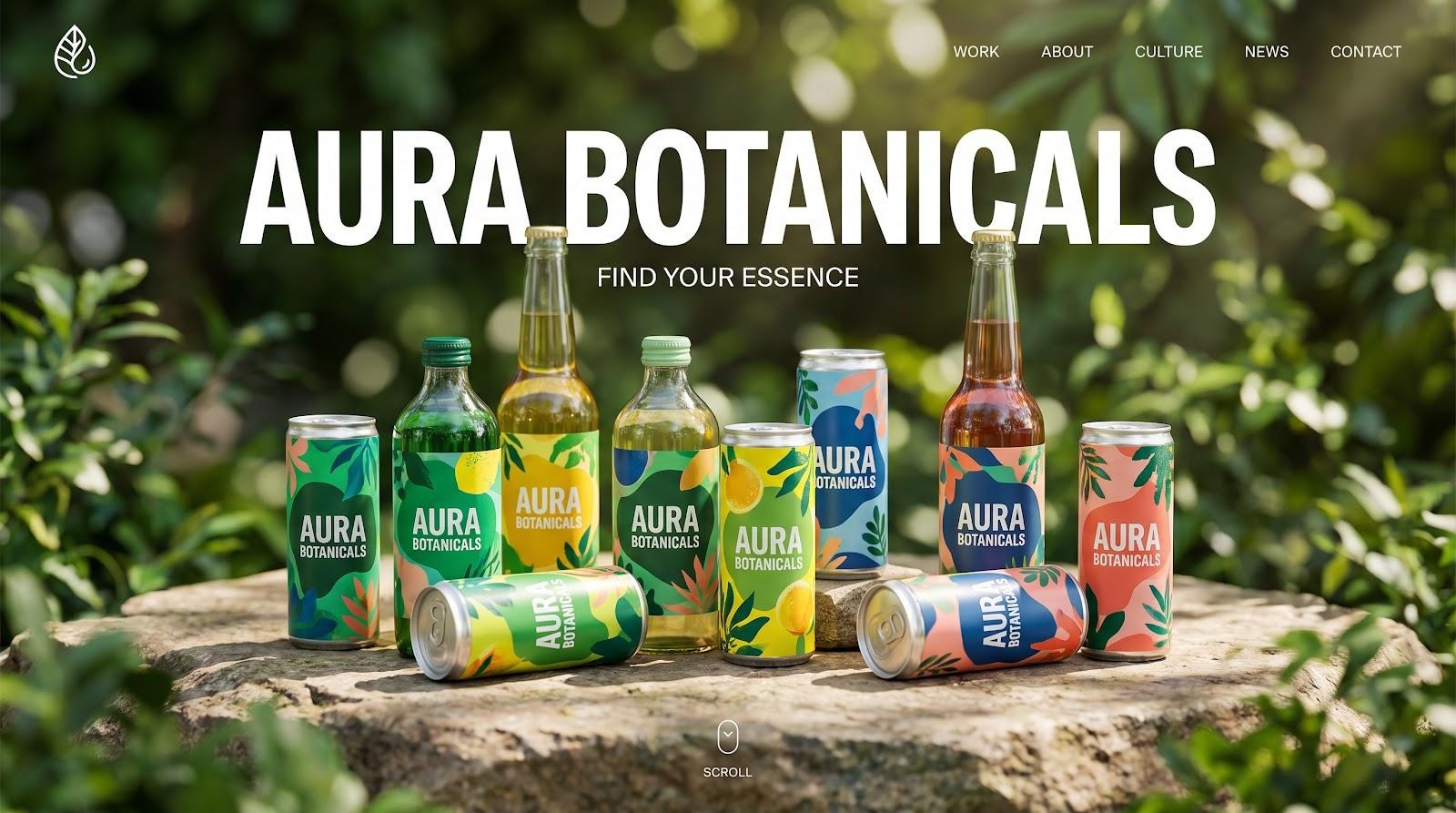
JKR Global Brand Transformation and Packaging Design Agency Website Screenshot
When your packaging must knit together billboards, delivery apps, and 34,000 restaurants, as KFC’s 2026 rebrand did, you need a studio that can keep every touchpoint in tune. JKR meets that need, earning a 2026 Cannes Lion for its D&AD Festival typography work while rolling out graphics, restaurant decor, and digital ordering assets across continents.
The firm’s edge is strategic storytelling. Teams map brand equity, portfolio architecture, and cultural cues before anyone opens Illustrator, pairing strategists with structural and product designers so the vessel matches the voice.
The trade-off is transparency. JKR publishes no price bands, sample timelines, or owned production assets. It delivers press-ready artwork, then leaves manufacturing, color control, and logistics to your procurement team. Enterprise brands value that independence; lean teams may struggle with the extra coordination.
Choose JKR when you are rewriting a household name, launching across regions, or wrangling dozens of SKUs that must harmonize overnight. Pass if you need turnkey tooling, rapid prototypes, or a partner on the factory floor.
Questions to raise
- How long does the studio stay involved after artwork approval?
- Will JKR recommend multiple converters or a single preferred supplier?
- Who owns press-check sign-off and physical proof approval?
3. SmashBrand: best for data-backed CPG decisions
SmashBrand turns subjective shelf appeal into statistics. The Idaho studio builds quantitative testing into every sprint, running purchase-intent, positioning, and message diagnostics before you commit to print. One verified client reported a 13-point lift in purchase intention after a redesign.
The rigor is not cheap. Engagements start near $25,000 and can reach $500,000 for multi-SKU national launches, with a 2 to 5-month timeline that includes iterative testing and confidence checks. Brands facing seven-figure production runs treat that premium as insurance against costly misfires.
What you do not get is a factory. SmashBrand delivers validated artwork and data, then steps aside while your converter handles plates and line trials. That keeps bids competitive for established CPG teams but leaves project management on your plate if resources are thin.
Choose SmashBrand when you need proof for retailers, investors, or skeptical executives, such as national food, beverage, pet, or supplement launches. Skip if budgets are tight, volumes modest, or you require structural engineering under one roof.
Confirm before signing
- Sample size and audience criteria for each test round.
- The metric that triggers SmashBrand’s performance guarantee.
- Ownership of raw testing data after project completion.
4. GPA Global: best for multinational production and nearshoring
Launching across three continents and four languages can turn local printers into a relay race. GPA Global lowers that risk by offering design, engineering, rapid prototypes, manufacturing, and fulfillment through a 51-site network spanning North America, Europe, and Asia. The promise: a carton printed in Warsaw matches its twin from Shenzhen.
Recent Pentawards and UK Packaging Awards shortlists show the design team can compete with boutique studios, yet GPA’s real advantage is scale. Technology and development centers handle mock-ups, material science, and contract proofs before tooling locks in.
Transparency remains a concern. The “51 sites” headline bundles owned plants, accredited partners, and service offices, and the website lists no public pricing or sample-turnaround data. Clarify plant ownership and numbers early.
Choose GPA when your supply chain faces regional tariffs, freight swings, and retailer lead times, all common in luxury spirits, cosmetics, electronics, and premium gifting.
Due-diligence questions
- Is the proposed facility owned, long-term leased, or third-party accredited?
- Can color, finish, and substrate stay consistent across regions?
- Who holds corrective-action authority if runs in different countries diverge?
5. JohnsByrne: best for premium cartons and specialty print
When razor-sharp foil, flawless spot UV, and cartons that open like jewelry boxes matter more than a sweeping rebrand, JohnsByrne delivers. The Illinois converter houses structural design, prepress, UV printing, finishing, assembly, and fulfillment on one campus, all backed by ISO 9001 and G7 Master color certification.
End-to-end print ownership pays off when color accuracy, tactile finishes, or retail-display deadlines decide the launch. In 2025 the company collected six Paperboard Packaging Council awards, including Folding Carton of the Year. During the same year it added a 160,000 sq ft assembly facility and acquired a West Coast plant to trim freight for beauty, spirits, and luxury-health brands.
Limitations mirror focus. Upstream brand strategy and consumer research sit outside scope, and pricing or turnaround details remain NDA-only, so request line-item quotes early.
Make the first call count
- Which steps (naming, messaging, consumer validation) sit outside scope?
- How many prototype rounds and press approvals are included before tooling costs trigger?
- Can the new West Coast site match Midwest color standards for regional runs?
6. Boundless: best rising studio for luxury structural storytelling
When your packaging must feel like a collector’s item (think premium spirits, fine wine, or velvet-lined gifting), Boundless delivers narrative, identity, and structural design that turns boxes into keepsakes. The World Brand Design Society named the studio Agency of the Year 2025-26 after a run of 99 design accolades.
Boundless works as a creative atelier, diving deep into story, materials, and experiential form rather than spreadsheets of manufacturing KPIs. That focus thrills brand teams seeking emotional impact but requires a separate production partner. The website lists no public pricing, sample timelines, or factory-liaison details, so extra diligence is on you.
Design freedom is the upside; added vendor coordination (and possible sticker shock) is the trade-off. Mature beverage houses with trusted converters can manage the balance. Cash-tight startups often cannot.
Clarify early
- Who supplies and tests premium substrates or specialty closures?
- How many structural revisions occur before dielines lock?
- Will Boundless attend press approvals to protect creative intent?
Design-only vs. integrated: pros and cons
Choosing between a pure design studio and a fully integrated production partner matters only when a printer calls to say your dieline will not run. Here is what each model really delivers.
Design-only studios trade manufacturing ties for creative independence. You get big ideas and the freedom to bid printing wherever cost, capacity, or geography makes sense. The risk sits with you: if an exotic foil triples lead time, your procurement team owns the scramble.
Integrated partners reverse that equation. With engineers, prototype labs, and QC managers a short walk from designers, manufacturability feedback lands in the first sketch review, not the hand-off email. You juggle fewer vendors, though you lose some freedom to pressure-test prices.
| Decision factor | Design-only studio | Integrated partner |
| Creative freedom | Highest (no in-house press bias) | Guided by available processes |
| Production accountability | Client manages converters | Single vendor owns it |
| Competitive bidding | Easy, multiple quotes | Harder, potential lock-in |
| Time to market | Varies with client coordination | Often 2–4 weeks faster thanks to fewer hand-offs |
| Best for | Brands with strong internal packaging teams | Lean teams, complex structures, or compliance stress |
A packaging engineer on Reddit warns, “Beautiful designs are often too costly to produce or straight up impossible.” That hard-earned lesson is why model choice should come before agency choice.
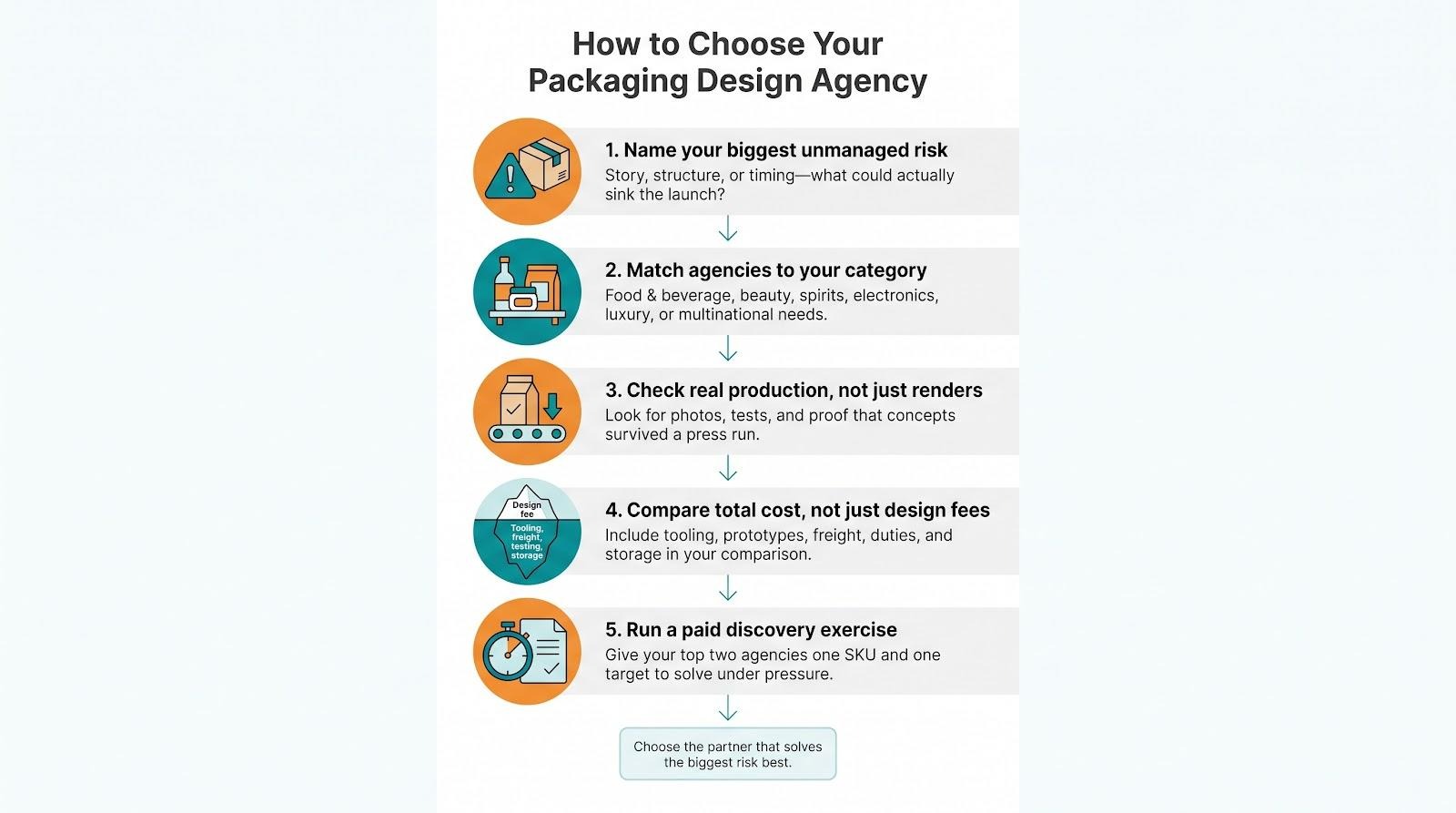
How to choose the right packaging agency for your brand
Start with your largest unmanaged risk
Pinpoint the single threat that could sink the launch, and the shortlist writes itself.
- If positioning still feels fuzzy and buyers keep asking “What’s the story?”, hire a design-led studio to sharpen narrative, architecture, and shelf blocking before a dieline is drawn.
- If prototypes collapse in transit tests, engineering and production are the exposed flank. An integrated partner with structural labs and QC desks is safer.
- When both risks loom (for example, supplements racing to market with untested dosing closures), retain one firm from each model for a paid discovery sprint and see which solves the bigger headache fastest.
Write the primary risk, share it with stakeholders, and half the names fall away. Focus saves money.
Match the agency to your category
Each sector has quirks a generalist might miss.
Food and beverage brands lean on SmashBrand’s consumer-testing muscle or JKR’s portfolio architecture.
Beauty, wellness, and spirits teams choose Zenpack for premium unboxing or JohnsByrne for shimmering specialty print.
Electronics and complex e-commerce kits benefit from Zenpack’s drop-test rigor.
Luxury gifting and collector packs favor Boundless for structural theater.
Multinational programs juggling region-specific artwork and lead times fit GPA Global’s networked plants.
Ignore trophies that do not relate to your product. Look instead for launches, retailer placements, or compliance case studies in your exact terrain.
Evaluate real production, not just renders
A 3-D mock-up never faced a cutting die or humidity swing. Insist on evidence that concepts survived a press run:
- Photos of finished packs under warehouse lighting, not studio strobes
- Videos of closure, drop, or fulfillment tests
- Confirmation that award entries shipped at scale, not 100 limited-edition units
Treat renders as promises and physical samples as receipts.
Compare total cost, not just the design fee
Design fees hide the iceberg below: tooling, prototypes, testing, plates, freight, duties, storage, fulfillment. Ask each agency for a stack that covers everything through landed unit cost at your projected volume. Blend that with converter bids so finance sees the real curve, not an optimistic design column.
Run a paid discovery exercise
Shortlisting is theory; discovery is reality. Pay the top two contenders to tackle one SKU, one structural challenge, and one cost or sustainability target. Keep it tight: one week, fixed fee, identical inputs. Then score them on:
- Depth of questioning: do they probe volume, logistics, and regulatory copy?
- Material awareness: can they explain substrate trade-offs and closure rules?
- Cost realism: does the rough bill of materials align with your ceiling?
- Collaboration style: are responses clear, timely, and senior-level?
The agency that thinks holistically under pressure is the safer long-term partner and well worth a modest discovery fee.
Packaging design RFP checklist
A tight RFP prevents the “I assumed that was included” email chain. Confirm each line below before proposals hit your inbox.
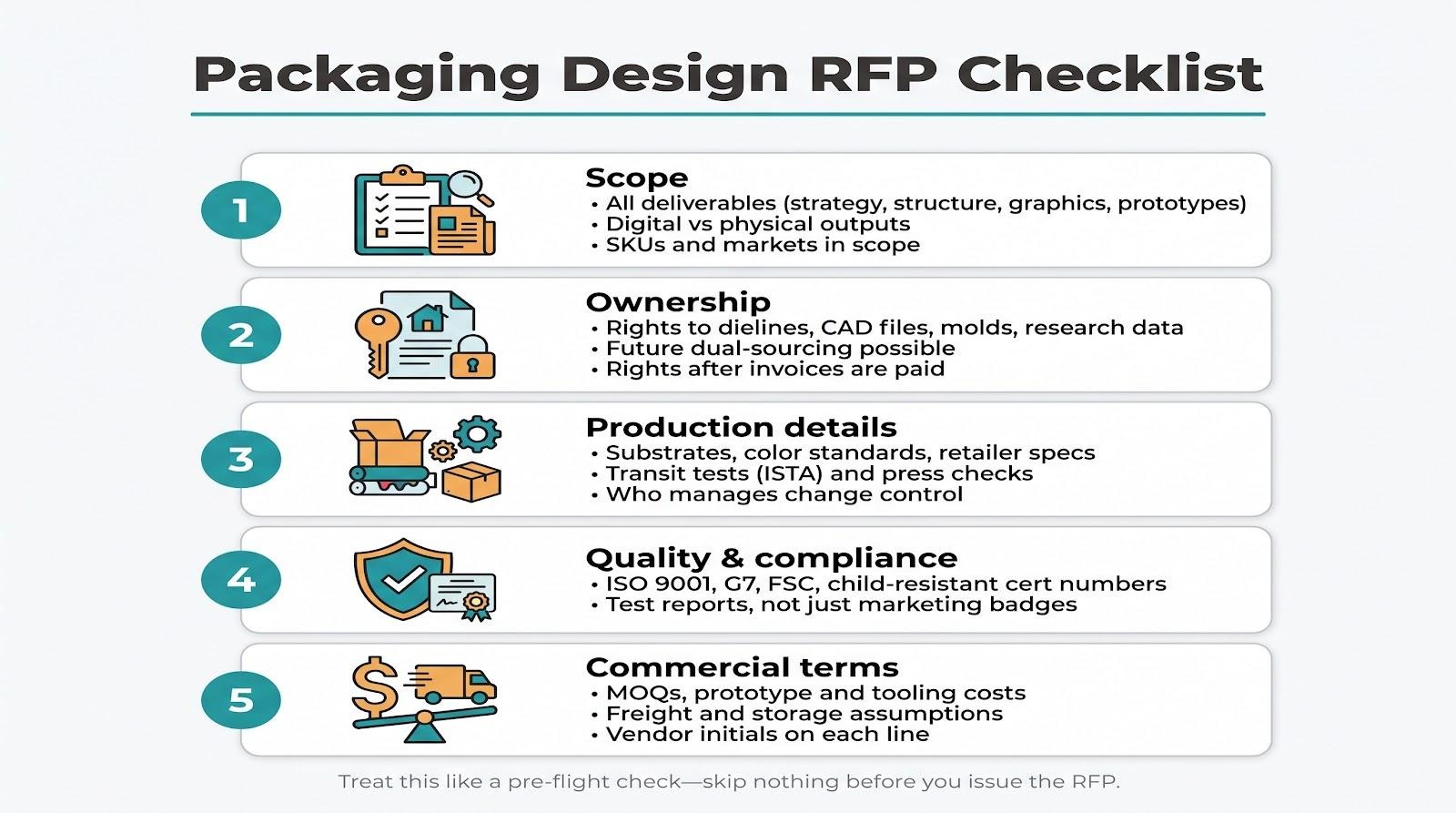
- Scope. Specify exactly which deliverables you need—strategy, structural design, graphics, physical prototypes, production artwork, fulfillment—so agencies can staff and price correctly.
- Ownership. State who keeps dielines, CAD files, molds, and raw research data once invoices are paid. Dual-sourcing later is impossible if tooling rights stay with the first vendor.
- Production details. List preferred substrates, color standards, retailer specs, and who books press checks, ISTA transit tests, and change control after the first run.
- Quality & compliance. Request certificate numbers for ISO 9001, G7, FSC chain of custody, child-resistant testing, or any category-specific standard; marketing badges are not enough.
- Commercial terms. Capture minimum order quantities, prototype costs, tooling amortization schedules, freight assumptions, and storage fees in a table; make vendors initial every line.
Treat this list like a pre-flight check. Skip nothing, and your project is airborne on time with no scope-creep holding pattern required.
Packaging trends that should affect your 2026 agency decision
PPWR and EPR make material data a core deliverable
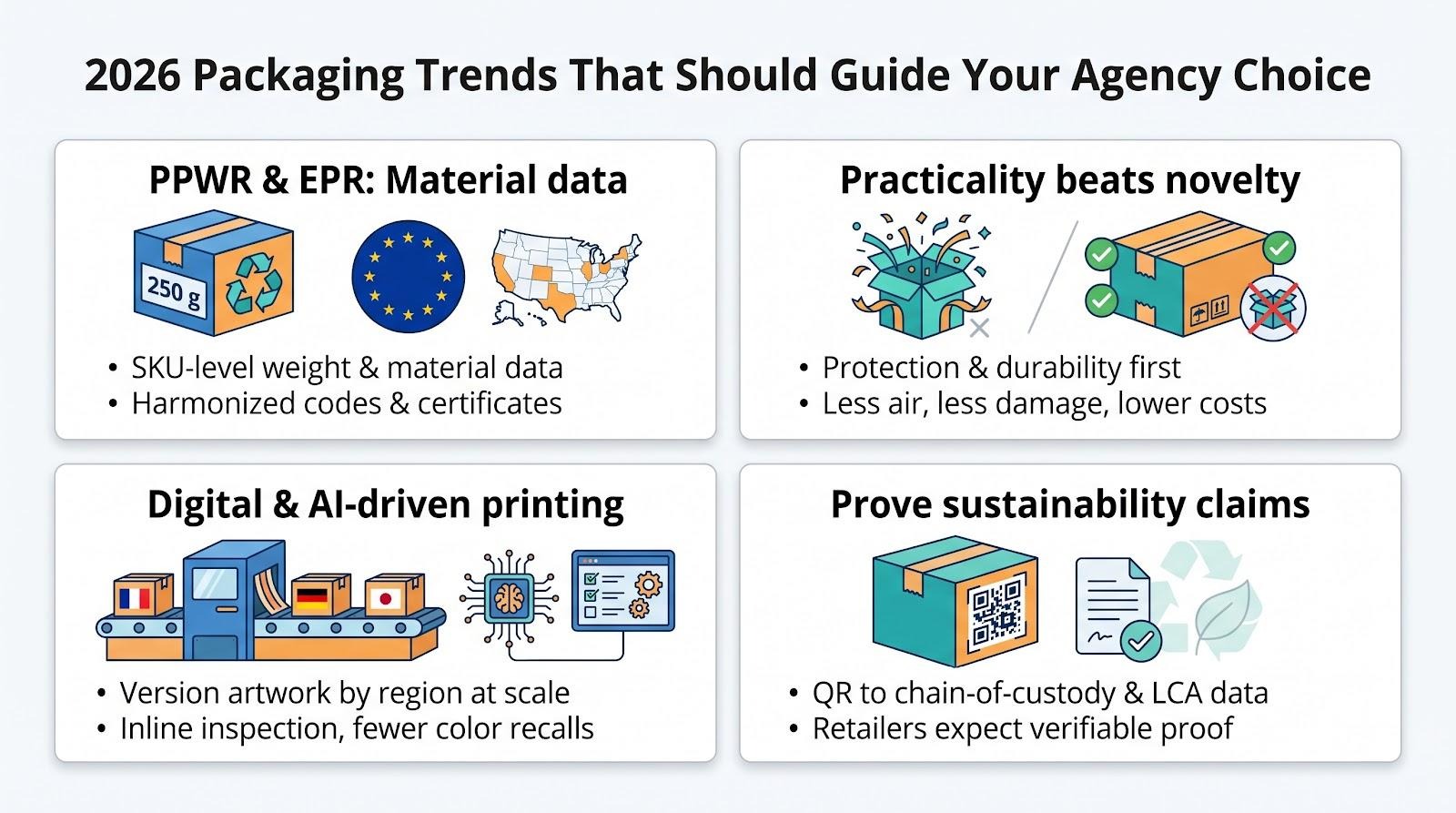
Europe’s Packaging and Packaging Waste Regulation took effect in 2025 and starts applying on August 12, 2026. Seven U.S. states have enacted Extended Producer Responsibility (EPR) laws, and two already bill brands by gram and substrate. Ask every agency for SKU-level weight data, harmonized material codes, and certificates for each component. Integrated firms often have this data ready; design-only studios can still provide it, but they need a disciplined hand-off to converters. If a partner shrugs at recyclability calculators or EPR portals, keep looking; regulatory fines make creative misalignment expensive.
Practicality outranks novelty in 2026
A 2026 Packaging World survey shows protection and durability outrank unboxing theater for e-commerce brands. Designs such as Zenpack’s one-piece Dwell Dripper (faster assembly, less padding) or JohnsByrne’s G7-certified color control save real money by cutting damage and reruns. When you review concepts, circle the line that removes material, air, or labor; if you cannot find it, the pack is a stunt, not an asset.
Digital printing joins the data conversation
AI-assisted pre-press, inline inspection, and variable-data engines now let brands version artwork for regions or promotions without stopping the press. Agencies should explain how they version files, hand off data, and verify color across substrates in one pass. Ask for a live example where 100,000-plus units shipped with region-specific graphics and zero color recalls; if the answer is a shrug, reconsider personalization plans.
Sustainability claims need hard proof
Retailers and regulators now expect QR codes that open chain-of-custody documents, recyclability scores, and life-cycle data, not a kraft box with a leaf icon. Vet agencies on certificate tracking (FSC, PEFC), third-party compostability tests, and costed mono-material alternatives. A converter selling “biodegradable” film without proof of local collection infrastructure is greenwashing; a studio that supplies a recyclability report for every concept empowers procurement to specify the right converter.
Bottom line: trends only matter when your agency can document how they will protect margin and compliance, not just win an award photo.
Other packaging agencies to watch
Most briefs fit our ranked six, but four specialists deserve a look for niche problems or future list upgrades.
- Burgopak: patented slider packs, at-home test kits, and certified child-resistant formats. Ideal when you need standout unboxing plus safety engineering.
- Kingdom & Sparrow: a food-and-drink boutique with recent FAB Gold and Dieline metals; regional craft producers like its brand-soul focus without global-agency pricing.
- Backbone Branding: emotion-led produce and confectionery work; named Pentawards Agency of the Year in 2019 and 2020, but publishes little on manufacturing.
- Murmur Creative: a B Corp studio with a Pacific Northwest vibe; values-led start-ups cite culture alignment as the clincher.
Track their launches, awards, and published results. Any could join the core list once they pair design flair with verifiable production and commercial outcomes.
Frequently asked questions about packaging design agencies
What does a packaging design agency do?
Most provide strategy, structural and graphic design, prototypes, and press-ready artwork. Integrated partners add tooling, press checks, and even fulfillment.
How much does packaging design cost?
Projects range from Zenpack’s $8,000-plus structural briefs to SmashBrand engagements that reach $500,000 for multi-SKU national launches. Tooling and unit production usually drive the biggest swings, so ask for a landed cost, not a design fee.
How long will the work take?
Creative phases typically run 6 to 12 weeks. Integrated partners need another 4 to 8 weeks for samples and tooling, plus production and freight. Design-only studios can release artwork sooner, but the converter schedule still rules the calendar.
Who owns the dielines and production files?
Ownership is contractual. Some agencies transfer dielines once the final invoice clears; others license the files or hold tooling. Always specify rights in writing.
Do agencies make physical prototypes or only 3-D renderings?
Integrated firms include physical samples. Design-only studios often outsource prototypes to a preferred converter. If you need ISTA drop or compliance testing, spell that out up front.
What certifications matter?
Look for ISO 9001 (quality), G7 (color), FSC chain of custody (fiber), ISTA (transit), and category specifics such as child-resistant protocols for cannabis. Ask for certificate numbers, not marketing badges.
Is consumer testing worth the premium?
For high-volume CPG launches, yes. SmashBrand and its peers use data to avoid seven-figure reprints. For micro-runs, moderated shelf tests or guerrilla feedback may suffice.
Does location matter?
Time-zone overlap and press-check access help, but modern video workflows make engineering expertise, category fit, and accountability more important than geography.
Keep this FAQ handy during stakeholder reviews to short-circuit the “have we asked?” scramble minutes before a decision.
Conclusion
By zeroing in on your biggest unmanaged risk, matching agency strengths to your category, and validating real-world production evidence, you can choose a packaging partner that protects budget, timeline, and brand integrity. The six agencies profiled here cover the major service-model and geographic scenarios most brands face in 2026. Use the checklists and comparison tables as a starting framework, then put contenders through a paid discovery sprint to reveal the partner who will keep your launch on-shelf and on target.