


For most businesses, the front door is only the most visible part of a much larger security problem. A modern facility has parking structures, loading docks, server rooms, executive suites, and dozens of interior doors, and a single lost key or propped-open door can put all of it at risk. Metal keys simply cannot keep up, which is why more organizations are handing the job to a dedicated access control provider.
At its core, access control replaces physical keys with digital credentials managed through central software, so a business can decide exactly who goes where, and when. Working with Taylored access control systems turns a patchwork of locks into one coordinated system. Here is how a strong provider protects a facility from the outer gate all the way to its most sensitive rooms.
1. Defense in Layers, Gate to Core
Picture the building as an onion. Each layer gets harder to clear, so the deeper someone wants to go, the more they have to prove:
- Outer ring. Down at the parking entrances, plate readers and long-range RFID tags wave through registered vehicles and hold everyone else at the gate.
- Secondary ring. The main doors want a valid credential even at noon on a Tuesday, so a stranger cannot just wander up to the front desk.
- Inner ring. Rooms holding servers, cash, or the corner offices sit behind their own locked tier, reachable only by the handful of people cleared for them.
This layered approach means a breach at one ring does not hand an intruder the entire building.
2. Modernizing the Credential Itself
Old proximity cards are easy to lose, steal, or clone with cheap online devices. A capable provider swaps them for encrypted alternatives that are far harder to defeat:
- Mobile credentials turn an employee’s phone into a key using Bluetooth or NFC, and they can be revoked remotely in seconds.
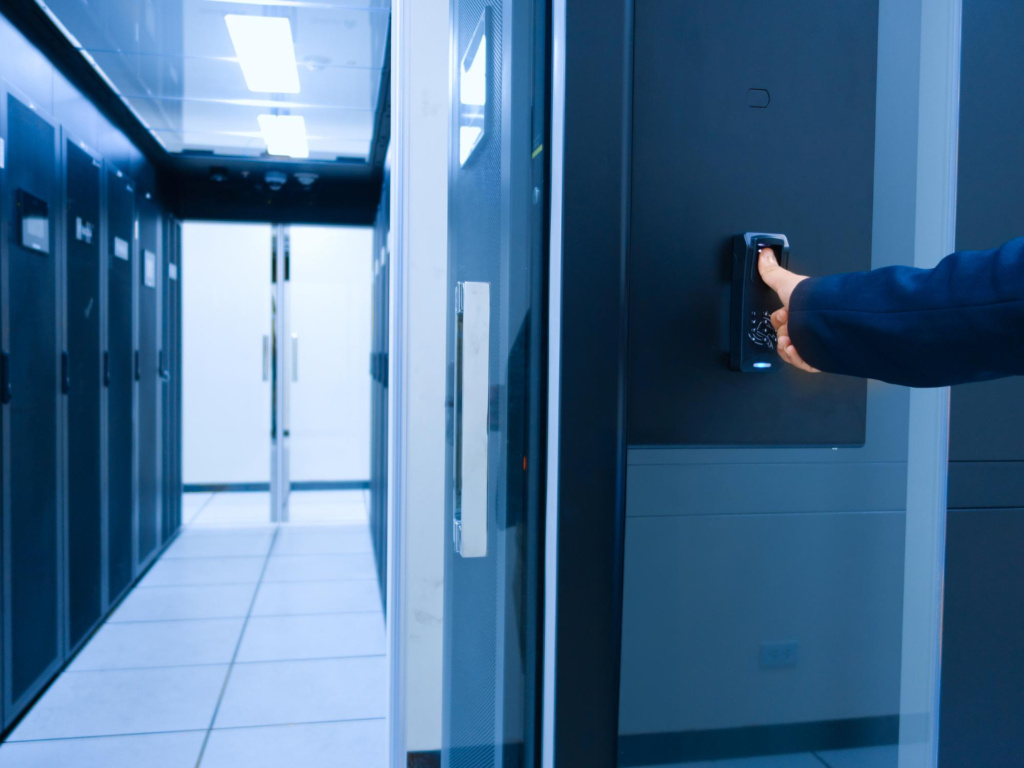
- Biometric readers use fingerprints, facial recognition, or iris scans for high-security areas like server rooms.
- Multi-factor authentication at the door can require both a phone tap and a PIN before a lock releases.
Because these credentials are encrypted, a stolen phone or badge is far less useful to an attacker than an old key ever was.
3. Centralizing Everything in the Cloud
The real power of a modern system is that administration moves off local servers and into a central cloud platform. That shift changes what a security team can actually do.
Provisioning or revoking access becomes a single click, so when an employee leaves, their entry rights across every location end instantly. Providers also set granular schedules, letting staff in only during assigned shifts, and they roll every entry log and door alert into one dashboard. Guidance from the government’s physical security resources reinforces this layered, centrally managed approach for organizations of any size.
4. Connecting the Whole Security Ecosystem
Access control works best when it talks to the rest of your systems rather than standing alone. A well-designed setup creates a proactive loop:
- Video synergy. A swipe or a held-open door automatically tags the nearest camera clip, so teams can spot tailgating in seconds.
- Intrusion response. A tripped motion or glass-break sensor can lock down interior sectors to contain an intruder until police arrive.
- Life-safety integration. During a fire or active threat, the system can fail-safe open evacuation routes or trigger a facility-wide lockdown.
Pairing access control with camera coverage is where an experienced provider adds the most value, since the two systems verify each other in real time.
5. Defending the Digital Side
Because these systems live on the internet, they are also a cyber target, and a serious provider protects the data as fiercely as the doors. That means using encrypted protocols like OSDP instead of legacy wiring that can be intercepted, and pushing automatic firmware updates so controllers stay patched against new vulnerabilities.
A door reader is, in the end, a networked computer. Treating it like one, with the same patching and encryption discipline as any server, is what separates a professional installation from a liability.
The Bottom Line
Protecting an entire facility is not about a single stronger lock. It is about layered zones, encrypted credentials, cloud-based control, tight integration with cameras and alarms, and solid cybersecurity behind all of it. A skilled access control provider ties those pieces into one system, giving you real-time visibility, instant control, and a facility that stays secure long after the keys have been retired.