


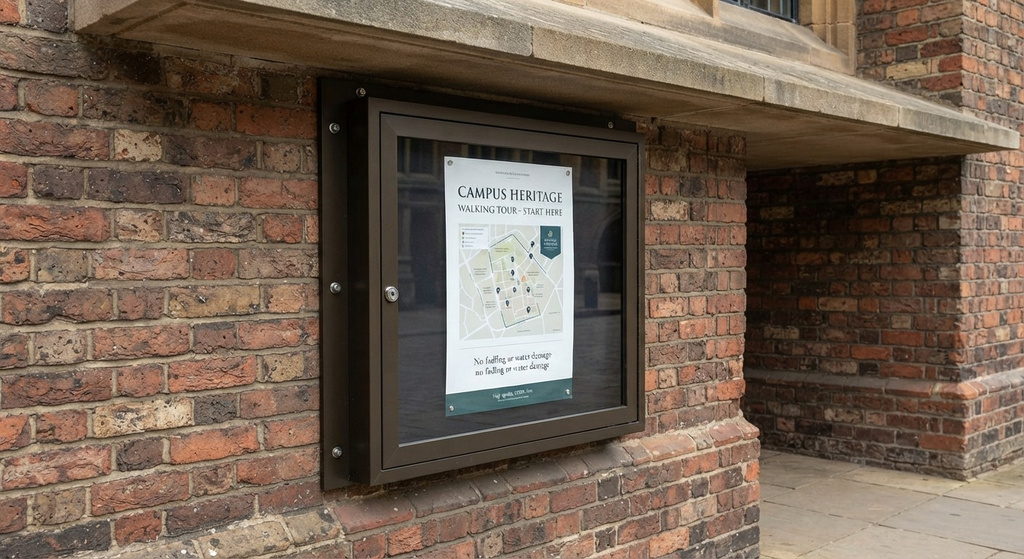
It usually starts with a small complaint. A notice board by the staff parking lot has fogged up again, the poster inside has curled and spotted, and the supplier says water damage is not covered because the unit was “designed for interior use.” The frame looked the same as the ones in the lobby. It cost the same, too. That is exactly the problem.
An outdoor frame display differs from an indoor one mainly in what you cannot see from the front: gaskets, drainage, vents, UV-stabilized glazing, exterior-grade finishes and fixings sized for wind. Those hidden components are what the extra price pays for, and they are what this article examines, one failure mode at a time.
The Key Difference Between Indoor and Outdoor Frames Is Everything Behind the Glazing
The key difference between an indoor and an outdoor solution is that an indoor frame is built to be opened easily, while an outdoor frame is built to stay closed against water, dust and sun and still be opened when needed. Every design choice follows from that tension.
An indoor profile can leave a gap at the opening edge because nothing needs to be kept out. An outdoor profile has to close that gap with a compressed gasket, give any water that does get in a way to drain, and let the interior breathe so that humidity does not condense on the inside of the front sheet. The metal itself may even be the same extruded aluminum. What changes is the finish class, the fasteners, the glazing chemistry and the seal.
This is also why “weather-resistant” on a product page tells you very little. The useful questions are narrower: resistant to what, tested how, and for how long?
Material, IP Rating, Temperature, Lifespan and Cost: How the Two Categories Compare
Indoor frames are cheaper, lighter and faster to update; outdoor frames trade those advantages for sealing, UV stability and corrosion resistance. The figures below are typical ranges across the market rather than guarantees, so each one should be checked against the data sheet of the specific model you are quoting.
| Criterion | Indoor frame display | Outdoor frame display |
|---|---|---|
| Profile and finish | Aluminum with decorative anodizing or standard powder coat; plastic or wood for low-cost and decorative uses | Aluminum with AAMA 611 Class I anodizing or AAMA 2604/2605 powder coat; coated steel where security matters |
| Front sheet | Anti-glare PET or standard acrylic | UV-stabilized polycarbonate or acrylic; tempered safety glass at premium or heritage sites |
| IP rating (IEC 60529) | Usually not rated | IP54 for sheltered spots, IP65 or IP66 for fully exposed façades and posts |
| Operating temperature | Conditioned interior, roughly 15 to 30 °C | Commonly specified around −20 to +50 °C or wider; illuminated units are limited by their LED driver rating |
| Typical service life | Profile 10+ years; front sheet replaced as it scratches | Profile 10+ years with the right finish; glazing and gaskets often 5 to 10 years in full sun |
| Typical relative cost | Baseline | Commonly two to four times a comparable indoor unit, before posts and structural fixings |
| Realistic drawback | Degrades quickly once exposed to moisture, UV or frost | Higher cost and weight, narrower choice of colors and custom sizes, slower content changes |
What this means on site: the cost gap is real, but it has to be weighed against the cost of replacing an indoor unit, and its graphics, several times over the life of one outdoor unit.
Reading an IP Code Without Being Sold a Number
An IP code under IEC 60529 has two digits: the first rates protection against solid particles, the second against water. For exterior display frames, the second digit usually matters most, and IP65 or IP66 covers most exposed positions. A higher number is not automatically better if it is not matched to the site.
- IP44 withstands splashing water and suits covered entrances and unheated vestibules.
- IP54 adds dust protection and fits canopies, covered walkways and parking structures.
- IP65 is dust-tight and resists water jets from a 6.3 mm nozzle, the usual baseline for façades, posts and gates.
- IP66 resists powerful jets from a 12.5 mm nozzle, which makes sense on exposed coastal sites or where surfaces are pressure-washed.
- IP67 covers temporary immersion and is rarely needed for frames unless the site can flood.
Two related ratings often matter just as much. In North America, enclosures are frequently described by NEMA 250 types, where Type 3R covers rain and sleet and Type 4X adds hose-directed water and corrosion resistance. For vandal-prone locations, the IK code under IEC 62262 rates impact resistance on a scale from IK00 to IK10; IK10 corresponds to an impact energy of 20 joules, which is a sensible benchmark for transit stops and public parks.
Ask for the test report behind any rating. A rating applies to the product as tested, so extra mounting holes or a missing gasket can take an installed unit outside that condition.
Why a Perfectly Sealed Frame Can Still Fog From the Inside
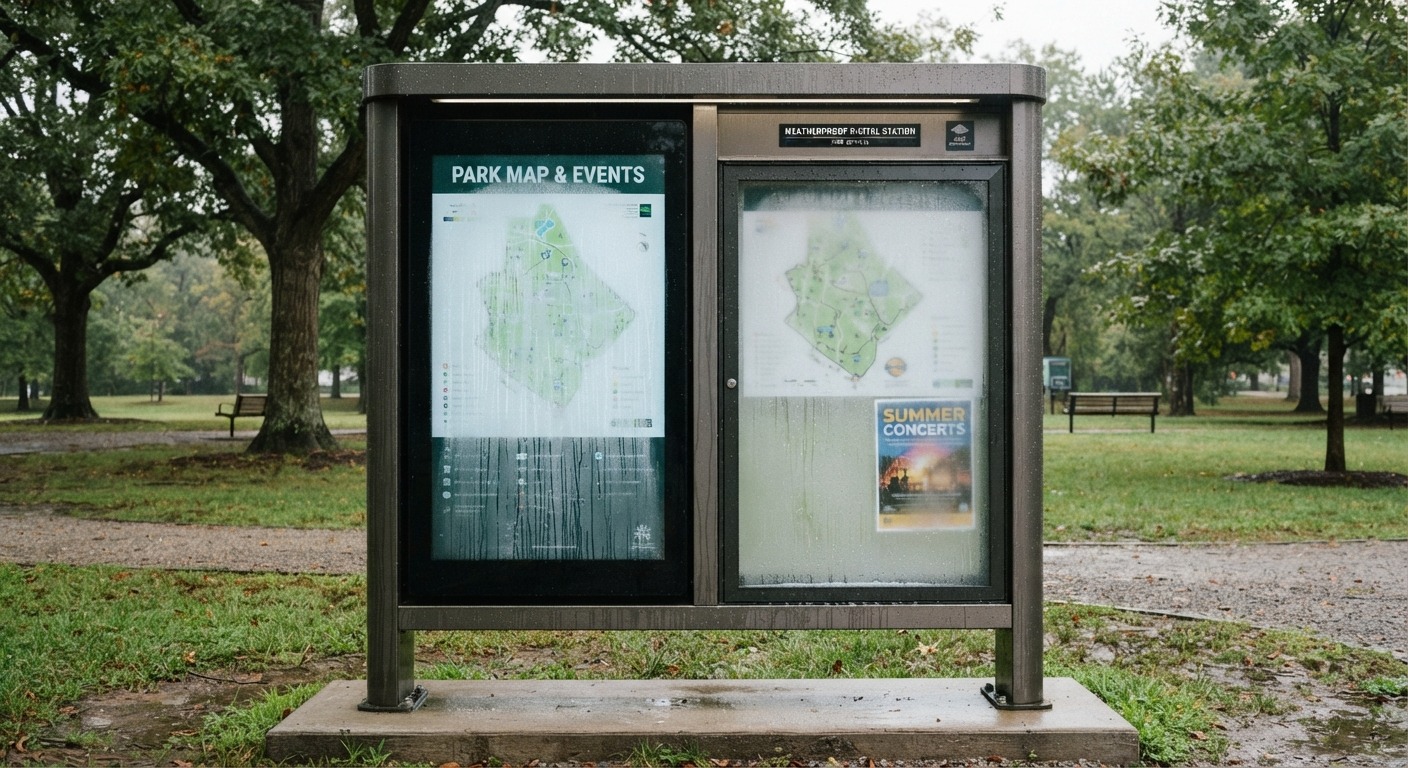
A sealed frame fogs because the air trapped inside it holds moisture. When the front sheet cools below that air’s dew point, typically overnight or after rain, the moisture condenses on the inside of the glazing. IP ratings do not address this, because they test water entering from outside, not humidity already inside.
The fix is ventilation, not more sealing. Well-designed outdoor frames use one or more of three approaches:
- Breathable vent membranes that let air and water vapor pass while blocking liquid water and dust, equalizing pressure as the unit heats and cools.
- Drainage paths or weep holes at the bottom of the profile, so any water that enters has a route out instead of pooling behind the graphic.
- Loading graphics in dry conditions. Changing a poster during rain or high humidity seals damp air inside the case. Many facility teams schedule outdoor changes for dry mornings for exactly this reason.
If a supplier cannot explain how their outdoor unit manages internal condensation, treat their IP rating with caution.
Desert Heat, Coastal Salt or Alpine Frost: Matching the Frame to the Climate
Climate changes which component fails first. Hot, sunny sites attack glazing and graphics through UV and heat; coastal and road-salt sites attack metal through corrosion; cold sites attack seals and plastics through freeze-thaw cycles and brittleness. Specifying for the dominant climate risk prevents most early failures.
- Hot and sunny sites mostly suffer UV damage, heat buildup and fading, so they call for UV-stabilized glazing, lighter finishes that absorb less heat, UV-resistant or laminated prints and vents to release heat.
- Coastal sites face salt and galvanic corrosion. Specify AAMA 2605 powder coat or Class I anodizing, 316 stainless fasteners isolated from the aluminum with nylon washers and sealed lock cylinders; ISO 9223 corrosivity categories C4, C5 or CX signal the highest risk.
- Cold and snowy sites break seals and plastics through freeze-thaw cycles. Polycarbonate handles low-temperature impacts better than acrylic, gaskets should be EPDM or silicone rated for sub-zero use, and drainage keeps meltwater from freezing inside the profile.
- Humid, temperate sites struggle mainly with condensation and mold, which venting, drainage and regular gasket checks prevent.
- Urban and industrial sites add grime, pollutants and vandalism, so easy-clean and IK-rated front sheets, tamper-resistant locks and finishes tested with ASTM B117 salt spray are worth the premium.
Plastics also expand far more than aluminum with heat. Acrylic and polycarbonate move roughly three times as much per degree as aluminum, so outdoor frames need clearance around the front sheet. A panel fitted tightly in winter can bow or crack at its fixings in summer.
The Wind Load Math That Turns a Poster Frame Into a Sail
Wind pressure rises with the square of wind speed, so doubling the wind speed quadruples the load on a frame. A large freestanding or façade-mounted frame behaves like a small sign panel and needs fixings and posts designed for the site’s wind exposure, not the anchors supplied for interior walls.
In the United States, structural sign supports are generally designed to wind loads defined by ASCE 7, and local building codes set equivalent requirements elsewhere. For facility managers, three practical checks cover most situations: confirm that the manufacturer states a wind rating or provides structural data for freestanding models; fix wall-mounted units into masonry, concrete or structural framing with anchors rated for exterior use; and pay extra attention to corner positions, rooftop edges and open plazas, where wind speeds are typically higher than on sheltered walls.
Gaskets Wear Out Before Frames Do: Planning the Five-Year Maintenance Bill
The frame body is rarely what fails outdoors; the consumables are. Gaskets, front sheets, lock cylinders and vent membranes wear out on their own schedule, and that schedule depends on how often the unit is opened. Budgeting for these parts from the start is what separates a durable installation from a recurring repair ticket.
Indoors, maintenance is light: the front sheet is cleaned as needed and replaced when scratches affect legibility, and hinges get attention when they start to stick. Outdoors, a realistic routine includes cleaning the glazing monthly or after storms (never with ammonia on acrylic or polycarbonate), inspecting gaskets quarterly and after each winter, servicing locks and hinges twice a year with lubrication before freezing weather, replacing front sheets every few years in full sun, and checking fixings and posts annually and after major wind events.
Change frequency drives most of this bill. A board opened weekly compresses and releases its gasket dozens of times a year and needs more frequent seal checks than a site map that is updated once a season. For frequent updates, front-opening hinged doors with replaceable gaskets usually last longer than profiles that have to be forced apart; for rarely changed content, screwed or tool-locked panels offer the tightest seal.
One Profile Family, Two Environments: Keeping a Campus Signage System Consistent
Mixed sites, such as hospitals, universities, municipal buildings and business parks, benefit from choosing a single profile family that is offered in both indoor and outdoor versions. Visitors see one consistent wayfinding language, and the facility team stocks one set of graphic sizes and spare parts.
Consider a typical campus scenario: directory boards at the parking entrance, notice boards at building entrances, and room signage and event posters in interior corridors. Hinged systems from manufacturers such as SwingFrame, along with comparable ranges from other suppliers, are one way to cover all three, because the same front-opening principle works indoors and in sealed outdoor versions. The same logic applies to any brand. Before standardizing, check that the outdoor variant has its own IP test result rather than borrowing the indoor model’s specifications, that finishes can be matched between variants, and that both accept the same graphic sizes and mounting accessories used by the rest of the signage system, from directional signs to door plates and digital screens.
Three Questions That Settle the Indoor-or-Outdoor Decision
The decision comes down to three questions asked in sequence: where the frame will be placed, what climate it will face, and how often its content will change. The answers determine the rating, the materials and the mechanism, in that order, before price enters the discussion.
Question 1: Where exactly will the frame hang?
- Conditioned interior (corridors, lobbies, offices): an indoor frame is the right choice. Paying for outdoor specifications adds cost without adding value.
- Semi-exposed (canopies, vestibules, parking structures): choose at least exterior-grade finishes and fasteners, and an IP54 rating or better.
- Fully exposed (façades, posts, gates): choose a fully outdoor unit, IP65 or IP66, with wind-rated fixings.
Question 2: What will the climate do to it?
- Strong sun: prioritize UV-stabilized glazing, light finishes and UV-resistant prints.
- Salt air or road salt: prioritize finish class, 316 stainless fasteners and isolation between metals.
- Frost and snow: prioritize gasket temperature ratings, drainage and polycarbonate glazing.
- High humidity: prioritize venting and drainage over higher IP numbers.
Question 3: How often will the content change?
- Weekly or monthly: a front-opening hinged frame with a replaceable gasket, or a snap frame indoors.
- Seasonally: a lockable case with a good seal.
- Rarely or never: a screwed or tool-locked panel with the tightest sealing available.
Before approving an order, request three documents from the supplier: the IP (and, where relevant, IK) test report, the finish specification with its AAMA or equivalent class, and the installation instructions that the warranty depends on. Together they answer most of the questions that otherwise surface only after the first wet season. A frame display specified this way should spend its service life doing its job rather than generating maintenance tickets.