



Moving in together is a big decision. The legal side, less so. But a cohabitation agreement protects both partners’ assets and expectations, and the services below make getting one considerably less painful than hiring two separate lawyers and waiting weeks for a draft.
What a Cohabitation Agreement Actually Covers
A cohabitation agreement is a written contract between two unmarried partners that spells out what each person owns going in, how shared expenses and property are handled during the relationship, and what happens if they separate or marry. It’s not reserved for couples with significant assets. Common-law rules vary sharply across provinces: Ontario offers no automatic property sharing for unmarried partners, British Columbia treats common-law couples as spouses after two years (or sooner when a child is involved), and Alberta applies the Adult Interdependent Relationships Act after three years. Without a written agreement, those defaults kick in, and they may not reflect what either person actually wants.
These agreements typically cover property each partner brings in, shared expenses, a jointly purchased or single-owner home, spousal support, debts, inheritances, businesses and pets. They can also include a clause converting the agreement into a marriage contract if the couple later marries.
Finding the right service depends on budget, province and how much legal guidance the couple wants alongside the document itself.
1. Jointly
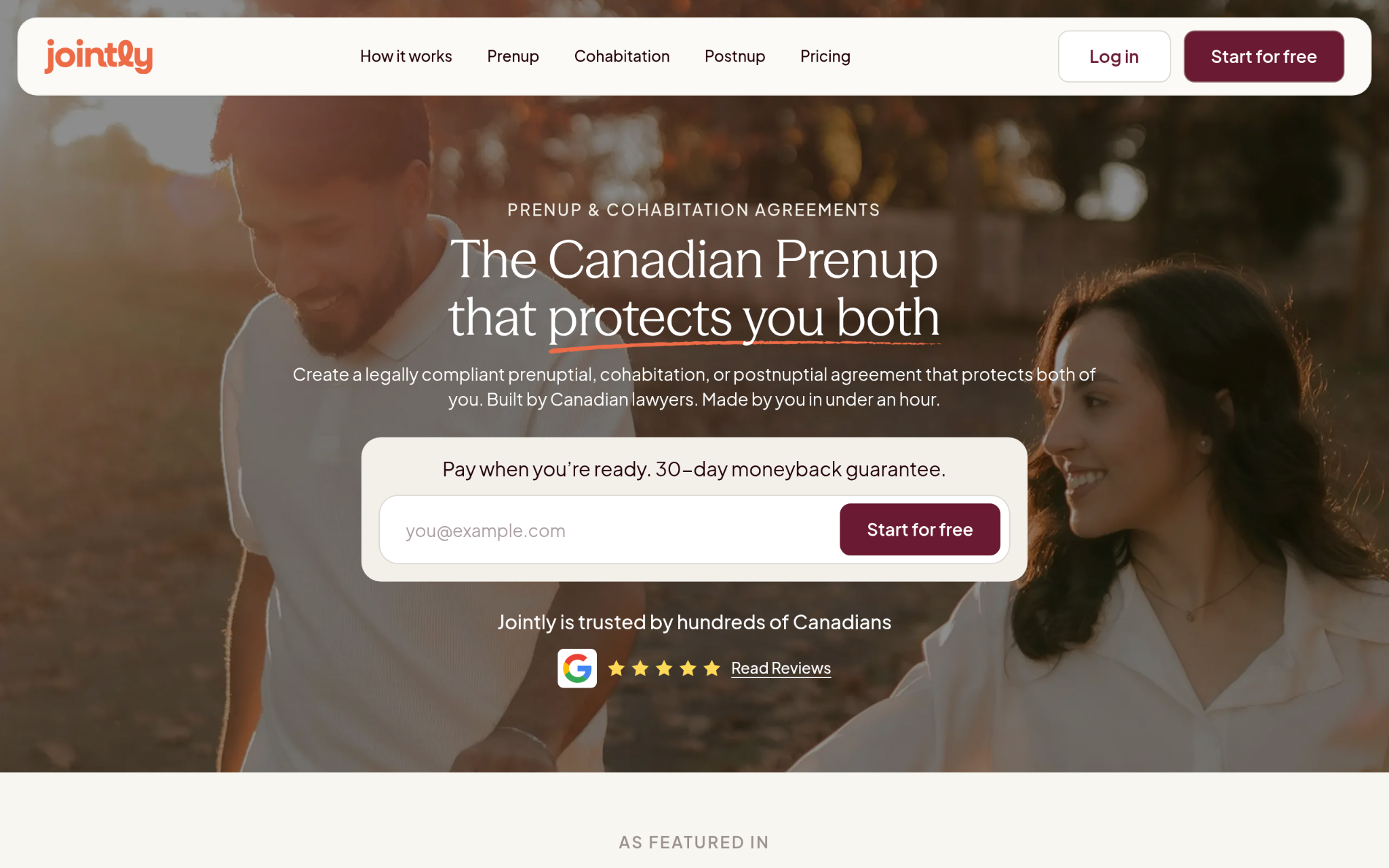
- Best for: Canadian couples in Ontario, BC or Alberta who want a lawyer-drafted cohabitation or prenuptial agreement without paying for full custom drafting
- Standout: Every clause written by practising Canadian lawyers; not AI-generated
- Pricing: Free to start (course and worksheets); $429 CAD flat for both partners; 30-day money-back guarantee
- Coverage: Ontario, British Columbia, Alberta (more provinces listed as coming soon)
Jointly was built by two BC lawyers, Aimee Schalles and Amanda Baron, each with over ten years of practice. Couples answer plain-language questions inside a guided builder, watch a live document preview take shape beside their responses, then download the finished agreement as a PDF or DOCX. When couples use the cohabitation agreement in Canada by Jointly, the builder applies province-specific rules on its own and flags disagreements between partners before anything gets signed.
The flat $429 CAD fee covers both partners; compare that to the $1,500 to $5,000 or more per partner that a traditional lawyer typically charges. Independent legal advice costs extra; partner lawyers start at $399 plus tax, and in Alberta it’s required for property provisions to be enforceable. Jointly holds authorized participant status in the Law Society of Ontario’s Access to Innovation pilot and is an approved participant in both the BC and Alberta Law Society Innovation Sandboxes. Builder access lasts six months per purchase, and a $99 update pass is available if changes are needed later.
2. Good Terms
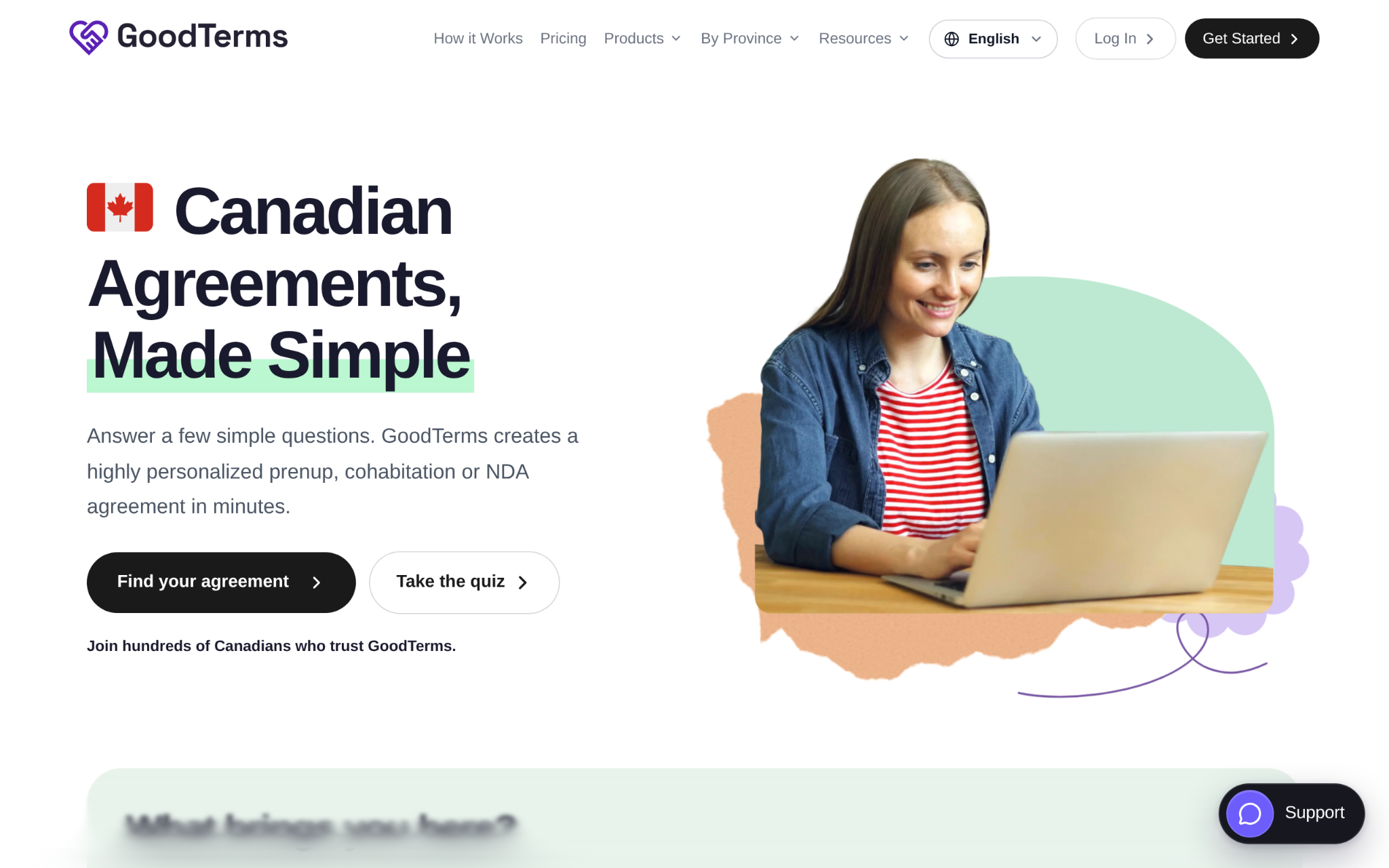
- Best for: Couples who want a province-specific draft at a low entry price and plan to have a lawyer review it
- Standout: Supports all ten Canadian provinces with province-specific questions; outputs editable Word and PDF files
- Pricing: $49 CAD one-time, includes three “generations” (revisions or different agreement types)
- Coverage: All ten Canadian provinces
Good Terms is operated by Prenuply AI Inc., an Ontario corporation based in Toronto. It’s a technology company, not a law firm. The platform generates agreement templates – including cohabitation agreements, prenups, postnuptial agreements, and business NDAs – through an AI-assisted guided questionnaire that users answer in plain language, receiving a customizable draft they can then bring to a lawyer for review.
At $49 CAD for three generations, Good Terms sits well below most alternatives on price. That low cost reflects what the service actually is: a starting point, not a finished document. The generated agreement needs independent legal review before signing, and that expense falls entirely on the couple. Good Terms positions itself between bare templates and a full custom draft, which is fair, but couples should budget for lawyer review time on top of the platform fee.
3. Prenups
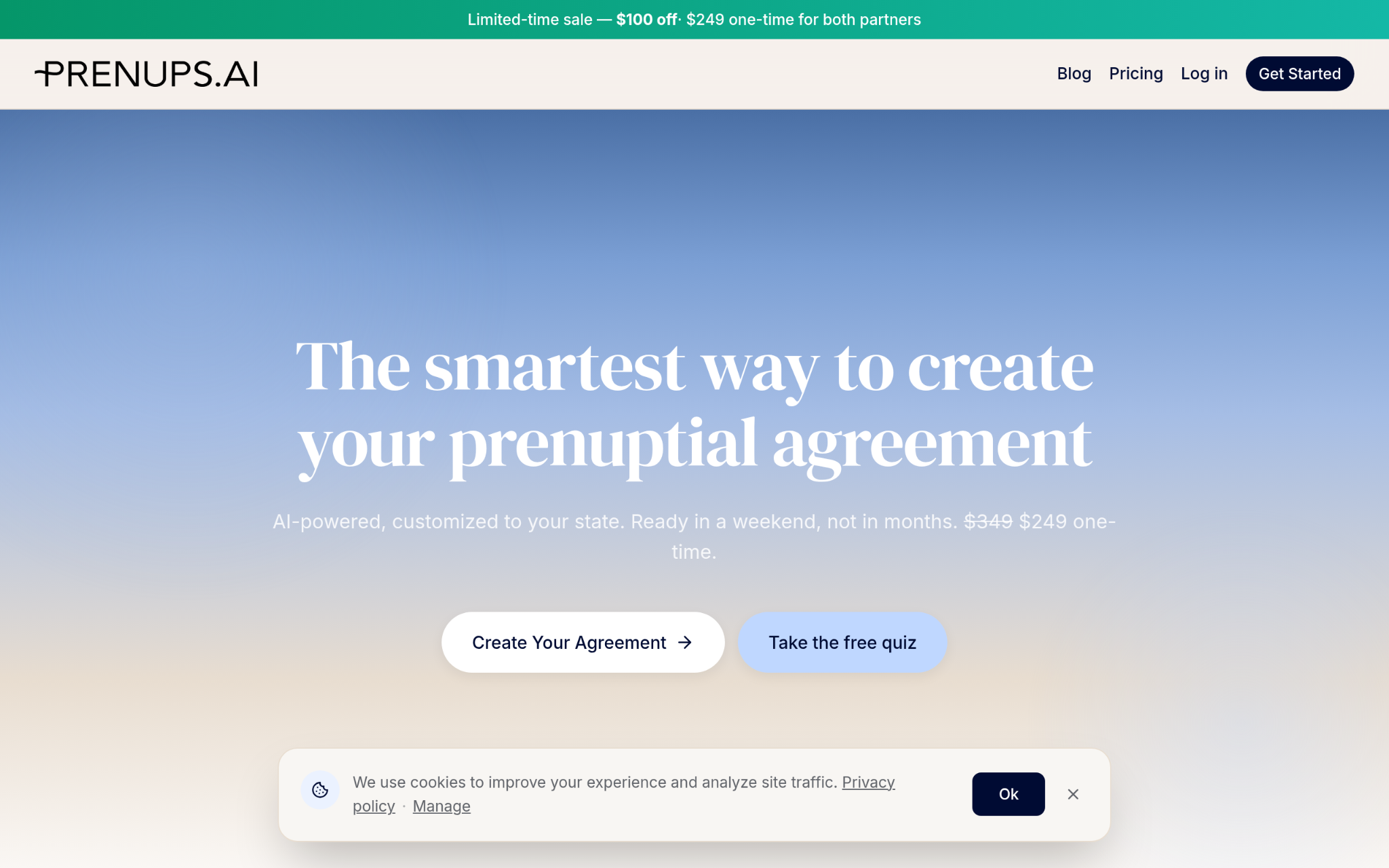
- Best for: Couples who need a prenuptial or postnuptial agreement and want U.S. or Canadian jurisdiction coverage in one place
- Standout: 12-step guided questionnaire; agreement regenerates up to 10 times; covers all Canadian provinces except Quebec
- Pricing: $249 CAD/USD one-time (listed at $349 with a limited-time $100 discount)
- Coverage: All Canadian provinces except Quebec; all 50 U.S. states and Washington DC
Prenups.ai launched in 2024 and is headquartered in Canada. The platform covers two agreement types only – prenuptial and postnuptial – and walks users through a 12-step questionnaire covering personal details, assets, debts, spousal support, and estate planning. The finished document downloads as an editable Word file and can be regenerated up to ten times.
The cross-border coverage is the standout feature here. Couples with ties to both Canada and the United States, or those who want a single platform spanning both jurisdictions, won’t find many alternatives. The $249 price sits higher than Good Terms but lower than most lawyer-drafted platforms, though it covers fewer agreement types. Prenups.ai explicitly states it’s not a law firm and recommends independent legal review before signing, sound advice no matter which service a couple chooses.
4. Steps to Justice
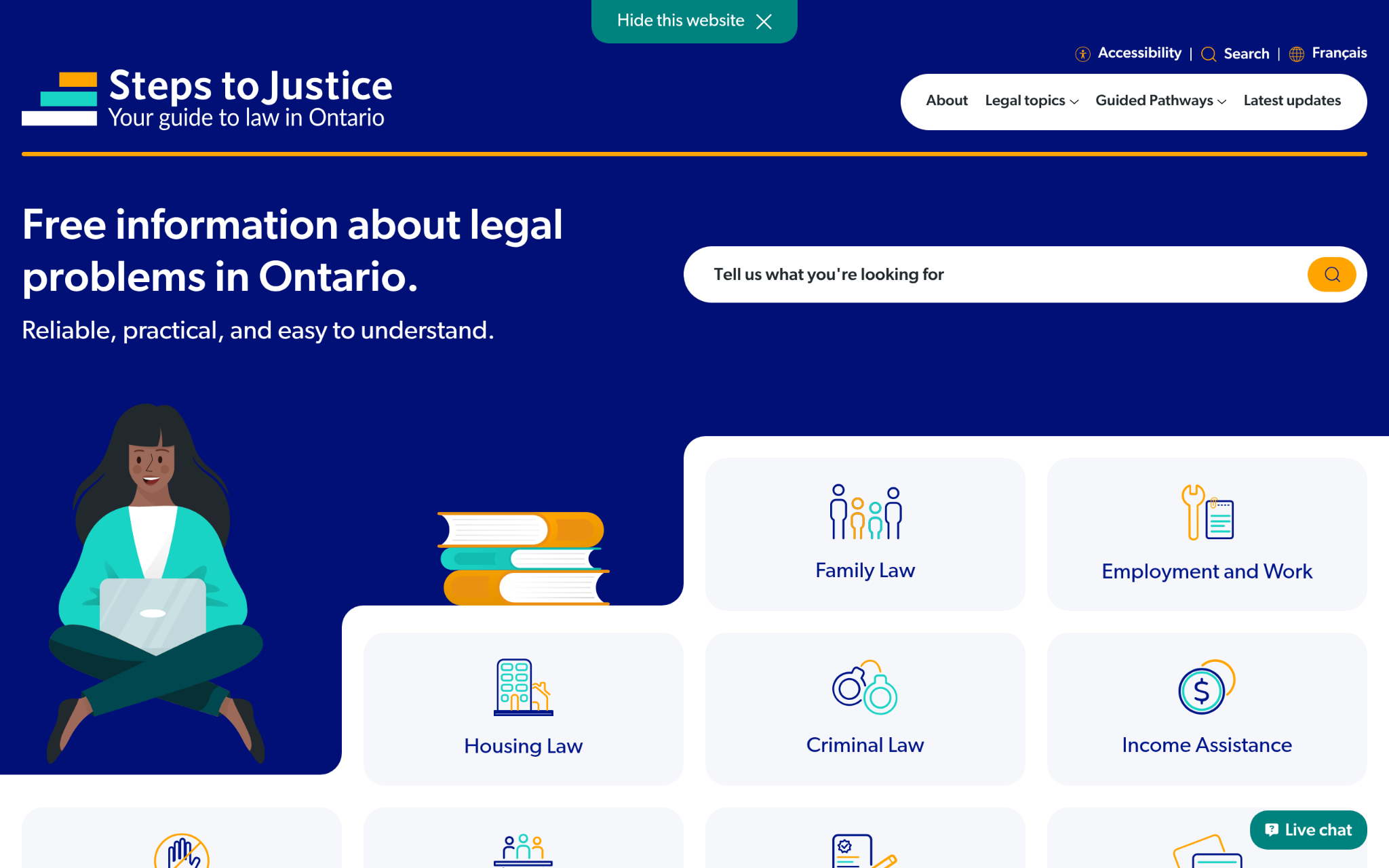
- Best for: Ontario residents who want free, plain-language legal information before deciding how to proceed
- Standout: Created by Community Legal Education Ontario (CLEO); includes checklists, fillable forms and referral information for legal and social services
- Pricing: Free
- Coverage: Ontario only
Steps to Justice is a legal information website, not a document-generation platform. CLEO launched it in 2015 with support from the Ministry of the Attorney General, Legal Aid Ontario, the Law Society of Ontario, and Ontario’s court system. It covers family law, housing, employment, human rights, and more; it also offers live chat and email support during business hours, Monday through Friday.
And it’s genuinely useful, particularly for someone who doesn’t yet understand what a cohabitation agreement does, what Ontario’s default common-law rules are, or where to find a community legal clinic. But Steps to Justice doesn’t generate agreements and doesn’t offer legal advice. It provides information so people can make better decisions with whatever services or lawyers they engage next. Anyone outside Ontario will need to look elsewhere; the French-language equivalent, Justice pas-à-pas, serves Ontario’s Francophone population.
5. Lexpert

- Best for: Couples or their lawyers looking for ranked, peer-reviewed Canadian lawyers by practice area
- Standout: Annual peer survey completed by over 13,000 lawyers; rankings cover specific practice areas and industries across Canada
- Pricing: Free to search the directory
- Coverage: Canada-wide
Lexpert has published Canadian lawyer rankings since 1994. Each year, more than 13,000 lawyers confidentially rate their peers across practice areas including family law, and those ratings feed into Lexpert’s published rankings. The platform also produces themed special editions and hosts industry events like the Canadian Law Awards. It’s owned by Media Business Information.
Lexpert isn’t a document service at all. It’s a research tool, the one lawyers and experienced clients turn to when they want to identify a well-regarded family law practitioner in a specific city or province. For couples who’ve decided they want full custom drafting rather than an online platform, or who have complex finances, children from prior relationships, or unusual asset structures, Lexpert is a practical place to start finding the right lawyer. It won’t generate an agreement and won’t quote fees for any particular lawyer; those conversations happen directly with the firm.
Bottom Line
The best cohabitation agreement services for Canadian couples in 2026 range from free legal information tools through to flat-rate lawyer-drafted platforms, with AI-assisted template generators sitting in between. The right pick depends on what a couple actually needs:
- Free information and referrals: Steps to Justice
- A low-cost starting draft to bring to a lawyer: Good Terms
- Cross-border prenup or postnup coverage: Prenups.ai
- A ranked family lawyer referral for complex situations: Lexpert
- A province-specific agreement built from lawyer-written clauses without full custom-drafting costs: the lawyer-drafted online builder covered in entry one above
Independent legal advice is recommended in every province and required in Alberta. Whichever service a couple starts with, both partners should have the finished agreement reviewed by separate lawyers before signing, that step is what makes enforceability realistic, not just possible.