



Customers make up their minds fast. According to a 2023 BrightLocal consumer survey, 98% of people read online reviews before choosing a local business, and Google reviews carry more weight than any other source. For businesses trying to stand out, the right review management platform can be the difference between a steady stream of new customers and a stagnant listing no one clicks.
Why Google reviews matter for building customer trust
Google reviews matter more than just vanity. They influence local search rankings, shape first impressions, and tell potential customers whether a business is worth their time before a single conversation happens. A business with 12 reviews and a 3.8-star average looks very different from one with 200 reviews and a 4.7, even if both offer identical services.
The trust factor runs deep. Shoppers, patients, and clients treat peer reviews as personal recommendations from strangers who had nothing to gain. And with Google’s local search algorithm factoring in review count, recency, and response activity, letting a profile go stale isn’t just a reputation problem, it’s a visibility problem.
What to look for in a review management platform
The best Google review platforms for improving customer trust share a few qualities worth checking before committing to one.
Start by examining how a platform actually collects reviews. SMS-based invitations beat email by a significant margin in open rates, so the delivery channel isn’t a minor detail. Check next whether AI-assisted drafts are on offer, both for customers writing reviews and for businesses composing replies, since responses that reference the real service or location signal to Google that someone’s paying attention. Third, does the platform fit into existing workflows, connect to tools already in use, and how long does setup genuinely take? Pricing transparency and trial availability matter too; any platform that won’t let a team test it before paying deserves real skepticism.
1. Reviewly AI
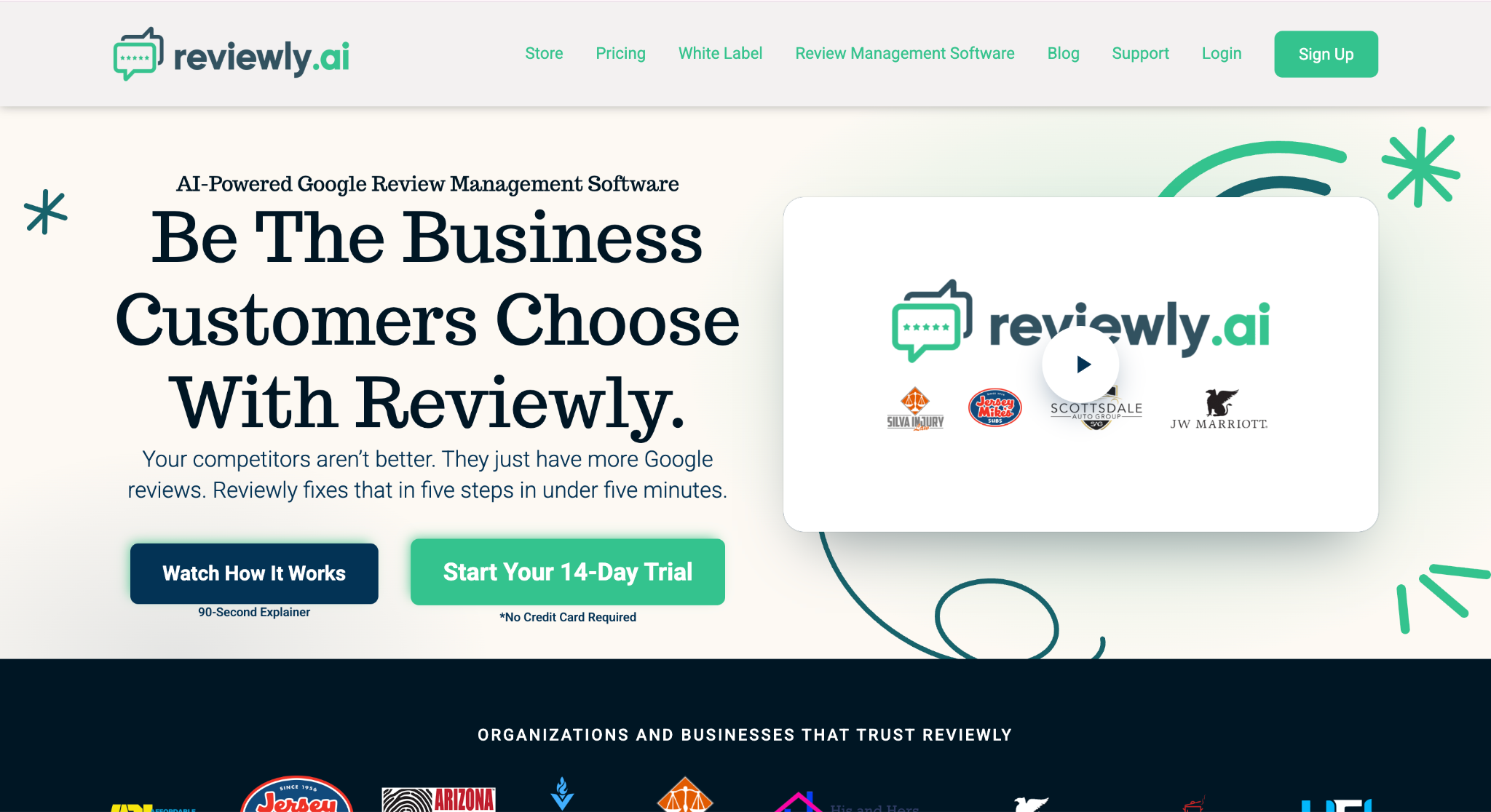
Reviewly AI is a Google review management platform built exclusively for Google Business Profile. It focuses on local service businesses – med spas, contractors, dental practices, HVAC companies, restaurants – as well as multi-location brands and marketing agencies that need a white-labeled solution to sell to clients.
What it does: Reviewly AI sends one-way SMS review invitations through a dedicated Twilio number, presenting each customer with three AI-drafted review options to pick from and edit before posting. When a new review arrives, the platform generates AI-drafted responses for the business owner that reference the specific service, location, and customer experience, not a generic reply. Setup takes about 90 seconds across three clicks.
Where it shines: The SMS open rate is company-reported at 97 to 98%, which is much higher than email-based request tools. Agencies get full white-labeling, custom subdomain, branded dashboard, Stripe billing, and clone-and-deploy client setup, included at the base agency plan with no upsell tier. Direct integrations include GoHighLevel, HubSpot, Stripe, Zapier, QuickBooks, and Jobber. One-way SMS requests now reach customers in more than 100 countries as of the Spring 2026 release, with automatic AI language detection built in. A HIPAA-compliant option is available for regulated industries.
Pricing & plans: Single-location plans start at $99 per month, with a 14-day free trial. White-label agency plans start at $199 per month for up to 50 client locations, with a 7-day free trial.
2. MagicReview
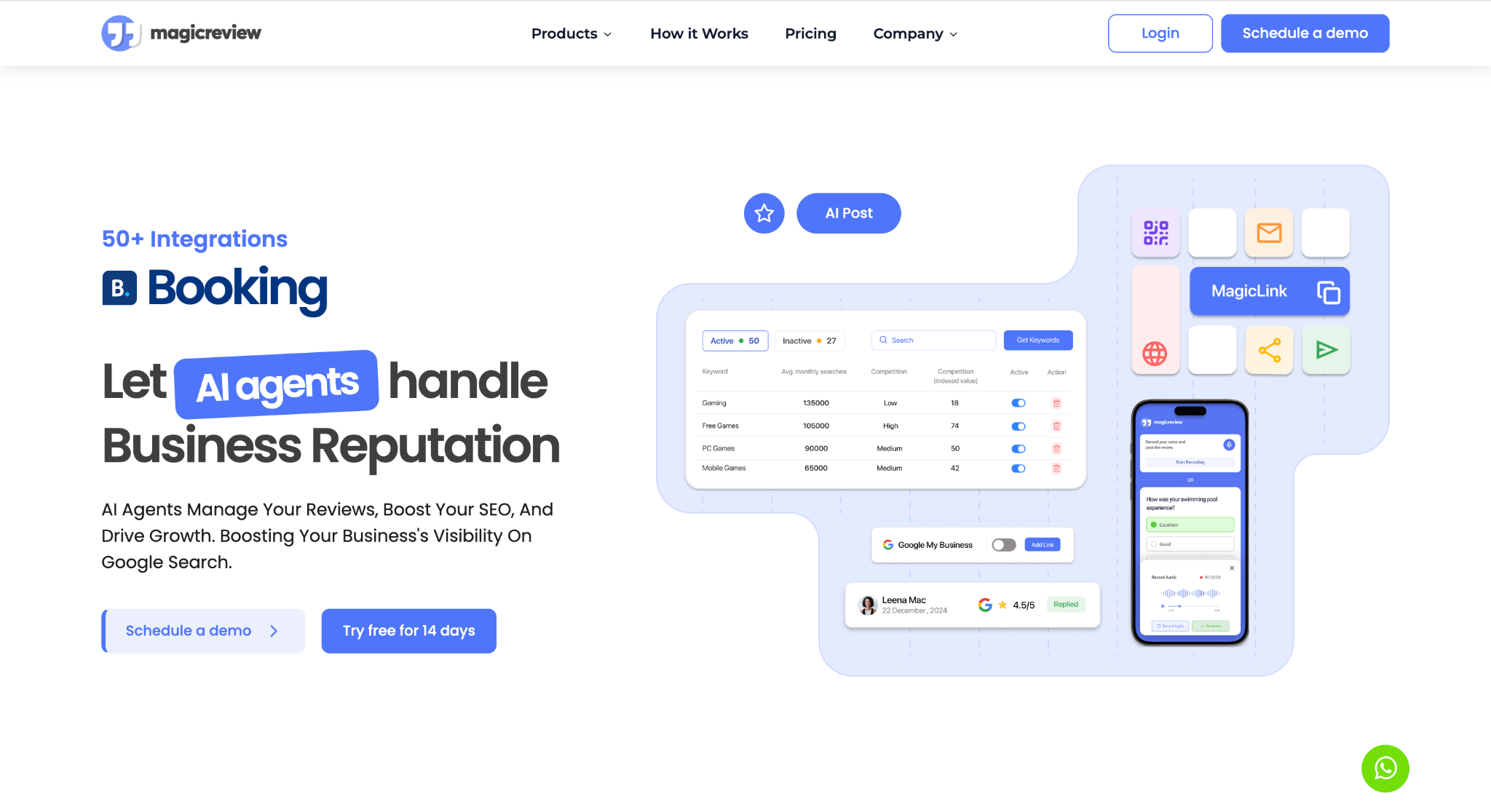
MagicReview is a review collection platform founded in 2020 by Saurabh R. Patil and Abdul Nihaf, designed to help businesses of all sizes grow their online presence through Google reviews.
What it does: The platform’s workflow uses a QR code: a customer scans it with their phone camera, selects a star rating from 1 to 5, and for 4 and 5-star ratings, receives AI-generated, SEO-friendly review suggestions ready to post on Google. For ratings below 3 stars, customers submit feedback through a private form instead, which routes directly to the business owner’s dashboard. It’s a straightforward funnel that keeps negative sentiment off the public record while capturing high-intent reviews efficiently.
Where it shines: The QR-code-first approach works well for walk-in businesses that don’t always collect a customer’s phone number. The AI-generated suggestions are positioned as SEO-friendly, which may help review content contribute to local search relevance.
Pricing & plans: Specific pricing details aren’t publicly confirmed. MagicReview reports serving 30-plus businesses; detailed client case studies and exact plan structures aren’t available in public sources. Teams evaluating MagicReview should request current pricing directly from the company.
3. Repmanager
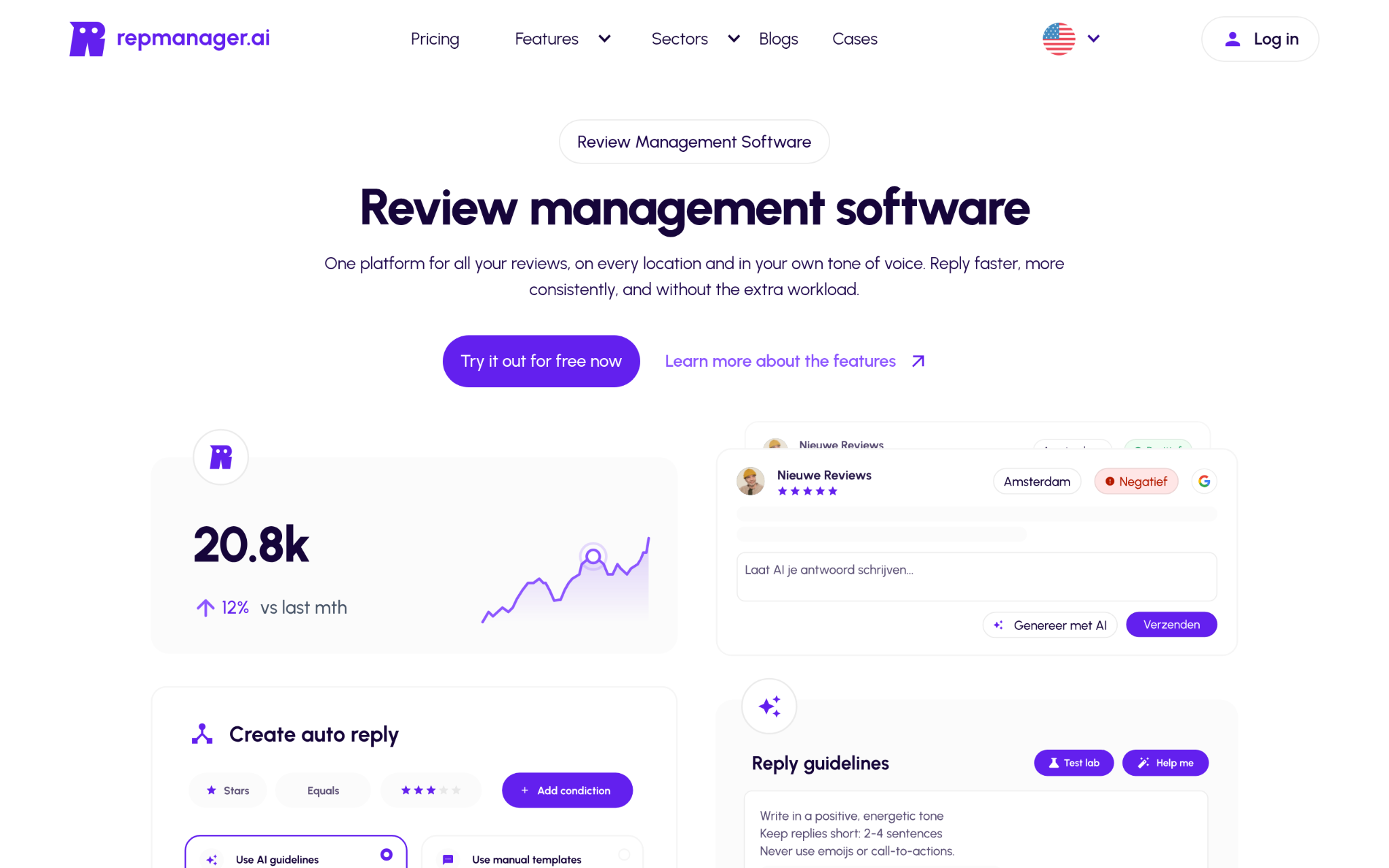
Repmanager is a Google review management platform founded in 2024 and headquartered in the Netherlands, built primarily for multi-location businesses and agencies operating across distributed local markets.
What it does: The platform consolidates Google Reviews from multiple locations into a single dashboard. AI-based sentiment analysis categorizes incoming reviews and suggests response drafts based on tone and content, teams can review and adjust before publishing. Users can also train their own AI model on their preferred response style. The multi-location view makes it practical for franchises, retail chains, automotive dealers, and hospitality businesses where local reputation varies by branch.
Where it shines: Repmanager supports performance comparison across locations and generates actionable reports, which helps regional managers spot which locations are excelling and which need attention. Beta access users rated the platform 4.8 out of 5 stars. The flexible subscription cancels anytime with no automatic renewals.
Pricing & plans: Pricing starts at $10 per month for the single-location tier. The Pro tier covers multi-location businesses and agencies. A 7-day free trial provides access to one location and 25 AI replies.
4. Reputation
Reputation (formerly ReputationDefender, founded in 2006 by Michael Fertik) is an enterprise-grade reputation management platform headquartered in San Ramon, California. It serves large organizations across healthcare, automotive, financial services, and retail.
What it does: Reputation’s SaaS platform monitors and responds to online reviews, social media, and surveys; analyzes customer sentiment; and surfaces insights teams can act on operationally. It covers Google alongside dozens of other review sources and directories, making it a multi-source tool rather than a Google-only solution.
Where it shines: The platform’s scale is impressive. Clients include Banner Health, BMW, Ford Motor Company, Hertz, General Motors, Sutter Health, and US Bank. Caraday Healthcare boosted review volume by 200% and improved its Reputation Score by 217 points in one year; Intermountain Health tripled organic leads and increased review volume by 510% in one year. Reputation has been ranked #1 in 26 G2 reports and holds over 500 Leader Badges since 2018, including recognition as a 2024 Best Software Award winner.
Pricing & plans: Reputation targets enterprise buyers; pricing is not publicly listed and requires a direct inquiry. Organizations with complex, multi-source needs and dedicated reputation teams will find the most value here.
5. rayyan
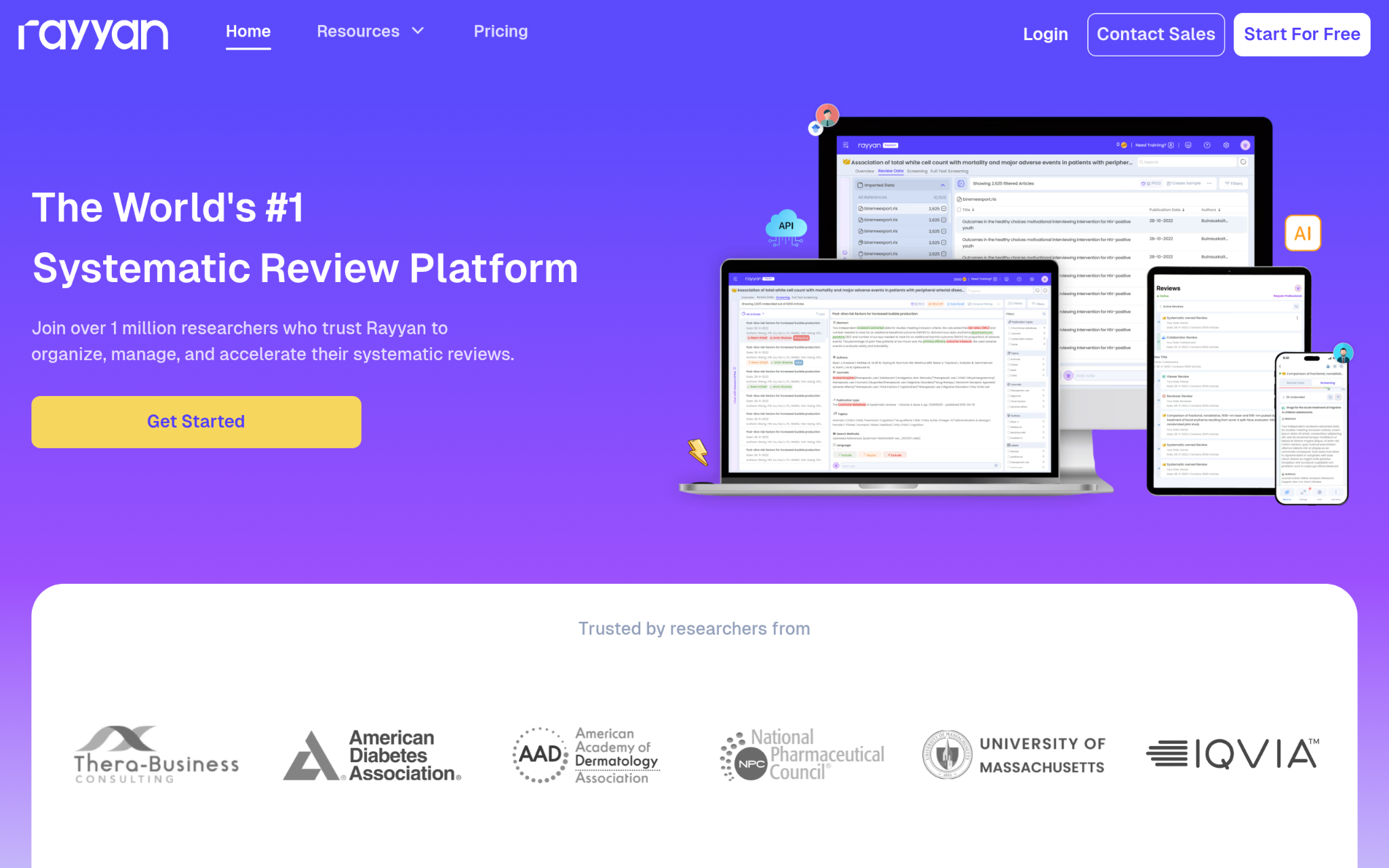
Rayyan was founded in 2020 by Robert Ayan and is headquartered in Cambridge, Massachusetts. The platform serves a different audience than the other tools on this list, it’s a research collaboration platform built for systematic literature reviews, not a business reputation tool.
What it does: Rayyan uses natural language processing, AI, and machine learning to help researchers screen and analyze academic literature. Features include advanced deduplication, PICO extraction (which automatically identifies Population, Intervention, Comparison, and Outcome elements in studies), and AI agents that assist with article screening and data extraction. The platform runs as a web and mobile SaaS tool compatible with distributed teams and offline work.
Where it shines: Rayyan reduces literature screening time by up to 90%, according to the company. Over 300,000 researchers across 180 countries have used it to review more than 700 million research articles. Users include teams from the Cochrane Airways group at St. George’s University of London and Adelaide Health Technology Assessment.
Pricing & plans: Specific pricing details aren’t publicly confirmed for Rayyan’s current plans. Teams in healthcare research, evidence-based medicine, or systematic review workflows are the intended users, not local businesses or marketing agencies.
Bottom Line
The right Google review platform depends heavily on scale and use case. SMS-based collection tools with AI drafting are a strong match for local service businesses and agencies wanting to automate Google Business Profile growth. Multi-location dashboard tools suit franchises and retail chains that need to compare performance across branches. Enterprise platforms like Reputation are built for large organizations running complex, multi-source review operations. And research-focused tools like Rayyan serve an entirely different function, they’re relevant for institutions conducting systematic literature work, not for managing local reputation. Getting that match between platform and actual workflow is what makes the real difference.