


Home > Speaking > POWERFUL Presentations
Presenting information to a crowd in way that engages, inspires, and moves audiences to act is an art form. If you can learn to present powerfully, you can teach, motivate, persuade and help people remember your most important ideas.
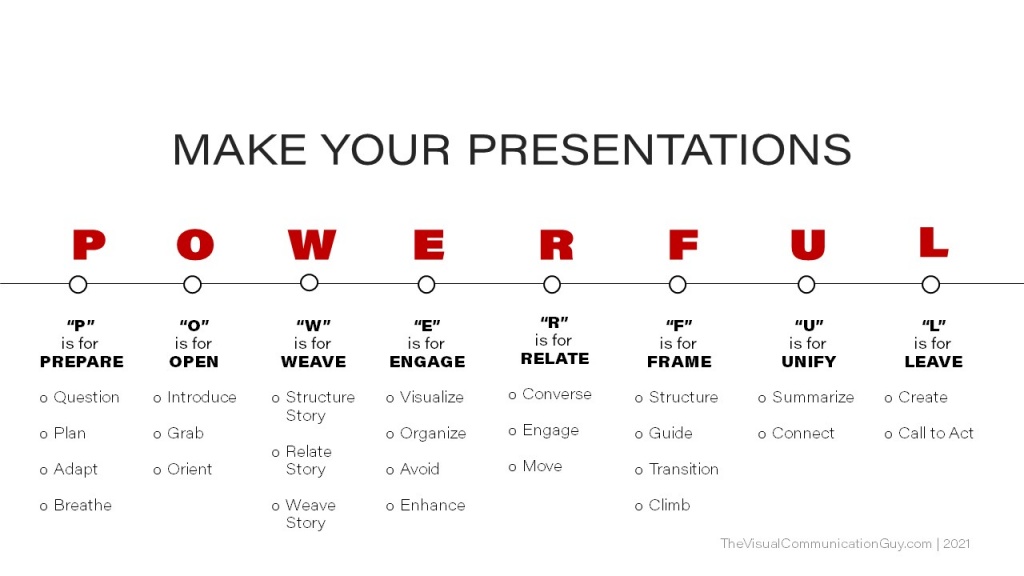
The good news is, becoming an amazing presenter doesn’t have to be all that complicated. Sure, good presentation skills come with time and practice, but the fundamentals for what makes presentations powerful can be summarized into a simple 8-part acronym that follows that very theme: P.O.W.E.R.F.U.L.


The P.O.W.E.R.F.U.L. Approach to Presentations
There is no one right to give a presentation and there is no perfect formula or step-by-step process. As you adapt to your audience, you’ll need to modify the content, structure, design, and experience. That said, there are several things that are proven to make presentation work when done well. Read more about using the P.O.W.E.R.F.U.L. acronym as an approach to presentation design, rather than as a process.

PREPARE for Your Moment
Before you put your presentation together, begin by asking questions about your key message, audience, and setting. Then, determine the purpose and presentation type. Start assembling ideas, adapting for your attendees and setting, and taking a deep breath to calm those nerves. Read more about preparing your presentation.

OPEN with Purpose
Start your presentation by introducing yourself and your topic. Then, grab their attention with one of ten ways to pull people in. Next, like giving a GPS to your audience, provide them a roadmap that orients them towards the direction you’re headed. If you get your audience started off on the right foot, they’re much more likely to stay with you throughout. Read more about great ways to open your presentation.

WEAVE in the Stories
One of the most effective, research-proven methods for helping people stay engaged, feel connected, and remember your presentation is to read stories. Be sure to use appropriate narrative structure and material that your audience can relate to, then weave in one or multiple stories at various points in your presentation. Read more about weaving stories into your presentation.

ENGAGE with Visuals
It’s a proven fact: people understand, process, and remember visuals better than they do text, numbers, or data alone. If you want to create memorable, impactful presentation, be sure to visualize your slides, organize your deck, and avoid design and visual faux pas. Read more about how to engage your audience with well-designed slides.

RELATE with Delivery
When audiences attend a presentation, content alone will rarely be enough to make a lasting impression. As the presenter, you need to relate to your audience, to connect with them. To do this, you’ll want to be strategic about your language and tone, your eyes and emotion, your body language and posture, and the way you move. Read more about how to relate with your audience.

FRAME the Message
Like in a good movie, where every scene helps build towards character development, a climax, and resolution, your presentation should be structured to build and climb towards a final destination. To do this, you’ll need to have a clear beginning, middle, and end. Start strong, then use signposts and transitions throughout, always building towards a clear and powerful finish. Read more about how to frame your message.

UNIFY the Parts
As you review the script of your presentation, you’ll want to ensure that there are no loose ends, that everything comes full circle, and your audience isn’t left to guess or wonder about key parts of your takeaway message. Summarize your key points, bring the beginning back, and connect all the dots. Read more about how to unify the parts of your presentation.

LEAVE with Power
Last, but certainly not least, you’ll want to be sure that you end your presentation with a clear, well-thought-out final statement. This may be a powerful statement you developed, an important and thought-provoking quote that summarizes the message, another short story, or a contrasting statement. You can also leave a call to action, getting people to start acting upon this new information right away. Read more about how to leave your presentation with power.
Prepare for Your Audience
Know who they are, then give ‘em what they want. Knowing your audience and what they expect is the most important aspect to a successful presentation.
- Who Are They? What’s their education? Occupation? Position in the company? Age? Background? Experience?
- Why Are They There? Do they expect formality or informality? How long do they expect you to speak? Are they expecting to be instructed, inspired, or something else?
- Why Are They There? Did they choose to be there or are they required to be there? Are they happy about it? Will they likely be tired, excited, nervous, or something else?
Open with Vigor
Grab ‘em early, and keep ‘em hooked. Start with pithiness and punchiness and you’ll enjoy the fruits of a captivated crowd. Here’s a list of the ten best ways to open with awesomeness:
- Tell a Story. Human beings love stories. A lot.
- Use Impressive Statistics. Not just any statistic. A “wow” statistic.
- Say Something Provocative. Make ‘em think. Or squirm. Just back it up.
- Tell a Relevant Joke. Make sure it’s funny. And relevant.
- Develop an Imaginative Scenario. “I want you to close your eyes. Now imagine…”
- Pull Out an Object. If it’s interesting, let ‘em see it.
- Do a Demonstration. Show ‘em how it’s done. Don’t just tell ‘em.
- Share a Personal Anecdote. You’ve been there, done that. So share it.
- Give a Quote. A good quote. One that makes you think.
- Ask a Question. Get ‘em involved. Wait for their response.
Weave in the Stories
If you tell it, they will listen. People love stories. They like to know how stories end. They’re intrigued by the plot, the conflict, the conclusion. If you ever seem to be losing your audience, just say, “let me tell you a story.” Watch in amazement as they suddenly perk up and listen. Of course, make sure the stories are relevant and have a purpose. Good stories have five things:
- Purpose: The story must have a purpose. What will your audience gain from the story?
- Reality: Make it real. Don’t make things up or exaggerate. Use real people, real places, real problems.
- Characters: We need somebody to cheer on. Care about. Root for. Give personality and put it in context.
- Conflict: What’s the issue? Build the whole story around it.
- Resolution: Don’t leave ‘em hanging. Let ‘em know how it ends.
Express with Visuals
Think you’re a visual learner? You are. Think your audience might be as well? They are. People remember information almost twice as well if an image is attached to the message. Text isn’t near as effective. Make your slides simple, congruent, and beautiful. And use lots of pictures and simple diagrams.
- Simplify the Slides. Reduce the text to few, if any words, per slide. No paragraphs, limited bulleted lists, and no complex charts, tables, or data sets. Use very simple backgrounds (plain white or black is a good option). Simple is almost always better.
- Use Relevant Pictures, Not Goofy Clip-art. Use images of people, things, and processes that are relevant and interesting. Avoid cheap, pixelated, and unrelated or non-useful stock photos and clip-art.
- Be Design Savvy. Use two fonts—one for headings, one for everything else. Repeat a visual element on every slide (like a logo or thematic icon). Make colors match and reduce all visual noise.
Relate with Delivery
Relate to your audience and they’ll relate to your message. Be smooth, be confident, be extemporaneous.
Do:
- Make eye contact
- Smile often
- Move naturally
- Speak loudly
- Intonate your voice
- Keep good posture
Don’t:
- Look at notes, screen, or elsewhere
- Appear bored or uninterested
- Have awkward nervous ticks
- Speak softly or mumble
- Sound robotic, choppy, or monotone
- Slouch, lean, or sway
Frame the Content
Give it structure, keep it organized. Let your audience know where you’re headed, where you’re at, and where you’ve gone. Transition, layer, and build towards a finish.
- Provide a Road-map & Stay on Course. Shortly after beginning, tell ‘em where you’re headed. Then stick
to the plan. No veering off, no tangential excursions. - Give ’em Signposts. Remind your audience where you’re at and where you’re headed. Take them smoothly to the next point. “This brings up…,” “now to switch gears from_____, let’s move to…,” “so we just did_____; I want to now…”
- Build towards the Finish. Know your ultimate goal and head towards it. Each section of your presentation should build on the previous. Don’t bounce back and forth, avoid repetition.
Unify the Message
Bring ‘em home and tie it together. You’ve covered an array of things—now let’s hear how they call connect.
- Bring the Beginning Back. End where you started. Come full circle. If you started with a story, remind ‘em the purpose. If you gave a statistic, tell ‘em how it makes better sense now. Wherever you started, pull it back in.
- Summarize Key Points. Remind your audience what the main points are. Keep it simple. Narrow the focus into three or four things, reiterating what you told them bore, only much quicker.
- Connect the Dots. You’ve told a few stories, laid out some facts and statistics, explained a process or. But don’t leave anything left wanting. Connect the dots for your audience and they’ll leave filling fulfilled.
Leave with a Punch
Finish strong. Make it clear you’re done so they know when to clap. Don’t ever finish by just saying “thanks” or “I’m done” or “that’s it; any questions”? Lead into the “thanks” and ask for questions after your pithy close.
- Call ’em to Action. If appropriate, give your audience something to do. It may be as broad as changing the world or as specific as changing their toothbrush. But make it clear and make it count.
- Make a Contrast. “We can do _____ or we can do _____ ; which will you decide?”
- Tell Another [short] Story. Give an anecdote that puts emphasis on the message. Make it
short, but make it powerful. - Give a Good Quote. Find a quote that is relevant, credible, and awesome. Leave
your audience with something to ponder and post on their fridge.