

Giving P.O.W.E.R.F.U.L. Presentations: “O” is for “OPEN with Purpose”
HOME > SPEAKING > POWERFUL PRESENTATIONS > “O” Is For OPEN
The “O” in your POWERFUL presentation is for “Open with Purpose.”
The way you start your presentation is critical. Most audience members will determine within the first 30 seconds of you speaking if they’ll be interested in what you have to say. To start off on the right track, you’ll want do three things: introduce yourself, grab their attention, and orient them for what’s coming.
Opening to Your Presentation: Three Parts
1. First, Introduce Yourself and Your Topic

Start by Introducing Yourself
If you’re presenting to an audience where even some in attendance do not know you, you should always start by introducing yourself. This doesn’t need to be long, but it should include three things:
- your name;
- the organization or department you represent; and
- why you’re there.
Introducing yourself does a few things. First, if you’re feeling nervous, it can help you calm your own nerves. It allows you to take a minute to talk, to breathe, and to share information that is easy to share. Second, it helps break the ice with audience members, removing any possible awkwardness or uncertainty. Third, it clarifies why YOU. Why you’re credible and why you’re there.
A quick example for introducing yourself: “Welcome everyone! [Smile] So great to be with your today and I’m thrilled you’re here. I’m Richard Steffensen, Director of Packaging Science & Design at Haywater Institute. My my goal today is to help you get even more excited about taking your new products to the next level!”
Then, Introduce Your Topic
In addition to introducing yourself, you’ll want to address your topic. While your audience may already be expecting your topic, it’s important that you remind them exactly what you’re going to be covering. Make sure that you clarify right from the beginning what you’ll be covering. This can be a somewhat broad statement, but it should encapsulate the main idea of your presentation. Audience members should have a pretty good idea about what they’ll generally leave knowing more about from the very first minute or two.
A quick example for introducing your topic: My topic today, as you can see on the screen, is “Placement/Design: The Power of Positioning and Shape to Attract Customers. In the next 30 minutes, we’re going to cover a sophisticated—and really cool—packaging position and display process.”
2. Second, Grab the Audience’s Attention

Grabbing an audience’s attention in the first couple of minutes isn’t just nice. It’s critical. And this goes for any presentation, any topic, any purpose. Even if you’re presenting highly technical information or relaying numbers and research, you must work to make the presentation relevant and engaging. You must give the audience a reason to care and you do this by first grabbing their attention and making your subject matter meaningful to them. Attention is a commodity that isn’t automatically given. You have to earn it.
Fortunately, there are at least 10 proven tactics for pulling your audience in right away: stories, anecdotes, statistics, provocative statements, jokes, scenarios, objects, demonstrations, quotes, and questions. You’ll only need one of these to get your presentation started. Let’s break down how you might approach each.
Tell a Story or Personal Anecdote
Storytelling is widely considered the most effective, reliable way to grab an audience’s attention. Human beings are storytellers. But here’s what’s remarkable: even if a story isn’t all that interesting, we are naturally curious how it ends (just think of those awful movies you’ve watched, but still had to know how it ended). User experience expert and neuropsychologist Susan Weinschenk has even observed that you can effectively rely on saying six magic words to automatically get people to look up and pay attention: “Let me tell you a story.”
Whenever possible, start your presentation with a story or personal anecdote (a story about your own life and experience). No matter your topic—even if technical, scientific, or data-focused—if you start with a story about how your topic affects something (like people, budgets, the planet, etc.), people are likely to listen, drawing them into your broader message.
Storytelling is so important, it gets its own letter in the POWERFUL approach. See “W” is for “WEAVE in the Stories.”
Use Impressive Statistics or Provocative Statements
If you’re not using a story, impressive statistics and provocative statements can also work. BUT, TAKE NOTE: not just any statistic will do and provocative statements must not be offensive.
Statistics: When staring with a statistic, it needs to be impressive, meaningful, and relevant. The audience needs to make sense of it and it needs to matter. Saying something like, “Did you know there was a 13% drop in automobile-related deaths last year” isn’t all that interesting. Rather, re-frame the data to something the audience can feel moved by:
“Did you know that, per capita, fewer people lost their lives by automobile accidents this year than any other year since 1964? Whereas a year ago, with our data, we would have said someone in this room was likely to die of in a car accident, if the trends continue, we’d have to have 15,000 more people in this room to make that statement.”
See how that second statement makes the statistic more meaningful? It’s the same data, just re-framed. Aim for that!
Provocative Statements: You can also grab the audience’s attention by saying something they likely don’t agree with or that sounds somewhat alarming. Don’t be tacky about it by using “bait” phrases and don’t be offensive. But think about your audience and what might surprise them or perk their ears. For example, Steve Jobs once did this in his 2005 commencement speech. Speaking in front of thousands of graduating college students—who had spent a fortune and a lot of time and stress to graduate—and in front of university administrators and faculty, he said,
“After six months, I couldn’t see the value in [college]. I had no idea what I wanted to do in my life and no idea how college was gonna help me figure it out. …So, I decided to drop out. …Looking back, it was one of the best decisions I ever made.”
Steve Jobs’ comments drew both laughs and raised eyebrows. But they also grabbed attention. They weren’t overly offensive, but they did make people curious. Did he really say that? To us? Will redeem himself?
Yes, he did. It’s widely considered one of the best commencement speeches on record.
Tell a Joke or Create a Scenario
You can also start a presentation by telling a joke or creating a scenario for your audience to imagine. But, like with provocative statements, jokes must be relevant and they must NOT be offensive. Scenarios should be interesting and the should NOT require the audience to “close your eyes and imagine…”
Jokes: People love humor. If you can get people laughing, they’re likely to listen. But to make jokes work, they have to be 1) funny; 2) relevant; and 3) clean. The first seems obvious, but it’s harder than you might think. If you’re not a real funny person (I’m usually not in front of crowds), you might not want to go there. There’s nothing more embarrassing that trying to tell a joke in front of a crowd when they don’t laugh. Second, though, the joke should be related to your topic. Don’t just say a joke for the joke’s sake. Make it segue into what you’re going to be talking about, which will be far more memorable. Third, don’t say anything offensive. No foul language. Nothing sexist. Nothing that insults people, religions, cultures, etc.
A good example of a joke comes from Pamela Meyer’s TED talk, “How to Spot a Liar.” She starts her presentation off with this joke:
Okay, now I don’t want to alarm anybody in this room, but it’s just come to my attention that the person to your right is a liar.
The joke was funny. And it segued nicely into her topic.
Scenarios: Sometimes, you might want to start your presentation by placing your audience in a specific scenario, helping them understand an emotion, situation, or state of being. Just don’t tell your audience to close their eyes and imagine. Audience members usually feel awkward doing this to the point that they don’t focus on what you’re actually saying. Plus, it feels cheesy to adult audiences. Still, though, you can set up a story.
Consider Ric Elias’ TED talk, “3 Things I Learned While My Plane Crashed.” He sets up a scenario for his audience:
Imagine a big explosion as you climb through 3,000 feet. Imagine a plane full of smoke. Imagine an engine going “clack, clack, clack.” It sounds scary. Well, I had a unique seat that day. I was sitting in 1D.
The scenario is relatable to anyone who has been on a plane. We can all imagine ourselves sitting in that seat. Now we want to know the rest of what Elias has to say!
Use Objects or Demonstrations
People are also engaged by seeing interesting objects or watching live demonstrations. Objects are good for creating metaphorical connections between abstract ideas. Demonstrations are good if you have really interesting thing to show.
Objects: You can use just about anything, but you’ll want to make it interesting. You can use a plain glass bottle, for example, but then add liquids and talk about the role of the bottle and the color of the liquids, in relation to your topic. Maybe something about control? Or unity? The idea is that you can use objects to pull people into a topic that may not be as interesting or as immediately clear. Bring in a cool sword or a Rubic’s cube or a chess set. Now tie that into your topic.
Demonstrations: If you have a unique skill (or you can bring someone in that does), you might consider showing it and then tying it into your presentation. Maybe you’re a skilled chef and you want to do a veggie-cutting demonstration. Or maybe you do speed origami or jump roping. If you can demonstrate something, then smoothly tie that into your topic, it can make for a really interesting attention-grabber.
Saying Quotes or Asking Questions
Your final options for grabbing attention are to say thought-provoking questions or ask interesting questions. The key words here are “thought-provoking” and “interesting.” Just saying a regular quote doesn’t do much, even if it’s famous or inspiring. The quote needs to make people think. Same with questions. Don’t just ask any old question. Ask one (or several) that get people thinking about the topic.
Quotes: It isn’t enough to state a quote by a famous person to grab someone’s attention. The quote has to be phrased or written in such a way that people say to themselves, “Huh. That’s really interesting. They have a good point. Never thought about it like that.” Quotes used for attention-grabbers tend to work best if they’re thought-provoking, directly relevant to your topic, and from real people (rather than from a movie or book character).
Consider the quote by Jonathan Safran Foer and how it makes us think:
“If we were to one day encounter a form of life more powerful and intelligent than our own, and it regarded us as we regard fish, what would be our argument against being eaten?”
Or, consider this quote by Ruth Ozaki:
“Information is a lot like water; it’s hard to hold onto, and hard to keep from leaking away.”
Find quotes that are pithy, meaningful, and make people want to know where the rest of your presentation is headed.
Questions: You can also ask your audience questions. But don’t ask questions where the answer is obvious, like, “How many of you believe that murder is bad?” Rather, ask questions that pull people into your topic. Maybe something like this, with follow-on questions:
“How many in this room consider yourselves artists?” “How many in this room have taken a college graphic or document design?” “How many of you write emails?” Did you know that every time you write an email, you are making artistic, design-centered decisions? We’re all artists. And we need think of ourselves that way if we’re going to be better communicators.
3. Third, Orient Them for What’s Coming
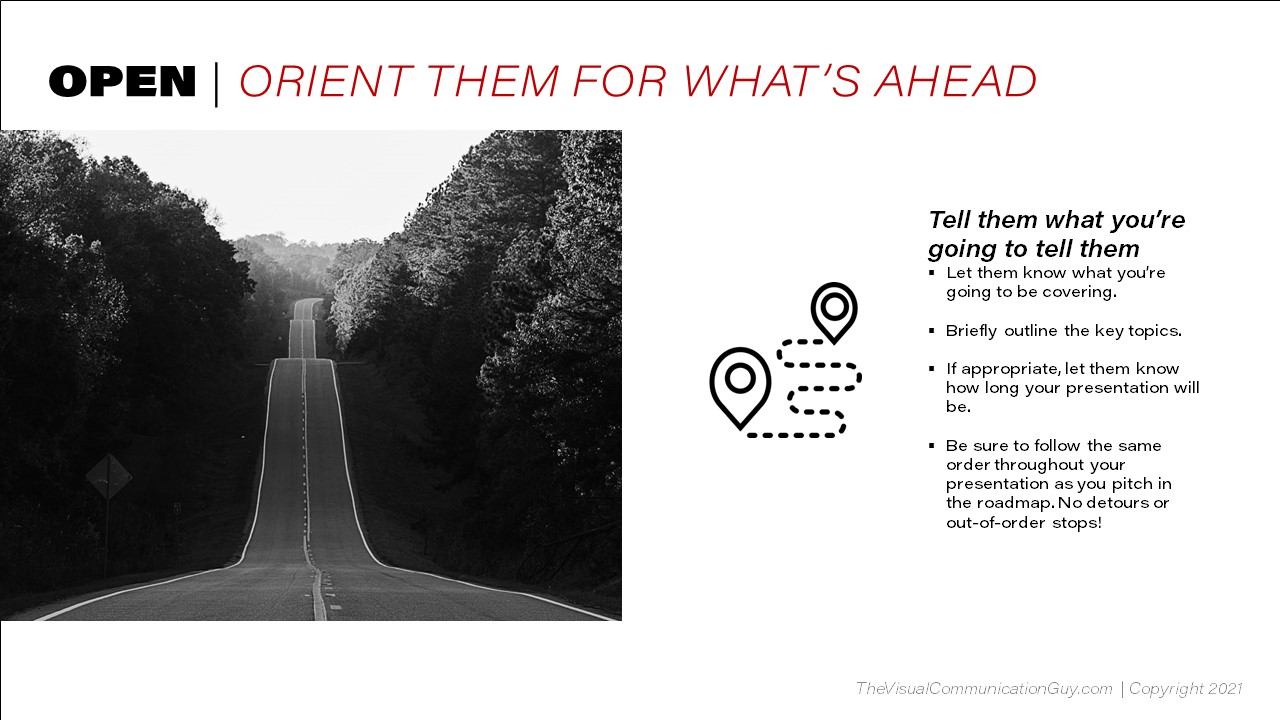
The third and final step in creating a memorable opening to your presentation is to orient your audience. You’ve already introduced yourself and your topic. And you’ve given an amazing attention-grabber that makes your topic both relevant and interesting to your audience. Now you just need to tell them where the presentation is headed.
People like to know what to expect. If you can give them some direction—and then follow that path throughout—your audience members are more likely to feel comfortable with the trajectory, more likely to pay attention, and more likely to remember what it is you had to say. Plus, it just makes you look more prepared and professional if you give your audience a roadmap, then stick to the plan.
“Roadmap” is often a term we use in public speaking because it suggests a route—a planned direction with a destination in mind. It also suggests concepts like “signposts,” which are statements along the journey that tell your audience where you are on the map in relation to the destination.
Good orientations do three things, but not necessarily in any order:
- Reiterate the purpose or goal of the presentation.
- Remind audience of the length of the presentation.
- Provide a short outline (map) of the presentation.
In all, this part of the opening will typically take about 30 seconds, though that can vary depending on the length of your presentation. It will come right after your attention-grabber and it will sound roughly like this (but make it your own!):
In the next 30 minutes, we’re going to walk through what unintentional bias is [purpose and length of presentation]. By the end of the presentation, you should feel comfortable with what the term means, how it affects you individually and all of us here at work, and how you work to create a more inclusive workplace right away [goals of presentation]. First, we’re going to define the term. Then, we’re going to outline scenarios in which unintentional bias affects you and those around you. At the end, I’m going to show you some techniques to recognize when your own biases are affecting the way you interact with others.
There are, of course, many ways to state these orienting remarks. The key is just that you give your audience that roadmap and then you stick to the plan as you present your subject matter.
There’s an old adage in public speaking: “Tell them what you’re going to to tell them. Then tell them. Then, tell them what you told them.” That’s the full trajectory of your presentation. At the beginning, you just need to tell them what you’re going to tell them.
Conclusion
You may need to revise your opening as you develop the rest of your presentation. At the end of the day, what you’re going for is an opening that captures exactly what your presentation is going to be about. It puts your audience at ease, sets the mood, clarifies the purpose, grabs their attention and makes it relevant to them, and orients them so that they have a mental plan for what to expect. If you do this, you’re on your way to a powerful presentation.