

Giving P.O.W.E.R.F.U.L. Presentations: “W” is for “WEAVE in the Stories”
HOME > SPEAKING > POWERFUL PRESENTATIONS > “W” Is For WEAVE
The “W” in your POWERFUL presentation is for “Weave in the stories.”
Storytelling has been shown to be one of the most effective ways to do three things in presentations: 1) grab attention; 2) keep engagement; and 3) improve recall. Basically, if you want people to listen to and remember what you have to say, telling stories is a huge part of your secret sauce.
The word “weave” is intentional here. As best you can, work to weave a thread of a single story throughout, or work to weave in multiple stories within the same presentation. Either way, the more you draw in storytelling, the more memorable–and powerful–your presentation is likely to be.
Weaving in Stories: Three Things to Do
1. First, Apply the Story Structure

Somewhat surprisingly, to make stories work for your presentation, they don’t need to be all that remarkable or even exceptionally interesting. And they definitely don’t need to be long. Sure, it helps to tell a story that is dramatic, alarming, funny, or exciting, but even if you tell a relatively dull story, as long as you use the story structure—meaning, you follow a three-act narrative and you include characters, setting, plot, conflict, and resolution—you’ll likely still grab and hold the attention of your audience.
Why? Because people like stories. They’re drawn to stories. And…when a conflict arises, they just have to know how it ends. It’s part of the human DNA.
Study This Sample Story
Now, let me re-tell a story (in very abbreviated form) that was first written by author/designer Robin Williams (not the actor) in her book The Non-Designer’s Design Book. This isn’t a very interesting story. But it’s how she starts her book and I’ve remembered it for nearly twenty years since I first read it. As simple and basic as it is, it follows narrative structure and it makes the point clear:
Williams, as a grown adult, returns to her childhood home at Christmastime in California where she lived for 13 years. Someone gives her a tree identification book as a gift. She opens the book and sees a Joshua Tree, which the book tells her is native to her childhood home in California. She remembers thinking to herself, that’s a very odd looking tree! I’ve never seen one of those in my life! Then, she goes outside only to discover that there was a Joshua Tree in the front yard of her home where she grew up. And, there is a Joshua Tree on the property of four of the six houses in her cul-de-sac and on 80% of the homes in her neighborhood. That’s when she has an epiphany. We may be surrounded by something our whole lives, but until we can name it, we’re not conscious of it. And that applies to graphic design—once we can name some basic design principles, we’re conscious of them. Then, we can have power over them and become better designers.
See? Not very interesting. It’s about a woman who reads a tree book and finds one on her property, then has an epiphany. But her point is made very clear. And for me, an aspiring designer-communicator, it stuck with me.
So what makes her story work? It follows the three-act structure and it includes the five components.
The Five Components (Character(s), Setting, Plot, Conflict, and Resolution) and the Three-Act Story
Character(s): All stories must have a central character or set of characters. That can be you, other people, animals, or even inanimate objects. But the story must have a primary character (or set of characters) that somehow changes or is affected in the course of the story. In the story above, the character is the author, Robin Williams.
Setting: When you tell a story, the setting must be clear. To make Williams’ story make sense, we needed to know that the home she was visiting was one she lived in as a child for 13 years. That provides context. We know she’s in California, where Joshua Trees are native.
Plot: The plot is a series of connected events that provide clarity to the story. In our example, Williams comes home for the Christmas holiday, she is given a book, she thinks to herself that she’s never seen the tree before, then she walks outside to discover the trees.
Conflict: The conflict is an event—something that happens to the primary character—that needs some kind of resolution. Conflicts don’t need to be huge, alarming, or intensely negative (though they can be). They just need to be something where the audience says, “I wonder what happens!” In Williams’ story, she says she’s never seen one of those trees, but the book tells her it’s native to her area. That’s the conflict. There is a contradiction in her mindset with what the book is telling her. We want to know who is right! (Note that the conflict isn’t huge or even all that interesting; but we still want to know how this story ends.)
Resolution: The resolution is how the conflict is resolved. Even if the resolution isn’t what the audience hopes for, they need to be given a rough understanding of what happened. Leaving gaps or cliffhangers usually only frustrates audience members. In Williams’ case, the resolution is when she realizes that not only was she wrong—that she was surrounded by Joshua Trees her entire childhood—but that this is an applicable lesson in her life.
The Three-Act Story: Keeping the five components in mind, all stories should include three acts: a beginning, a middle, and an end. That sounds obvious, but it’s shocking how many people fail to provide either the beginning or the end of a story. It all has to come together to work. In Williams’ story, she sets up the setting and characters—her childhood home in California and people exchanging gifts (Act I); then she tells of opening the gift and feeling confused, drawing attention to the conflict (Act II); and she concludes by sharing her epiphany and resolving her internal conflict (Act III). It’s a simple but powerful formula.
2. Second, Make the Story Relatable

Once you have a story in mind and you have the structure and components built into it, ensure that it is relatable. “Relatable” means that audience members have some way of relating to it—that it’s understandable (it’s not too abstract or complex); that it’s something they’re familiar with, whether at work or in their personal lives; and that it somehow relates to your topic, even if metaphorically.
If you tell a funny story about your four-year-old sleepwalking, for example, it usually helps if audience members have had some experience with children (and most have) and that they know what sleepwalking is (and most will). The story must also relate to something broader about your topic. The cool thing is, even if your presentation is highly technical and about an engineering concept, if you can tie the two together, it’s usually a winning formula. Perhaps you can talk about how the child subconsciously activated—and began using—the vacuum. That might morph into a broader topic about the value of user experience and designing so that even partially conscious four-year-olds can understand the mechanics.
Consider a short story about an engineer. Who is the audience for this story, how will it relate to them, and what might the broader point or takeaway be?:
In 1985, mechanical engineer Roger Boisjoly was working for Morton-Thiokol, the manufacturer of the solid rocket boosters for the Space Shuttle Challenger program. He had been conducting research on O-rings and determined that if a space shuttle were to launch in cold weather, it could harden the rubber enough to potentially fail, thus causing a catastrophic disaster.
He sent several memos to his managers over the next year, but was apparently ignored. When NASA announced the launch was to be on January 28, 1986, Boisjoly tried to stop the flight. Temperatures were predicted to be -1 C (30 F) overnight, which Boisjoly predicted would be too cold for the rubber o-rings and that they would fail upon launch. Morton-Thiokol discussed the matter and determined to notify NASA to postpone the launch.
NASA officials strongly questioned the recommendations and pressured Morton-Thiokol to reverse the recommendation. Morton-Thiokol management held a meeting where they deliberately did not invite the engineers, including Boisjoly. The management team then decided to advise NASA that their data was inconclusive; when NASA asked if there were objections, none was given.
NASA decided to launch the mission which, as you most likely know, ended in NASA’s worst disaster, killing all seven crew members.
Most likely, a story like this will be good for engineers or managers, especially those working in rocket science or technical fields. It may be even more impactful if they’re familiar with the Challenger explosion. However, as long as audience members can generally understand the concepts of management, internal politics, and engineering safety, this story can still work for them. The takeaway might be something about internal communication, silo-ing departments, democracy in the workplace, or groupthink. Using the template above, be sure you can identify the purpose of the story; the audience and their understanding of the material; the key takeaway(s) from the story; and the style and tone in which it’s delivered meets audience expectations.
3. Third, Weave and Integrate the Story(ies)
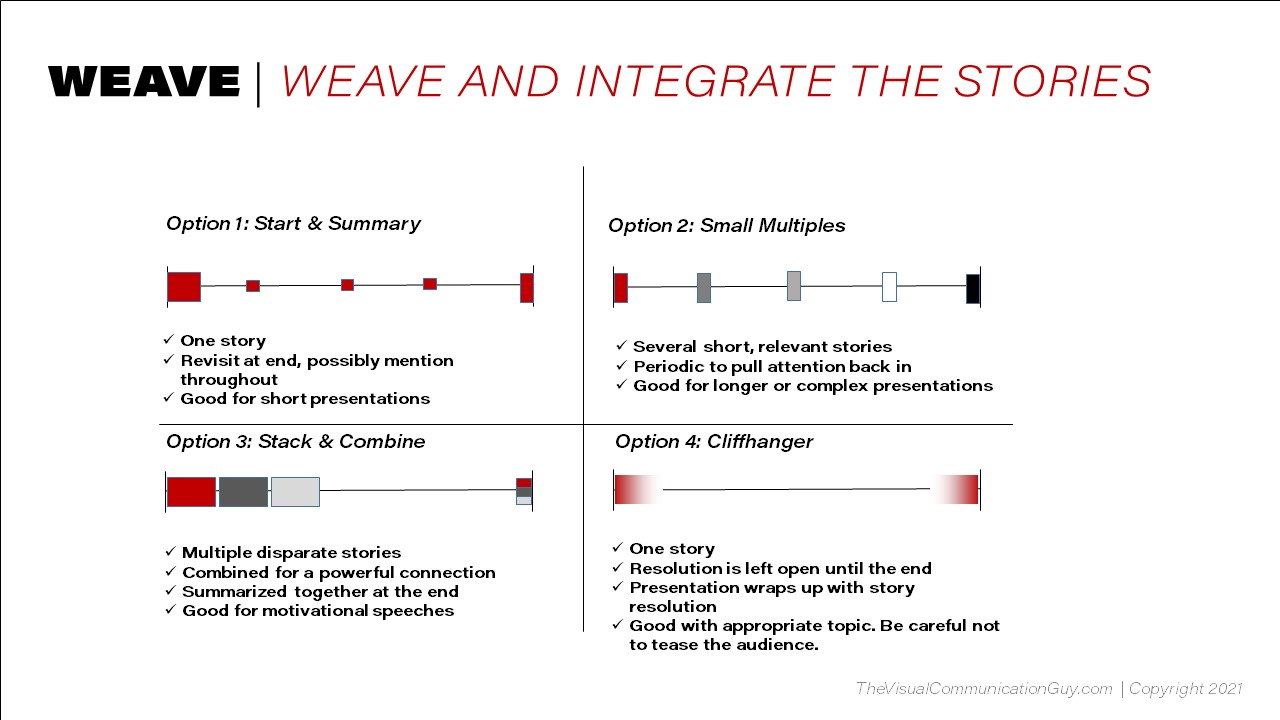
The last step to weaving in stories is to figure out how they’ll best fit into the larger narrative of your presentation. Remember that the average adult attention span is 6 – 7 minutes and you’ll need to be looking for ways to keep pulling their attention back in. Telling stories is a good way of doing that. If your presentation is short, one story may be enough, or you may need to refer to parts of that story throughout. If you’re presenting for an hour, you might need to add a few more in. Stories aren’t the only way to capture attention (see the attention grabbers, in the “O is for OPEN” section), but they are one of the best.
Consider four different ways you can approach the integration of stories into your presentation:
Option 1: Start and Summary
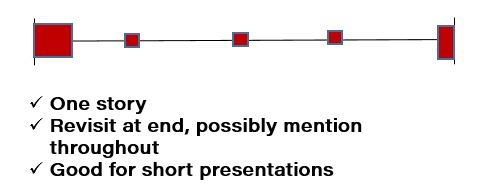
One option is to tell one story, possibly referring to it a few times throughout your presentation. This method usually works best if you also revisit it at the end, reminding your audience of the story and how it applies to your broader message.
Option 2: Small Multiples

Another option is to tell several short stories throughout your presentation. The benefit here is that you can tell different but related stories that address something unique or specific about something you’re saying at different parts of your presentation. This method is especially helpful for presentations that are longer and where you need to keep pulling in the attention of your audience.
Option 3: Stack and Combine
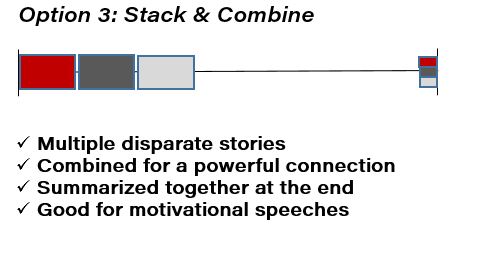
A third option is to tell multiple completely different stories back-to-back. The idea is to have a key motivational or big takeaway concept underlying all the stories combined, keeping audiences intrigued and progressing toward a powerful connection. At then end of the presentation, you’ll want to make sure that all stories combined work in harmony to make a powerful point. To see an example of this in action, watch Steve Jobs’ 2005 Stanford commencement speech. He tells three stories, makes a point at the end, at sits down. But the message is incredibly powerful.
Option 4: Cliffhanger

A fourth option is to tell one story at the beginning, but then hold to the end to tell the audience how the story ends. This can be a unique way to keep the audience engaged. To make this work, though, you don’t want to leave the audience in suspense for too long or they may feel annoyed or confused. If your presentation is an hour long, the cliffhanger may be too far away for them to remember. You also might need to give a few added details to the story throughout so that they can stay intrigued. Usually, cliffhangers work best in short (15- 20-minute presentations).
Conclusion
There is no perfect or single right way to weave stories into your presentations. Get creative with it. Just remember that, regardless of your topic, if you can find a way to tell stories, people will be more likely to stay engaged and, above all, remember what you had to say later.