
Information Design Rule: Simplify Your Audience’s Life
Apple founder Steve Jobs famously lived by a mantra often attributed to Leonardo da Vinci: “Simplicity is the ultimate sophistication.” Regardless of who coined the phrase, its message is poignant: simplicity isn’t easy, but when achieved, people will become attracted to its sophisticated appeal. The principle of simplicity applies to physical products as much as it does to information design—the easier something is to read and access, the more people are likely to use it and be persuaded by it.
Steve Krug, renown usability expert, wrote an entire book about simplifying design to better serve website users. The title? Don’t Make Me Think. The idea is that when people find things to be simple, clear, free of ambiguity or distraction, and generally stripped of clutter and noise, they become entranced by its usefulness and effectiveness. Simplifying doesn’t mean “dumbing-down” information or making communications less intelligent, less complete, or less effective; rather, simplicity means giving people exactly what they need (nothing more and nothing less) in as easy a manner as possible. Simplicity as a rule leans on several theories that come from many scholars and researchers over many centuries. In the spirit of simplificiation, though, there are three key principles you’ll want to embrace that will still allow you to maintain the integrity of your content: Ockham’s Razor; Signal-to-Noise Ratio; and Layering and Separation.

Ockham’s Razor
Ockham’s Razor (or Occam’s Razor, also known as the Law of Parsimony), is a theory attributed to William of Ockham which suggests that, given multiple options, the simplest method is usually preferred. If your employees, clients, or consumers are ever in a position to choose between your option and someone else’s, they will most likely choose the one that is simpler. If you ever have to choose between two or more designs, typically you’ll want to go with the visually simplest one.
Signal-to-noise Ratio
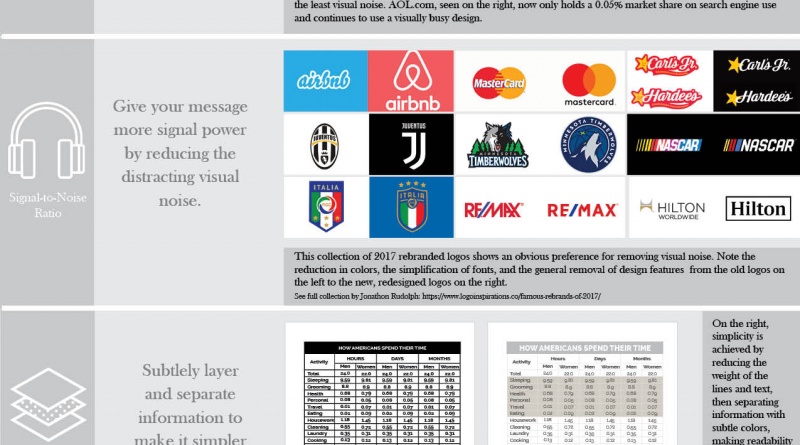
Signal-to-noise-ratio (SNR) is an electrical engineering term recognized as the amount of “signal power” in relation to “noise power” or interference. As a metaphor, the term is widely used in many fields—including communication—where the goal is to reduce excess in favor of clarity. Your goal, any time you communicate, is to reduce the “noise power” (meaning all clutter, superfluity, and generally unnecessary distractions) while increasing the “signal power,” or the clarity of your message. Every time you write or design information, take note of everything your audience does not need and cut it out. Look for all visual elements—text, lines, photos, borders, extra lines and margins, shapes, ClipArt, and so forth—that make your document look less simple. Even consider the weight of fonts and edges of designs. If it’s too heavy or not needed, take it out.
Layering and Separation
When working with large amounts of information or information that is complex, find ways to layer and separate it. Create subtle but obvious cues that dictate information is different while reducing as much noise as possible. Use color subtlely to separate information, simplifying the amount of viewing effort required by viewers to interpret information. In interactive and website designs, consider how you might use tabs and nesting to keep information layered, rather than all visible, all at once.