

The 9 Local SEO Tools Worth Shortlisting in 2026
At one location, local SEO is a listing you tidy up. At forty, it becomes a system, and that system is what most local SEO tools are built to run. The demand is real: 82% of US smartphone shoppers use “near me” searches, and mobile drives more than half of US organic search visits. Hyper-local intent isn’t new either: “near me” plus purchase-intent searches grew more than 500% between 2015 and 2017, when proximity became a ranking input. Past a handful of storefronts you’re no longer optimizing a profile; you’re running geo-grid accuracy, listings hygiene, and review response across a footprint. This roundup ranks nine local SEO tools by how they hold up at that scale.
Five criteria decided the ranking, each weighted for behavior at scale:
- Geo-grid rank-tracking accuracy: position truth across many grid points, not one centroid check.
- Multi-location and bulk workflows: acting on dozens of profiles at once, not one listing at a time.
- Listings and NAP consistency: pushing name, address, and phone data across directories and catching drift automatically.
- Review monitoring and response: a real workflow for replying across platforms, not just a count.
- API and reporting depth: data that feeds an external, revenue-weighted backlog, not just its own dashboard.
Method: I mapped the local SEO tools category and weighted each entry by behavior at multi-location scale. Pricing was verified on each vendor’s page in August 2026. Gaps are named in every card.
| Tool | Type | Geo-grid rank tracking | GBP management | Listings & citations | Review management | Best-fit scale | Entry price |
| SE Ranking | All-in-one SEO suite, local module | Yes | Yes | Yes | Yes | Multi-location and agencies | From $129/mo |
| BrightLocal | Dedicated local platform | Yes | Yes | Yes | Yes | Agencies, US/UK/CA/AU | From $31/mo (annual) |
| Whitespark | Unbundled local toolkit | Yes | Partial | Yes | Yes | Citation-led programs | From $10/mo |
| Local Falcon | Geo-grid rank tracker | Yes | No | No | No | Rank-tracking teams | From $24.99/mo |
| Yext | Enterprise listings, knowledge graph | No | Yes | Yes | Yes | Enterprise franchises | Quote-based |
| Semrush Local | Local add-on on Semrush core | Yes | Yes | Yes | Yes | Enterprise and agencies | Add-on on $139+/mo core |
| Moz Local | Per-location listings and reputation | Partial | Partial | Yes | Yes | Per-location listings | From $16/mo per location |
| Localo | GBP-focused local app | Yes | Yes | Partial | Yes | GBP-centric teams | From $39/mo (annual, +VAT) |
| Google Business Profile | Free native listing tool | No | Yes | No | Single listing | Single listing | Free |
Read it by constraint, not feature count. If you run local across many locations, scan the geo-grid and bulk-workflow columns first; those break when you multiply storefronts. Among local SEO tools, entry price is where you land, not where you start, because the real cost is per location.
1. SE Ranking

SE Ranking is a full SEO platform whose Local Marketing module runs local rank tracking, GBP, listings, and reviews inside one system.
Best for: in-house teams and agencies running local across many locations who want it inside one SEO workflow, not a standalone local app.
Standout feature: Its Map Rank Tracker plots rankings across grid points down to street level, so you read a whole service area, not one aggregate number. That geo-grid sits alongside GBP posting, listings and NAP automation, and review management inside its Local Marketing toolset, and it feeds an API you can pull into your own reporting.
Pros:
- Track rankings on a geo-grid down to street level with the Map Rank Tracker
- Schedule GBP posts and monitor and respond to reviews across Google, Yelp, Tripadvisor, Facebook, and more
- Automate NAP consistency across GBP, Facebook, Apple, and Bing
- Pull audit and rank data through the API and MCP included in every plan, straight into a revenue-weighted reporting sheet
Cons:
- Local is one module of a broader SEO platform, not a pure-play local tool
- The local rank tracker caps at 1,500 keywords and 3 locations on Core and Growth; wider coverage needs add-ons
- Depth rewards systematic multi-location or multi-client use more than a single storefront
Pricing: Core $129/mo ($103.20/mo billed annually), Growth $279/mo; API and MCP included in every plan; 14-day free trial.
The backlog says: among all-in-one local SEO tools, this earns its slot if you track local across dozens of locations and want one system feeding your revenue-weighted scoring. One vendor, one API, no stitching tools together. For a single storefront the depth goes unused.
2. BrightLocal
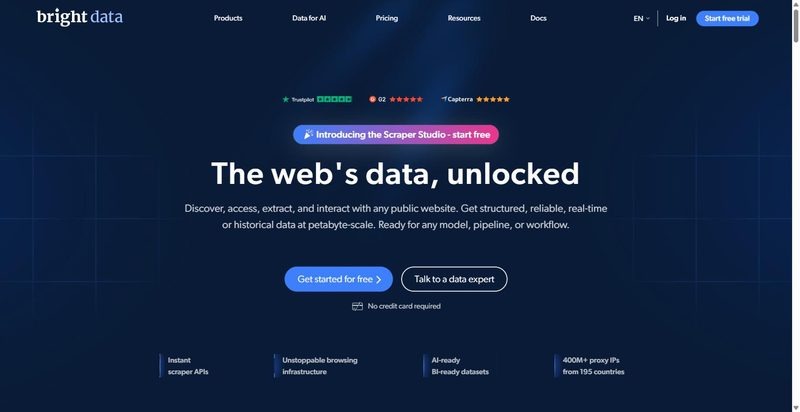
A purpose-built local platform bundling geo-grid tracking, citations, GBP auditing, and reviews in one dashboard.
Best for: in-house teams and agencies running geo-grid tracking plus citation building across US, UK, Canada, and Australia footprints.
Standout feature: The Local Search Grid plots rankings across a pin grid, so a footprint’s visibility reads as a heat pattern rather than one position. GBP audit and benchmarking make locations comparable, and reports export cleanly into a backlog.
Pros:
- Plots geo-grid visibility across street-level pins for multi-location comparison
- Audits and benchmarks Google Business Profiles in bulk
- Builds citations and manages reviews in one dashboard
- Exports agency-grade reports that feed external scoring sheets
Cons:
- Coverage stops at the US, UK, Canada, and Australia, so wider footprints fall outside it
- No broad organic toolkit; keyword and backlink depth live elsewhere
Pricing: Track $31/mo, Manage $40/mo, Grow $49/mo, billed annually; 14-day trial, no card.
The backlog says: inside its four supported countries this earns a sprint, covering most of local in one dashboard. Past those borders, or when organic keyword work shares the budget, it stops paying for the seat.
3. Whitespark
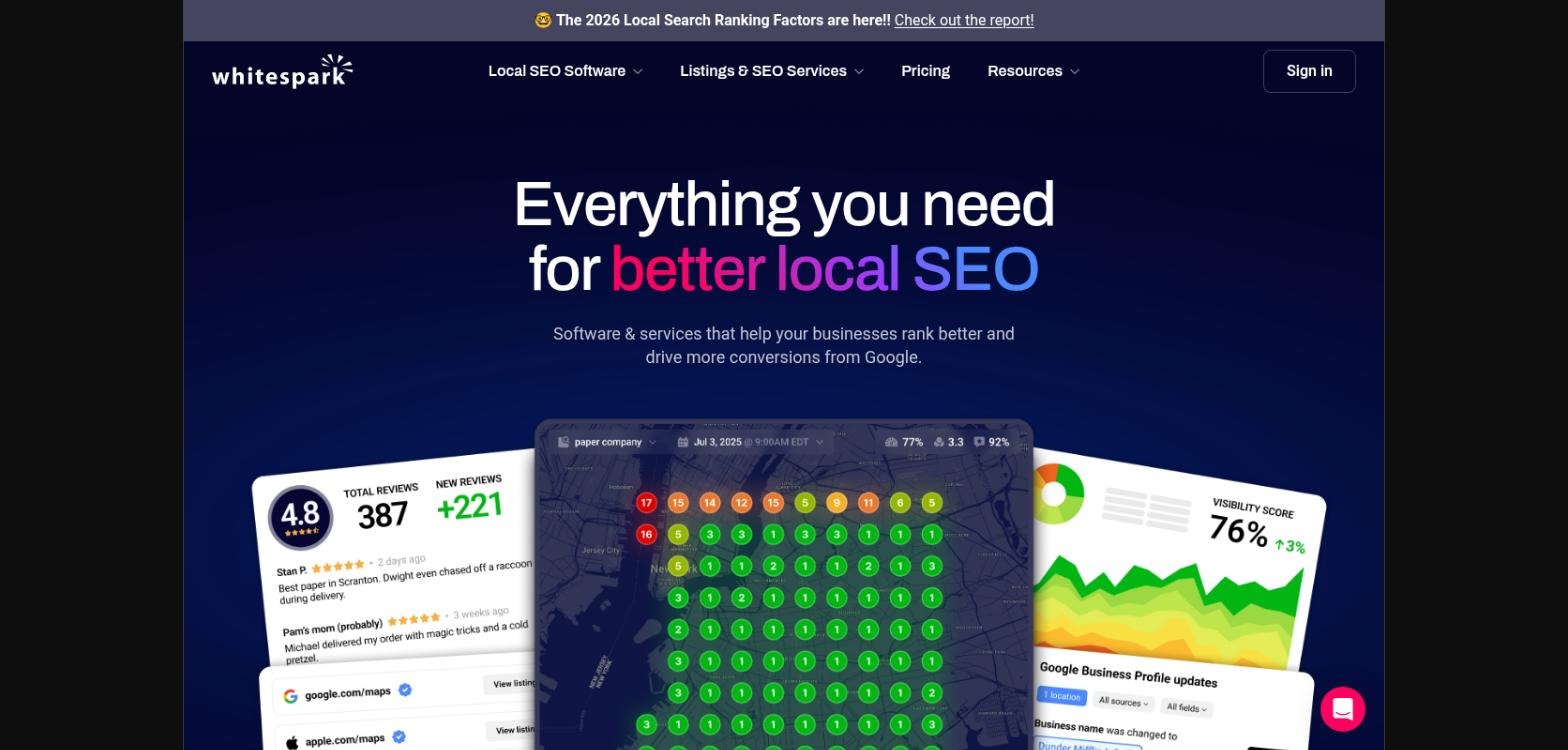
An unbundled set of local tools, anchored by citation work most rivals treat as a side feature.
Best for: teams whose local program is citation-led and want to pay only for the tools a footprint needs.
Standout feature: Local Citation Finder and the Listings Service are the reason to be here. Among listing management tools, few clean and build citations this thoroughly at scale. Local Ranking Grids, Local Rank Tracker, and Reputation Builder are sold separately, not as a forced bundle.
Pros:
- Runs citation discovery and listing cleanup at a depth rivals rarely match
- Scans ranking grids up to 225 points for street-level accuracy
- Lets you subscribe to only the tools a footprint actually uses
- Adds Reputation Builder for review workflows without a full suite
Cons:
- The a-la-carte model means several separate subscriptions to cover everything
- The all-in-one dashboard is thinner than platform rivals, so reporting stays manual
Pricing: Local Ranking Grids from $10/mo; Local Rank Tracker $14-200/mo; Local Citation Finder $33-149/mo.
Where it lands: if citations are the actual job, this wins a sprint outright. The cost is coordination: several subscriptions and a manual reporting step.
4. Local Falcon
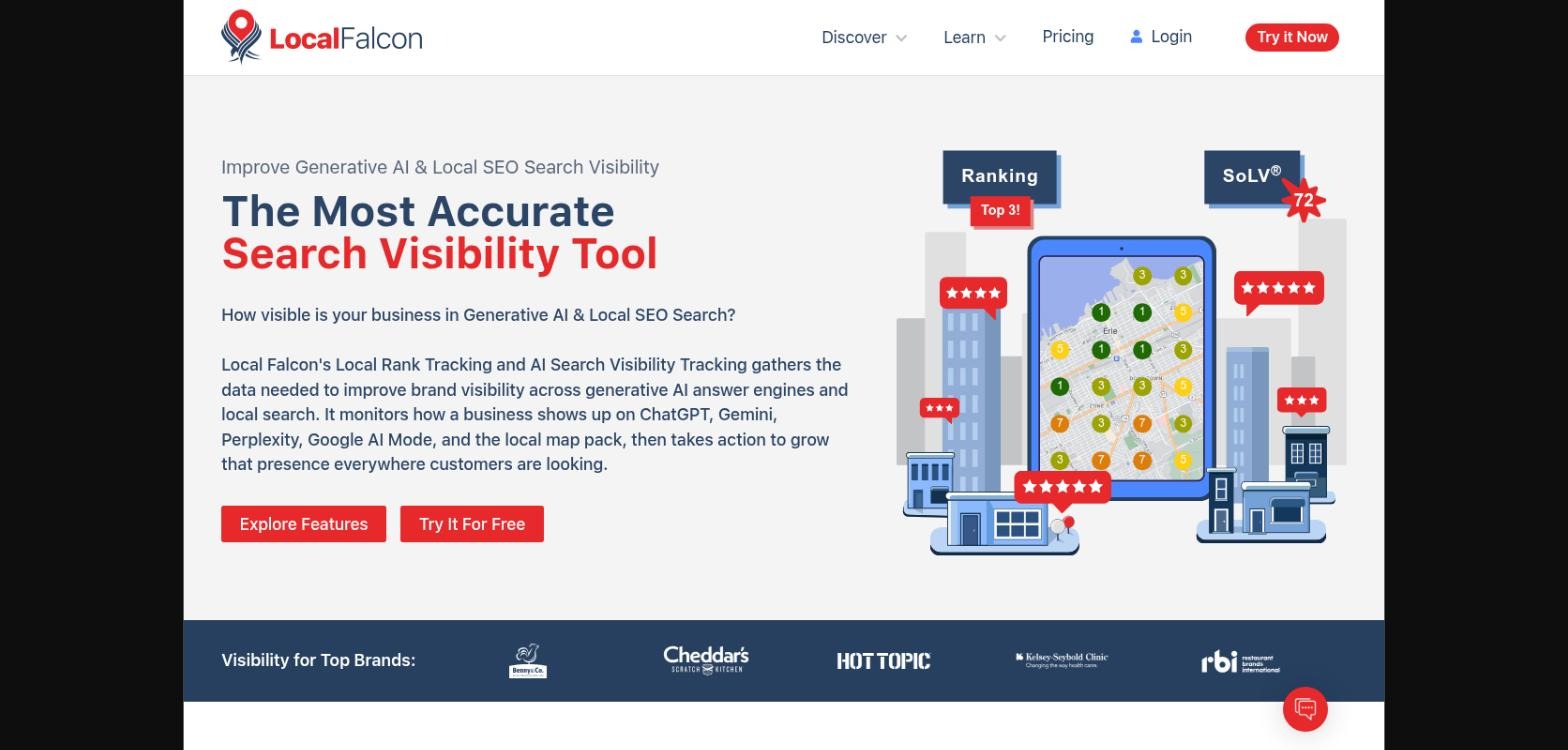
A geo-grid rank tracker built for one job: measuring where a business ranks across a map.
Best for: teams that need defensible geo-grid ranking data, with listings and reviews handled elsewhere.
Standout feature: Map-pin scans run from 3×3 up to 21×21 grids, so ranking reads as a spatial pattern down to the block. Falcon AI recommendations extend that into AI answers. It measures and diagnoses, it doesn’t manage.
Pros:
- Scans map-pin grids from 3×3 to 21×21 across Google and Apple
- Tracks AI-visibility alongside classic geo-grid position
- Surfaces Falcon AI recommendations from the scan data
- Ships 100 free credits, so accuracy is testable before spend
Cons:
- Credit-based pricing with monthly expiry is hard to forecast across many locations
- Tracking and analysis only; no listings, citations, or review management
Pricing: Starter $24.99/mo, Basic $49.99, Pro $99.99, Premium $199.99; 100 free credits on signup.
The backlog says: among pure local rank tracking tools, add this when you want geo-grid truth feeding a system that already owns listings and reviews. The credit model is the catch: forecast the monthly burn first, since expiring credits punish uneven scan schedules.
5. Yext
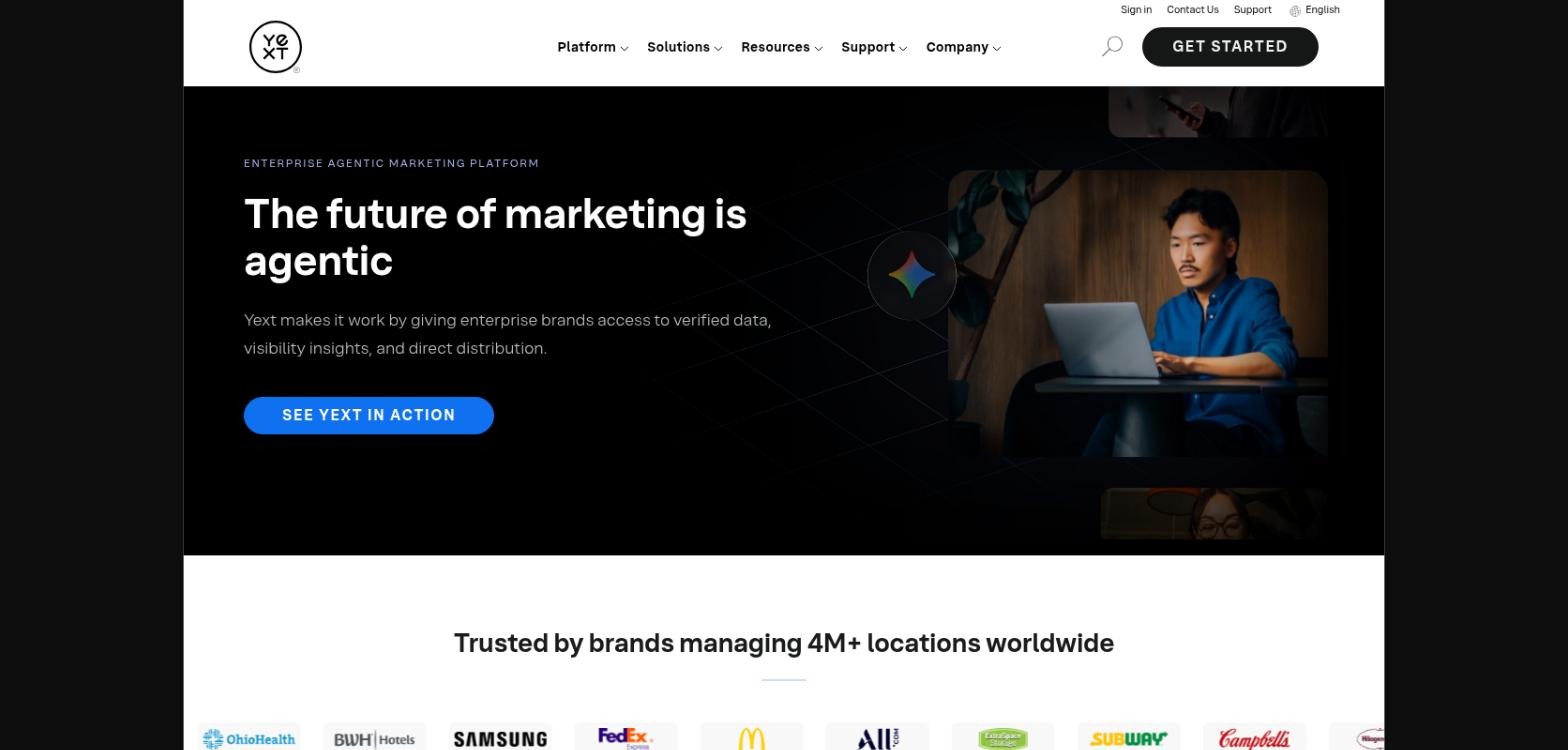
Yext manages enterprise digital presence as a knowledge graph: one record per location syncing across a deep publisher network.
Best for: large franchises enforcing one source of truth across hundreds of locations.
Standout feature: The knowledge graph is the differentiator at scale. You maintain each location’s data once, and Yext pushes it across its publisher network, so a brand running 800 storefronts updates holiday hours centrally, not listing by listing.
Pros:
- Syncs listing data across a deep publisher network from one record
- Enforces data consistency across hundreds of locations
- Adds AI search features beyond basic listings
- Handles enterprise governance and permissions
Cons:
- Enterprise-priced and quote-based, with no public self-serve pricing
- Overkill for a handful of locations
- Presence-focused, not a full local rank-tracking suite
Pricing: Quote-based; contact sales. Self-serve pricing has been retired, so plan for a contract rather than an online signup.
Where it lands: among the local SEO tools here, Yext earns its cost past a few hundred locations, where consistency becomes a governance problem. Below that scale, you pay enterprise rates for control you don’t need.
6. Semrush Local
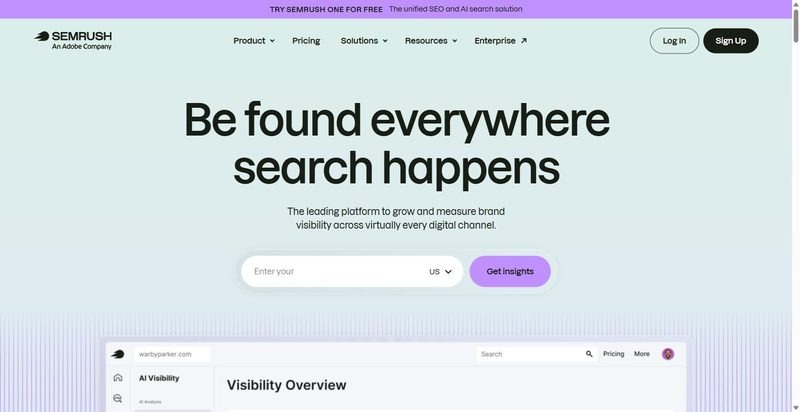
Semrush Local layers listing management, a Map Rank Tracker, and GBP and review management onto the Semrush platform.
Best for: teams already running Semrush core who want local workflows without a second vendor.
Standout feature: The pull is consolidation. If keyword research, backlinks, and reporting already sit in Semrush, the add-on tracks map rankings and manages GBP and reviews in the same login.
Pros:
- Adds Map Rank Tracker, GBP, and review management to Semrush
- Keeps local work in one login for subscribers
- Strong multi-location and agency features
- Sits inside a full SEO and AI-visibility suite
Cons:
- Local is a paid add-on on top of an already-premium core subscription
- Per-location costs stack as your footprint grows
- Little reason to adopt unless you run the core
Pricing: Semrush core runs $139 to $549 per month depending on tier; the Local add-on is priced separately per location.
The backlog says: as a local SEO tools choice, this justifies a line item only when Semrush core already sits in your stack. At #6 it’s a consolidation play, not a standalone local pick.
7. Moz Local
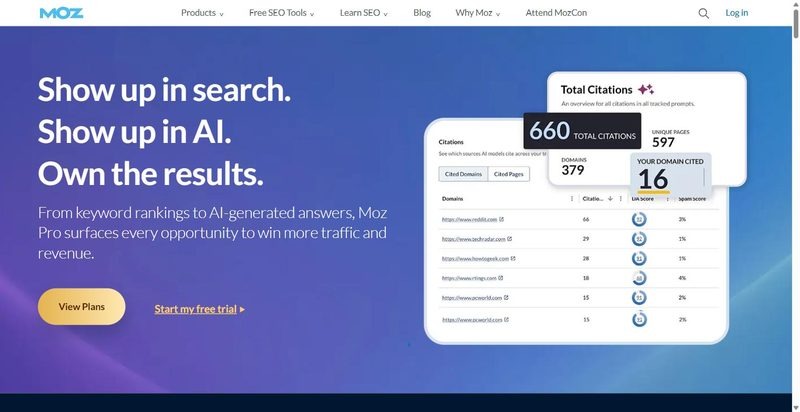
Moz Local handles per-location listings and reputation, with a Local Grid heatmap showing where a business ranks across a service area.
Best for: US, UK, and Canada operators wanting straightforward per-location listings and reviews.
Standout feature: The Local Grid heatmap is the draw: it maps ranking visibility across a service area, so you see where a location surfaces and where it fades, with listings distribution, review monitoring, and competitor analysis in the same dashboard.
Pros:
- Distributes listings and monitors reviews per location
- Maps ranking visibility with the Local Grid heatmap
- Adds social posting and competitor analysis
- Keeps each location’s local view quick to read
Cons:
- Listings coverage limited to US, UK, and Canada
- Each physical location needs its own subscription
- Lighter geo-grid depth than dedicated specialists
Pricing: Per location: Lite $16/mo billed annually or $20 monthly, Preferred $24 or $30, Elite $33 or $40.
Where it lands: among these local SEO tools the per-location model is the number to watch. Multiply the plan by your footprint before it reaches the backlog; a per-store fee compounds fast.
8. Localo
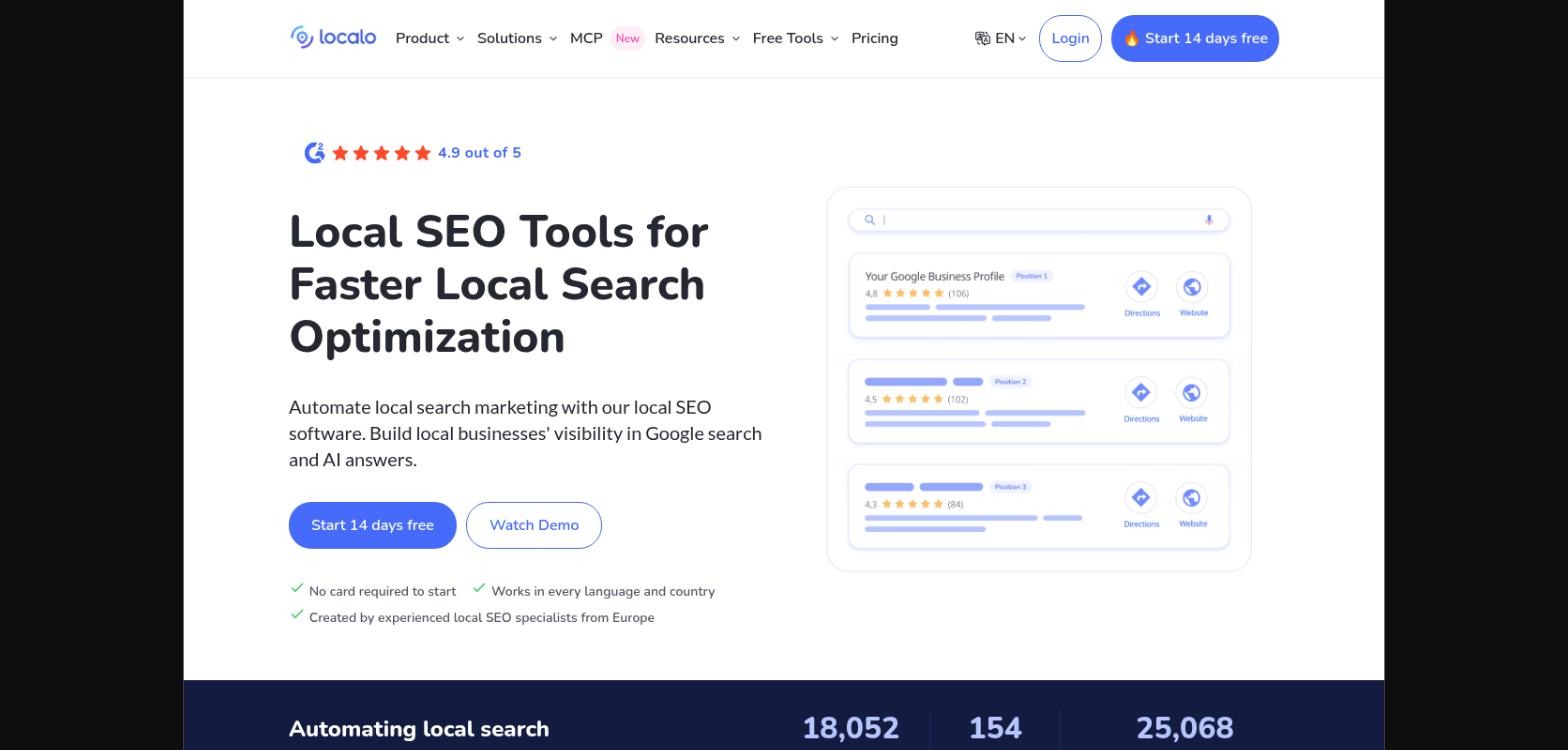
Localo, formerly Surfer Local, is a GBP optimization app that turns local presence into a queue of guided weekly tasks.
Best for: in-house teams whose local work is GBP-first rather than full-suite SEO.
Standout feature: Localo’s position map runs a geo-grid scan, then turns the gaps into a guided weekly task list an AI agent helps clear. GBP protection and white-label reports round it out for agencies.
Pros:
- Runs a geo-grid position map with guided weekly tasks
- Bundles an AI agent, review, and content tools together
- Adds GBP protection against unauthorized listing edits
- Ships white-label reports for multi-profile agency work
Cons:
- Centered on GBP, not full-stack SEO; no rank tracker or backlink depth
- European vendor, so listed prices carry VAT on top
Pricing: Single Business $39/mo annually, $49 monthly; Pro 10 $69/mo annually, $169 monthly; plus VAT; 14-day trial.
Where it lands: on a local SEO tools shortlist this is a scoped tool, not a system. It earns its place when GBP task management is the whole job, feeding no revenue-weighted backlog on its own.
9. Google Business Profile
<!– screenshot to capture: Google Business Profile homepage (not in library) –>
Google Business Profile is Google’s free tool for managing a listing across Search and Maps, the asset every paid tool here optimizes around.
Best for: any local operation, as the mandatory baseline before you buy a paid tool.
Standout feature: GBP is where posts, reviews, Q&A, messaging, and performance insights live. Every geo-grid scan and listing sync writes back to it, so every one of these local SEO tools optimizes around it. Optimizing a thin profile is optimizing a gap, so complete this one first.
Pros:
- Free, with no per-location or per-seat cost
- Provides posts, reviews, Q&A, and messaging natively
- Reports first-party performance insights straight from Google
- Serves as the source of truth paid tools sync to
Cons:
- Single-listing manual management, so no bulk multi-location workflow
- No geo-grid rank tracking or competitor analytics, the gap paid tools fill
Pricing: Free.
Where it lands: this isn’t a competitor to the paid tools, it’s the foundation they stand on. At catalog scale you still manage it manually, which is why a bulk layer earns a sprint.
How to choose (by footprint)
Choose your local SEO tools by footprint, priced in sprints.
- Many locations, one system feeding a revenue-weighted backlog: SE Ranking. Geo-grid, GBP, listings, NAP, and API in one platform, so local is one scored line, not a separate tool.
- Purely citations at scale: Whitespark. An unbundled citation and grid specialist for when listing volume is the work.
- Only geo-grid ranking truth: Local Falcon. Geo-grid accuracy alone, without workflow layers you wouldn’t staff.
- Enterprise franchise listings: Yext. A knowledge-graph engine that earns its cost only past genuine franchise volume.
- A dedicated local platform without a full SEO suite: BrightLocal. Rank grid, citations, GBP audit, and reviews when local is the whole remit.
Skip if: skip Yext unless you’re genuinely at franchise scale, and don’t stack the Semrush Local add-on if local is all you need.
FAQ
What are local SEO tools?
Local SEO tools, also called local SEO software, are platforms that track and manage a business’s visibility in local search: geo-grid rank tracking, Google Business Profile management, listing and citation building, NAP consistency, and review monitoring. At scale, local SEO tools replace manual per-listing work with bulk, template-level workflows.
What is NAP in local SEO?
NAP stands for name, address, and phone number: the core details that must match exactly across your Google Business Profile, directories, and website. Inconsistent NAP weakens local ranking signals, so at scale the job is automating updates so every location stays identical.
How long does local SEO take to work?
Most local SEO efforts show movement in three to six months, with competitive multi-location footprints often taking six to twelve. GBP changes and NAP fixes can register within weeks, but ranking gains across a service area build slowly. Judge progress by template-level trends.
What is the difference between local SEO and regular SEO?
Regular SEO competes for rankings nationally or globally. Local SEO targets searchers in a specific area and adds the map pack, Google Business Profile, listings, citations, and NAP consistency as ranking factors. Regular SEO optimizes pages; local SEO optimizes a physical footprint.