
How To Design Survey Invitations That People Actually Answer
Every researcher learns this eventually: even the most carefully designed survey succeeds or fails on the communication that introduces it. The questionnaire may be meticulously researched and the incentive thoughtfully chosen, but neither matters if the invitation fails to persuade someone to open it. Far from being administrative copy, a survey invitation is arguably the most consequential piece of writing in the entire project, deserving the same rhetorical care you’d give a cover letter or a grant proposal.
Strong invitations make a credible case: why someone’s time matters, what participation involves and how they’ll be thanked. Those sound like simple boxes to tick, but getting them right changes both how many people respond and who those respondents are.
The essentials
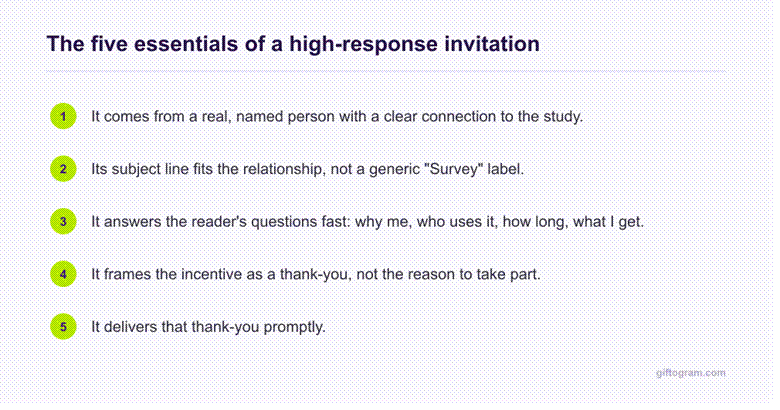
The best-performing survey invitations tend to share five characteristics:
- They come from a real, named person with a clear connection to the study.
- They use a subject line that reflects the relationship, rather than a generic “Survey” label.
- They answer the reader’s immediate questions: Why me? Who will use my answers? How long will this take? What’s in it for me?
- They present the research incentives as a thank-you, not the reason to participate.
- They deliver that thank-you promptly.
None of these are simply administrative decisions; each shapes how the invitation is received. Here’s how to get them right.
Start with the sender, not the subject line
Before anyone reads your subject line, they notice who’s sending it. Recipients make a remarkably fast credibility judgment: Do I know this sender? Does this person have a legitimate reason to ask for my time? That’s Cialdini’s principle of authority at work, and it’s why invitations from a dean, a program director or a named researcher consistently outperform messages sent from anonymous addresses such as noreply@surveys.example.com. Experiments on web surveys have found that both a personalized salutation and the sender’s status influence whether people log in at all. Use a real name, a reply-enabled email address and one sentence explaining that person’s connection to the study. That simple disclosure tells readers who’s asking and why they have standing to ask.
Write subject lines that match the relationship
Research by Porter and Whitcomb found that, among prospective university students, a blank subject line outperformed alternatives containing either the word survey or the sponsoring organization’s name. Yet among current students, subject lines made almost no difference because recipients already trusted the sender. The lesson isn’t to send blank subject lines. It’s to write for the relationship you actually have with your audience. Someone who already knows your organization doesn’t need the same reassurance as someone encountering you for the first time. Avoid generic labels like Survey or Please Complete Our Questionnaire. Instead, use subject lines that communicate relevance, such as the study topic, expected completion time or the recipient’s connection to the project.
Answer the reader’s questions quickly
Survey methodologists, particularly Don Dillman, have framed participation as a social exchange: people participate when the perceived rewards outweigh the costs and when they trust you to deliver on both. That means the body of the invitation should answer four questions as quickly as possible:
- Why was I selected?
- Who will use my responses?
- How long will this take?
- What do I receive in return?
A “10-minute” survey that actually takes 25 minutes damages trust long before respondents reach the final question. Honest time estimates matter because they signal respect for someone’s time.
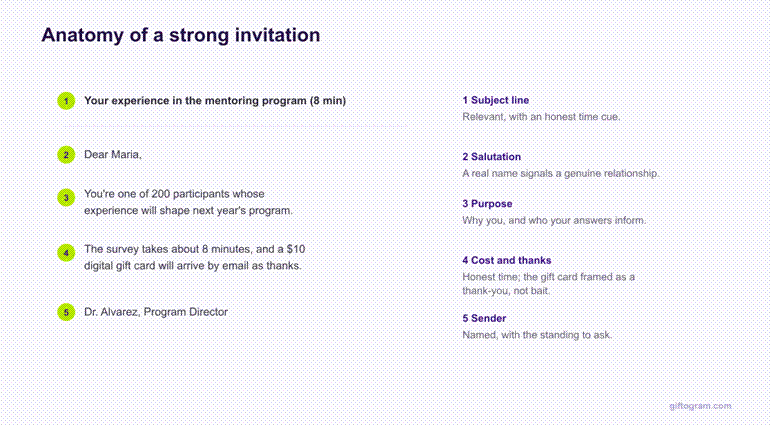
Personalization is another area where the evidence is mixed, which is useful in itself. Salutations appear to help when they reflect a genuine relationship, but they do little when recipients can clearly see the message came from a mail merge. Keep the invitation short, specific and honest rather than trying to disguise a mass email as personal correspondence.
Use incentives as thanks, not bait
Be upfront about the incentive you’re offering in return for someone’s time. If you haven’t considered using incentives, it’s worth doing, because the evidence consistently shows they work. Reviews of dozens of survey trials found that offering a reward can nearly double the odds of response. Even more interestingly, rewards given unconditionally, before someone completes the survey, outperform those promised only on completion. Behavioral scientists describe this as reciprocity. An unexpected act of generosity creates a gentle sense of obligation, making participation feel like returning a kindness rather than completing a transaction. Mention the incentive in the body of the invitation, after explaining the purpose of the study and the expected time commitment. It’s a thank-you, not a headline. Leading with “$10 GIFT CARD!” reframes your study as a promotion and attracts people interested in the reward more than the research itself.
Most research teams now deliver incentives as digital gift cards or virtual prepaid cards by email, because they can be sent almost immediately after someone participates. Smaller studies can manage this manually, while larger projects often use Giftogram to automate delivery and administration. Whatever approach you choose, speed matters. A thank-you that arrives promptly reinforces trust and becomes a credibility signal when it’s time to invite the same audience back for another study.
The invitation shapes the survey before it begins
Two invitations can describe exactly the same survey and produce very different responses.
An invitation from an anonymous sender with a generic subject line, vague purpose and reward-first messaging immediately feels transactional. An invitation from a named researcher, with a clear subject line, an honest time estimate and a thoughtful thank-you, feels credible before the survey has even opened. This insight is the basis for why invitation design deserves far more attention than it often receives. Researchers spend weeks refining questionnaires, testing scales and validating measures, yet participants encounter none of that until they’ve already decided whether the invitation deserves their attention. Before someone answers your survey, they answer a simpler question: “Is this message worth my time?” Every survey begins there.
Frequently asked questions
Do survey incentives increase response rates?
Yes, research consistently shows that monetary incentives can increase survey response rates; for example: in one study, a $15 gift card generated 142 completions compared with just 24 without an incentive under equivalent ad spend. Guaranteed gift cards have also outperformed lottery-based incentives, making digital rewards a practical way to drive participation at scale.
How much should my survey reward incentive be?
A survey reward should match the time, effort and audience involved. A short customer survey may justify a smaller incentive than a 30-minute interview or multi-stage study. There is no universal amount that works for every survey, so test response rates against incentive cost and adjust the reward to participant burden.
How can I automate survey rewards?
You can automate survey rewards by connecting your survey tool to a platform like Giftogram, which integrates with survey workflows through Zapier or its API. Once a response is completed, a choice-based reward can be delivered automatically without any manual follow-up.
Do incentives boost sales?
Yes. Survey incentives can support sales indirectly by increasing participation, creating another branded customer touchpoint and, when paired with a future-use offer, giving customers a reason to return. Research into the mere-measurement effect also suggests that asking customers about their attitudes can influence subsequent behavior.