
Six Tips for Taking a Good Picture
Visual communication includes a lot of different kinds of communication, from writing on signs, designs and illustrations, and of course, photography. Photography is a visual medium that is frequently used in design and can engage audiences.
In today’s highly visual and tech-savvy world, there are so many opportunities for anyone to be able to take a photograph. A camera is at the beck and call of anyone who has a cell phone.
Despite photography’s easy access to people, there are still guidelines that can help an aspiring photographer take a good picture, even without a fancy DSLR.
Here are five tips for taking a good picture:
1. Use the Rule of Thirds
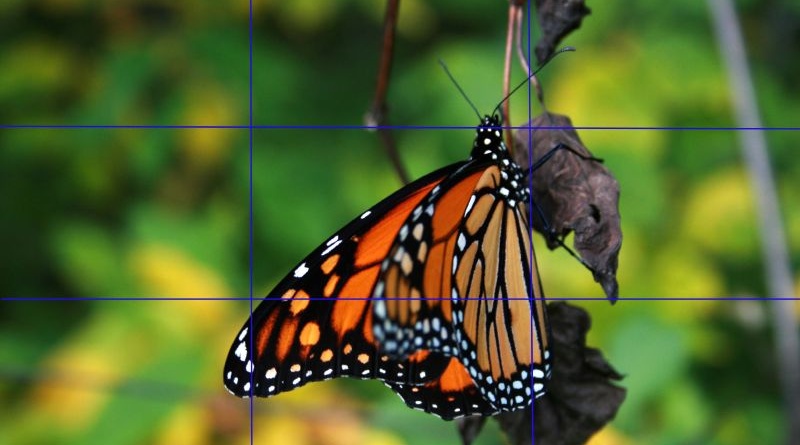
The rule of thirds is a guideline that I would argue is one of the most helpful guidelines, and often can be one of the easiest to use. The rule of thirds cuts the image into nine sections of equal pieces. This is accomplished by placing two horizontal and two vertical lines on the image. Positioning elements along these third lines or at the intersections of these lines will add visual interest and balance to the photo.
Some cameras (even cell phone cameras) will allow you to place a rule of thirds grid on the screen when taking a photo to make it easier to see and use the rule of thirds.
The image below shows an example of what an image with thirds lines shows.

2. Pay Attention to Headspace
Headspace (a.k.a headroom) is particularly important when taking pictures of people. The principles of good headspace change based on how much of the image that a person’s head takes up, but it generally deals with how much space a person’s head has from the top of the frame. Headroom can also include the space on the sides of the image, which helps indicate where the subject should be looking in order to not make the frame seem too cramped.
The rule of thirds can be a great help here, as it is generally held that the subject’s eyes should be positioned one third from the top of the photo, which places them on the topmost third line.
The image below shows a good example of proper headspace.

3. Use Contrast to Your Advantage
Contrast can add interest to a photo. This contrast may refer to brightness, as it is commonly referred to in photography, but it can also include things like color, size, shape and more.
Contrast can provide interest and impact in an image, which is something that can get a viewer thinking, or at least get them to stop and consider the image for a moment. Consider some of the tools you can use to help your viewers see more, enhancing contrast and visual appeals–including many free Lightroom presets available online which will save you lots of time–lighting kits, and filters.
The image below shows a contrast of textures and colors between the leaves and the tree bark.

4. Get An Interesting Angle
Another tip to add interest to a photo is to get an interesting or unique angle on a scene. Perhaps try getting above or below your subject in order to capture the image in a way that is not usually seen.
Playing with the angle can also allow you to tell a different story. Consider how getting a higher angle or getting a shot from a different distance changes the meaning of that image.
The image below is an example of using angles to create visual interest.

5. Make use of Natural Lines
The human mind likes things that are linear. That’s why photographs with lines can be so pleasing. The eye of your viewer will follow any natural line that is present within an image. Consider how you would like to draw your viewer’s eye through the scene present in your photo in order to give the lines in your photo more power.
The image below illustrates the use of lines to guide the eye.

6. Make Use of Symmetry and Patterns
Symmetry is pleasing to the eye. We like things to be even and appreciate thing that are nicely balanced. Symmetry is the perfect example of balance.
Patterns are similar to symmetry in the way that they are pleasing to the eye. They eye is drawn to things that have patterns or symmetry.
Make your photo effective by making use of symmetry and patterns, or perhaps break the symmetry add a focus on the element that breaks the symmetry or pattern.
The image below is a good example of an image that shows a spiral pattern.

All images used in this post are protected under a Creative Commons license and were not altered in any way.