
Living “Abnormal but Benign”: Some thoughts on the Fragility of Life
I’m going to step away from visual communication for a moment today and share a few thoughts on seizing the moment. Each of us, in our own unique way, has a collection of talents and perspectives that, if intentionally harnessed and shared, can change the world for good. Sometimes that becomes clearest when we face death in the eye.
About a year and a half ago, I was incorrectly diagnosed with an aggressive connective tissue cancer. For nine days, between PET and CT scans, lab tests, second opinions, immense personal introspection—and, weirdly enough, between a fortuitously pre-scheduled, providentially cathartic work trip to Paris—I thought my life would be abruptly and unfairly truncated at the hands of a cruel disease that would relentlessly shut my organs down.
But I was lucky. On the ninth day, after returning from that thoroughly pensive diversion to the City of Lights (including several guiltless jaunts into tantalizing French pastry shops), I sat face-to-face with my oncologist. In just four bumper-sticker-worthy words, he gave me my life and my normality back: “You’re abnormal, but benign.” Turns out, I didn’t have spindle cell sarcoma as was initially thought; I had an extremely rare but entirely innocuous growth called a “schwannoma”—basically a cylinder-shaped lump of nothingness whose sole purpose, apparently, is to remind people of how fragile life can be.
And fragile it is. In the past five years, eight people close to me have lost their lives to various diseases and accidents, including my own 57-year-old father at the prime of his life. I’m being reminded nearly every three to four months, it seems, that each day we wake, we ought to take advantage of what’s possible—to give and to accept every hug; to strengthen every relationship; to forgive and to be forgiven; to do one more nice thing; to take a step closer to our dreams; to embrace challenges and opportunities; to maximize the moments where our potential is pushed.
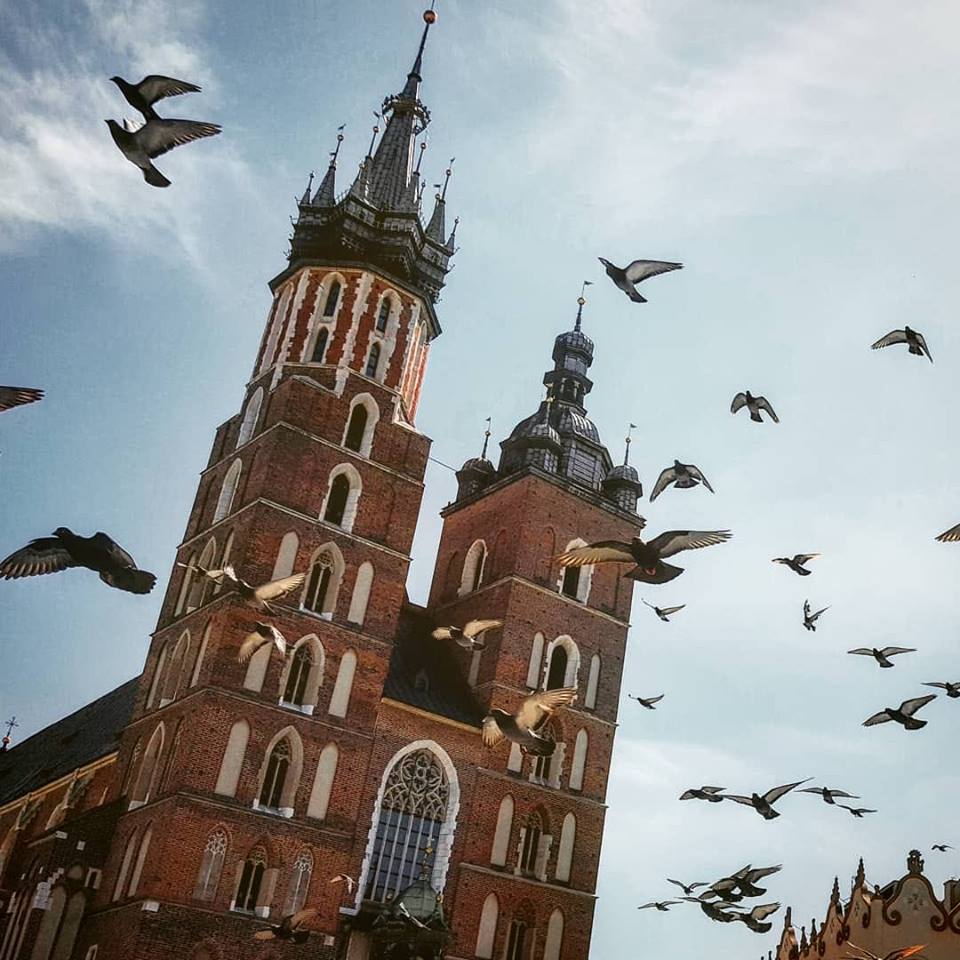
Five months after cancer so briefly but emphatically reframed my worldview, I stood here, at the foot of St. Mary’s Basilica in the main square in Krakow. It’s not all that interesting of a photo. It’s a bunch of pigeons in Poland. But as I look at this photo, I’m reminded of the fleeting but memorable impression that made my heart smile as these pigeons flew above me—enough to lift my camera and capture the scene. The late Neal A. Maxwell once said that “moments are the molecules that make up eternity.” Not everyone will get the same exhilaration that I do when pigeons fly overhead, but everyone, in their own and unique, “abnormal” way, can find joy in similarly small and inconsequential moments. As we assemble and harness our own abnormal penchants, we are weaving our life tapestries. I believe that the more we soak in, the more beautiful, rich, and substantive our tapestries become—and the more good we eventually will do in the world.
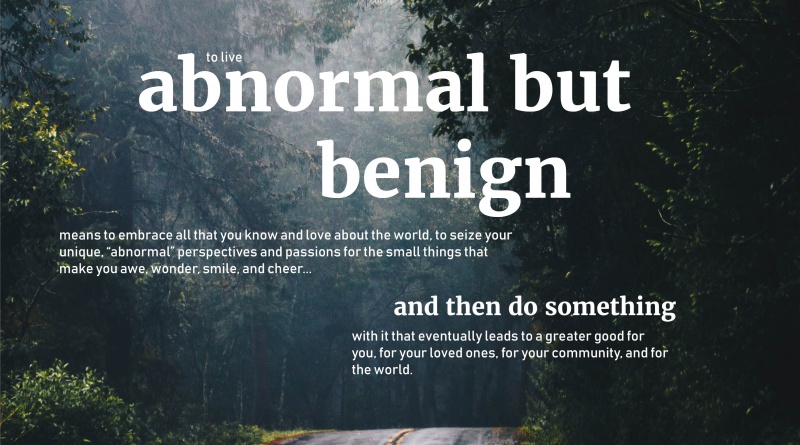
I’ve been thinking lately that life in general should be tackled with an “abnormal but benign” approach. “Benign” in cancer terms means “not malignant,” but its etymology is more closely tied to the ideas of kindness, compassion, goodness, friendliness, and generosity. Of course, “abnormal” draws a thesaurus train that includes terms like “nonstandard,” “atypical,” “peculiar,” “anomalous,” and even “odd” and “deviant.” I like to think of “abnormal” as a zest for embracing idiosyncrasies, a passion for triggering our seemingly small, disconnected quirks, dispositions, and “abnormalities” into a collection of uniquely orchestrated talents. To live “abnormal but benign” means to embrace all that you, as an uncommonly awesome human being, know and love about the world, to seize your unique perspective and passion for the small things that make you awe, wonder, smile, and cheer and then do something with it that eventually leads to a greater good for you, for your loved ones, for your community, and for the world.
I’m still learning what my idiosyncrasies are and how they collectively work together. I don’t know what dreams of mine will ever be realized in this life or how my passions, talents, and quirks will affect those with whom I come in contact. But I do know that, through trial and failure, through highs and lows, through accomplishments and setbacks, I want to continue taking pictures of pigeons in Poland. I want to continue living abnormal, but benign. Some might say that there are pigeons in my own backyard. Why stop and admire them across the world in the streets of Krakow? Because, I say, the opportunity is in front of me and I’m going to seize it and to savor it. And, who knows, maybe nine months from now, it will inspire me to write something about it. Maybe that’s all that will come of it. Or maybe it will do some small good in ways I may not ever know or understand. Regardless, it seems totally worth it.