
The Research Supports It: Wearing Masks Works
I recently heard my state’s epidemiologist say on the radio that, when it comes to reducing the spread of COVID-19, wearing masks is one of the most effective methods.
While that seems straightforward enough, unfortunately, when I go into the grocery store, it seems like many people still haven’t locked into the science that supports that enough to actually put a mask on.
Here are the facts:

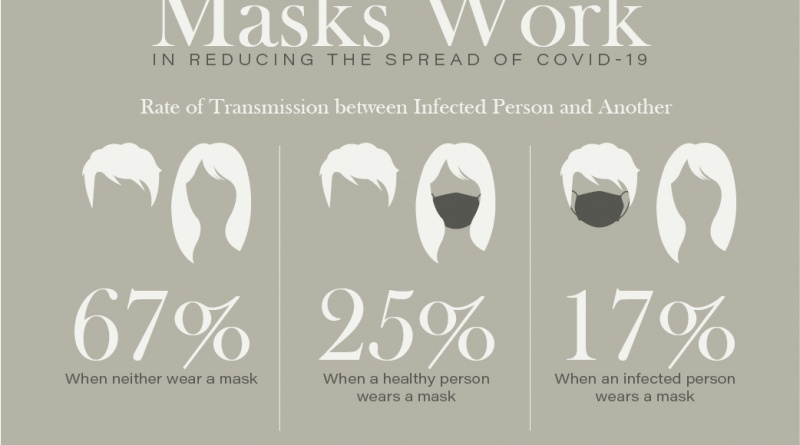
A research study published on May 30, 2020 by Oxford University Press and the Infectious Diseases Society of America corroborates the idea. In fact, it appears that if an infected person isn’t wearing a mask (even if they’re asymptomatic), they will transmit to another person who isn’t wearing a mask 67% of the time! That number drops clear to 17% if the infected person wears a mask. (Some epidemiologists have even suggested that if both an infected person and a healthy person are wearing a mask, transmission may drop to as low as 3%!)
So, how did the study work?
Three groups of hamsters were tested, each group divided into two cages–one cage with hamsters infected by COVID-19, the other cage healthy (hamsters have very similar immune responses to infectious as humans). The cages were set close to each other.
In the first group, no covering was placed between the two cages. Sixty-seven percent of healthy hamsters became infected.
In the second group, a covering was placed by the healthy hamsters’ cage. In that group, 25% of hamsters became infected.
In the third group, a covering was placed by the infected hamsters’ cage. In that group, on 17% of the hamsters became infected!
In short, if your health permits it, wear a mask when in public, even if you’re not feeling sick. That’s probably the single best way we’ll beat this thing.
It would be more fun and accurate if the silhouettes looked like hamsters. It is not clear which one is infected (maybe hamster with Bill-the-cat frazzle?)
Or, leave the uncertainty about which one is infected and a fourth situation where both are masked, with ‘winner’ emphasis. Why have gendered hair?