

7 Best SaaS Consulting Companies That Help Startups Scale
You probably feel it every week: the market moves faster than your backlog. In 2026, distribution channels shift in months, not years, and AI-powered competitors can ship features overnight. That pace has raised the bar for performance, security, and user experience. Investors now look past vanity metrics and inspect gross-margin projections, churn cohorts, and time-to-value curves before wiring funds. All of that translates into one simple truth: execution risk has never been higher for early and growth-stage SaaS companies.
Founders and CTOs still wear multiple hats, yet the decisions that make or break scale are more specialized than ever. Microservice boundaries, event-driven data flows, go-to-market ops, SOC 2 automation, and usage-based billing engines each call for deep expertise that even a strong in-house team may lack during crunch time. That gap is why specialized partners have become an extension of winning SaaS teams rather than a cost center to be minimized. The seven firms we’ll discuss have built reputations on filling that gap quickly, credibly, and with measurable impact.
What Modern SaaS Consulting Really Covers
The phrase “SaaS consulting” used to mean a slide deck from a big-name advisory shop. Today, it is much closer to a hybrid squad that blends strategy, engineering, and design to shorten your learning cycles. A solid partner will first validate or challenge assumptions about the target segment, pricing model, and technical roadmap. From there, they zoom into architecture – helping you decide, for example, whether an event-sourced system on a serverless backbone is worth the overhead right now or how to split workloads between GPU-heavy AI inference and cheaper CPU pools.
A good consultant also looks beyond the codebase. User journey mapping, compliance checkpoints, incident-response playbooks, and data-driven growth experiments all fall under the same engagement because they shape the end-to-end customer experience. Finally, top partners don’t shy away from rolling up their sleeves. They prototype, set up CI/CD pipelines, run performance benchmarks, and leave behind documentation plus KPIs that the core team can own after the engagement ends.
Matching the Right Partner to Your SaaS Types and Growth Stage
No single firm is perfect for every situation. Horizontal collaboration apps, highly regulated health-tech platforms, and AI-first analytics products are different SaaS types, and each stress-tests different layers of the stack. Aligning a partner’s history with your own inflection point prevents wasted budget and missed deadlines.
Seed to Series A: Speed Without Future Regret
At the idea-validation stage, founders need click-through prototypes and a deployable MVP fast. A nimble partner should favor opinionated frameworks, managed cloud services, and rapid UX loops. But they still need to keep clean domain boundaries so you don’t face an expensive rewrite six months later.
Series B to C: The Messy Middle
Once revenue passes seven figures, priorities flip to scalability, cost containment, and data visibility. You’ll care about stripping idle-compute waste, formalizing DevSecOps, and adding customer-facing analytics. Partners who routinely harden multi-tenant architectures and negotiate enterprise procurement hurdles shine here.
Pre-IPO: Enterprise-Grade Expectations
Late-stage companies juggle international data residency, disaster-recovery RTOs, and product-led-growth telemetry. A partner must bring battle-tested playbooks for audit readiness and global rollout. They also help fold acquisitions into your core platform without breaking SLAs or brand promise.
7 Best SaaS Consulting Companies for Ambitious Startups
Below are seven partners that repeatedly surface in peer recommendations, conference talks, and due diligence calls. Each brings a slightly different mix of domain focus, delivery model, and cultural fit, so the order is not a ranking but a curated lineup.
1. Brights: Strategic SaaS Consulting and Development Partner
Source: Brights
Brights has spent 14 years refining a playbook built exclusively around SaaS scale-up challenges. The engagement usually starts with a performance and strategy audit that uncovers growth bottlenecks, whether technical or commercial. From there, Brights’ consultants craft a roadmap that covers architecture refactoring, UI/UX upgrades, and go-to-market experiments in the same breath, so trade-offs are transparent.
A few factors set them apart. First, seniority: Brights staffs almost entirely mid-to-senior engineers and product strategists, which removes the “learning on your dime” worry. Second, their retention rate – about 89 percent of clients return for follow-on phases – signals genuine, ongoing value. Third, global perspective: engagements span fifteen countries, so they know how to handle multi-regional data compliance without stalling velocity. Whether you need to validate an AI-infused MVP or migrate a legacy license model to subscription billing, Brights can own the heavy lifting while transferring knowledge to your core team.
2. BCG Platinion
Source: BCG Platinion
Born as the technology backbone of Boston Consulting Group, BCG Platinion combines classic management consulting rigor with modern engineering chops. They excel when the mandate involves high-stakes architecture decisions and cross-functional change management. A typical engagement might re-platform a monolithic fintech product into a cloud-native configuration while simultaneously redesigning customer workflows and updating the pricing algorithm.
For startups entering regulated markets – insurance, banking, digital health – Platinion’s familiarity with compliance and enterprise procurement processes can shave months off sales cycles. Their rates sit on the higher end, but the upside is credibility during Series C and later fundraising rounds; investors trust their technical due diligence notes.
3. Slalom Build

Source: Slalom Build
Slalom Build positions itself as an end-to-end product studio with roots in cloud and data modernization. They are known for embedding mixed squads – product strategists, UX researchers, DevOps engineers – directly into a client’s agile cadence. That co-delivery style can be a lifesaver when an internal roadmap feels stalled because they bring fresh energy without bulldozing your culture.
Slalom invests heavily in AWS, Azure, and GCP partnerships, qualifying them to optimize cloud spend while upgrading reliability targets. If you are chasing FedRAMP or SOC 2 Type II compliance, their repeatable blueprints cut down audit prep time. Founders I’ve spoken with highlight Slalom’s ability to articulate trade-offs between speed and future cost with transparency that CFOs appreciate.
4. Deloitte Digital

Source: Deloitte Digital
Deloitte Digital mixes brand strategy, MarTech integration, and cloud engineering, allowing a startup to treat demand generation and platform resilience as two sides of the same coin.
One of their strengths is forging ecosystem alliances. If your product requires marketplace distribution or embedded finance rails, Deloitte can line up partnership pilots quickly. They also maintain a large bench of cybersecurity specialists who help you bake security architecture into sprint planning instead of retrofitting it later. Expect more process overhead than with boutique shops, but also deeper bench depth when deadlines collide.
5. Thoughtbot
Source: Thoughtbot
Thoughtbot is a design-led engineering studio famous for Ruby on Rails expertise, but has, in recent years, diversified into Elixir, Python, and TypeScript. Their sweet spot is the zero-to-one phase or a post-launch redesign when user feedback demands quick iteration. Thoughtbot explicitly limits team sizes to keep communication crisp and charges flat weekly rates, which lets a founder predict burn with few surprises.
Because they emphasize test-driven development and continuous deployment, CTOs often retain Thoughtbot as quality guardians while hiring internal engineers. They won’t be your choice for a multinational roll-out, but for validating product-market fit and achieving reliable deployments, they punch above their weight.
6. AccelOne
Source: AccelOne
AccelOne operates out of Seattle with near-shore delivery centers in Latin America, giving it a cost-to-talent ratio many U.S. startups find compelling. They focus on cloud migration, API ecosystem buildout, and data pipeline hardening – common pain points for Series A/B companies that suddenly need to ingest and expose large data volumes without breaking SLAs.
A differentiator is their DevSecOps framework, which they integrate from day one, including automated SCA (software composition analysis) and IaC (infrastructure-as-code) scanning. AccelOne also offers fractional CISO and DPO services, useful when you need governance credibility before moving up-market but can’t afford full-time hires yet.
7. Toptal’s SaaS Practice
Source: Toptal
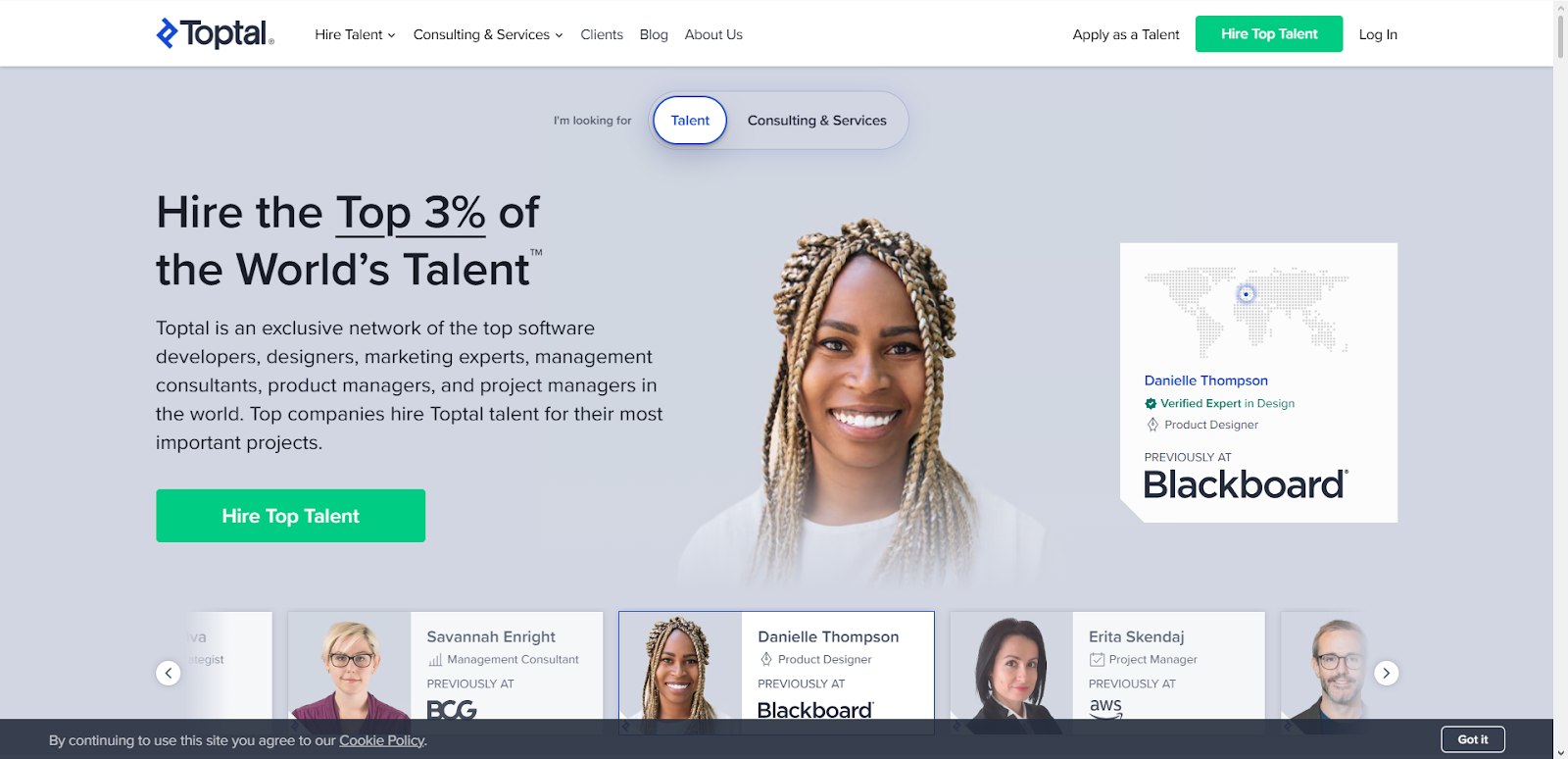
Toptal, known as a curated network of freelance talent, rolled out a dedicated SaaS practice. Rather than assigning a single team, Toptal assembles a pod from its vetted pool an architect, a product manager, a UI/UX lead, and a growth analyst within days. That fluid model is ideal for tackling well-scoped initiatives like containerizing a legacy component, integrating usage-based billing, or experimenting with AI search.
Because the engagement is talent-network driven, you gain flexibility to scale hours up or down each month. The trade-off is greater responsibility on your side to handle roadmap continuity, but many founders appreciate the speed and lower commitment when exploring new growth opportunities.
Choosing Among Top SaaS Consulting Firms: a Practical Checklist
Selecting from the universe of top SaaS consulting firms can feel like speed-dating mixed with due diligence. A bit of structure keeps emotions (and slick sales decks) in check.
- Domain proof. Do they have live references in your vertical and ARR band?
- Architectural stance. Are they opinionated enough to guide you but flexible enough to adjust when data proves an assumption wrong?
- Team seniority. What’s the senior-to-junior ratio on the delivery squad, and who actually joins your stand-ups?
- Success metrics. Can they define “done” in numbers you already track – latency, activation, gross margin?
- Knowledge transfer. How will they leave behind docs, automated tests, and recordings so your engineers aren’t forever dependent?
Budget obviously matters, but think in terms of opportunity cost. A two-month delay caused by a sloppy data-partition decision can dwarf any difference in day rates. Most top SaaS consulting firms will flex engagement models – fixed-scope sprints, outcome-based milestones, or fractional advisory hours – so tie spend to value delivered, not calendar pages.
Final Thoughts
The gap between a clever SaaS idea and a durable business has widened. Complexity hides in feature flags, multi-tenant isolation, cross-border tax engines, and AI model drift. The top SaaS services offered by partners like Brights, Slalom Build, or Thoughtbot compress learning curves, de-risk big bets, and let your core team focus on unique value. Mentored businesses see an average 83% growth in annual revenue, compared to 16% for non-mentored businesses.
Pick wisely, stay curious, and keep building. 2026 is going to be a great year for builders who work smart and fast.