
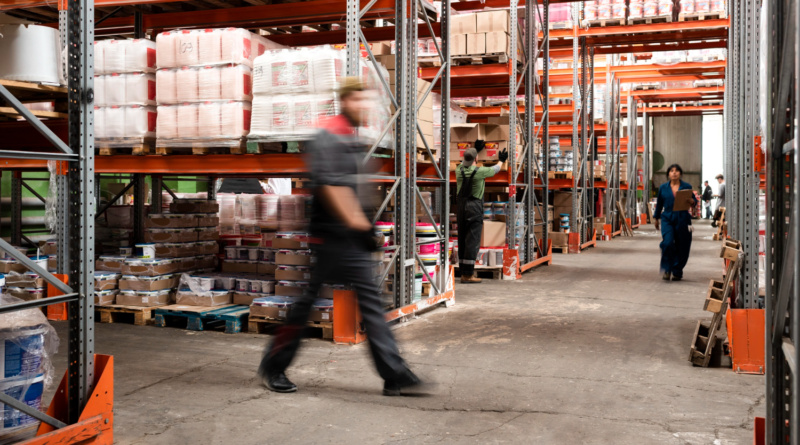
The Ultimate Guide to Planning and Managing Seasonal Warehouse Spikes
Fluctuations in demand don’t happen overnight. They develop over time, and you can find those patterns in your previous business operations. Warehouse managers should take an audit of three years of the following data: inventory turnover rates, inbound and outbound order volumes, labor hours, and equipment utilization.
This will help you identify your demand curve. You will be able to see exactly where the peak is, how long it lasts, and how the ramp-up and ramp-down look. Most businesses are surprised by how steady their own operations data is. The surge doesn’t start on the first of November or December. Give it one or two weeks, and that is where your planning should start.
If you aren’t working off this baseline, all other decisions in this list will be based on assumption.
Redesign your layout before stock arrives
Most of the seasonal congestion you’re experiencing isn’t because of volume alone – it’s because your layout is the same in-season as it is off. Your team is still driving the floor plan it was using in February, so you’re surprised when lift truck travel times triple in November.
Step one is to perform an ABC analysis across your whole seasonal SKU profile. The products you know are going to be high-velocity, and move thousands of units in the course of a peak, need to be close to the shipping docks. That means temporarily pushing slower, permanent stock further back to make room and ring-fencing the lowest rack positions closest to outbound staging for your fast-moving seasonal lines. The fewer feet each and every lift truck operator is traveling every pick cycle will add up fast when it’s multiplied by the thousands of movements a day they’re making.
Staging area optimization is just as important. You’ve got to have inbound and outbound staging zones that don’t overlap. When the two sets of pallets get intermingled because they’re sharing the same real estate, that’s when receiving teams and dispatch teams collide, pallets pile up, and put-away becomes a nightmare. Do your tape-offs before your first truckload hits your dock, not after.
Cross-docking should be evaluated for specific categories of product as well. If the demand downstream for specific seasonal lines is quick enough, and it’s possible to push them straight from receiving over towards outbound staging without them ever sitting in storage, then you’ve just freed up floor space and cut down the number of truck movements per unit. It won’t work for every SKU, but for pre-allocated, high-volume stock, cross-docking can be a major relief for both your storage footprint and your fleet.
The core fleet vs. flexible fleet model
The success or failure of an operation often comes down to how well you get that balance right. Peaking too high (or keeping too much idle) is costly and inefficient. Peaking too low means major opportunity costs in volume and top-line sales.
Top warehouses, according to the WERC DC Measures report, maintain peak-season capacity utilization between 80% and 85%. Once you push past 85%, efficiency drops sharply – congestion increases, pick accuracy falls, and safety incidents climb. That ceiling is the target. Your temporary fleet additions should be sized to keep you in that window, not just to handle maximum theoretical volume.
When sourcing short-term machinery, lead time is everything. Rental markets tighten significantly as peak season approaches. Operations that start procurement conversations in October for a December surge often find limited availability and higher rates. Those that plan in August or September get better terms and more equipment choice. For operations in major logistics hubs, locking in forklift rentals melbourne well ahead of the seasonal window ensures you’re not competing with every other warehouse in the region for the same machines.
Ensuring that load capacities match the actual requirements is a small thing that is easily let slide when your team is flat-out. However, seasonal stock is frequently not the same as regular inventory – it may be in larger packaging, on heavier consolidated pallets, or simply have bulkier dimensions. Make sure that the specified load capacities are measured against the loads you really intend to move before your rental arrives on site. An undersized machine is not only an inefficient use of resources. It is also a potential safety hazard.
Preventative maintenance before the surge, not during it
Equipment failures in high-demand times can halt the entire process and result in operation breakdowns. For example, if a forklift isn’t operational during your high-volume week, you can’t receive goods, put them in storage, or dispatch them on to customers – because all these processes require the same pallet movement equipment.
At least 30 days before your surge period, your equipment services checklist should include hydraulics, brakes, tire condition, mast chains, battery/range cycles if electric, and any of the previous operating periods’ fault codes. As issues discovered during a surge can’t be forced – substituting in rented equipment for broken-down machinery will ultimately cost more in downtime – leave enough lead time for any needed parts to arrive.
Regardless of it being a rental, the first day of a surge, or any other occasion, any forklift should undergo a pre-start safety check. This literally takes a matter of seconds, but it could save your life or the lives of one of your team. Don’t skip it.
Safety at volume: zone segregation and operator certification
Adding more equipment on the floor, more temporary staff, and more pedestrian traffic can easily put people at risk if the situation is not managed carefully.
The best place to start is with zone segregation. High-traffic forklift corridors must have physical barriers or floor markings to clearly delineate pedestrian zones. Designated crossing zones with a direct line of sight should be the only areas where forklift and pedestrian traffic cross paths. Don’t leave it to chance that operators and workers will work this out among themselves on a busy shift – it must be part of your floor plan before the peak period begins.
Temporary operators also have unique needs. An employee may have a current forklift license and 10 years of experience at another warehouse, but that does not mean they can instantly operate safely in your facility. Your racking configuration, the types of loads you handle, the equipment you use, and the traffic you see are unique to your site. Each temporary operator requires direct orientation – site layout, speed restrictions, and the unique handling requirements of the loads at your site.
Compliance during peaks is active, not passive. Pre-shift inspections, speed restrictions, and floor monitoring should all be conducted. Equipment quality and the operator’s skill can minimize risk, but even the best forklift operator may not avoid a spill in a busy aisle.
Dock scheduling and inbound flow control
Congestion at the yard is often underestimated as a source of peak-season disruption. If carrier arrivals are not spaced out, you have multiple trucks vying for limited dock doors, detention charges building up, and overwhelmed receiving teams facing simultaneous inbound volumes they can’t physically handle.
A digital dock management system addresses most of this. Scheduling carrier appointments at realistic intervals that account for unload time, put-away handoff, and dock door reset helps manage inbound flow. It also ensures that your forklift operators get a steady workload rhythm instead of long idle periods and then an undoable rush.
The receiving area is one of the most common operational bottlenecks during seasonal surges. Pallets that can’t be put away fast enough start accumulating in the staging area, which blocks dock doors, which delays the next carrier, which creates a cascade that eventually affects outbound dispatch. It’s cheaper and more effective to control inbound flow at the scheduling level than to try and recover from congestion.
Toolbox talks and daily floor communication
This is often dismissed as fluffy operations management. It is not.
On peak, the game is different every day. Volume targets are different. There are variable gaps in the staffing plan. A mechanized handling system is down. A segment of racking gets damaged and cordoned off pending inspection. A vendor has sent a non-standard pallet load, so you must change how one SKU is handled. The forklift team doesn’t get told about any of this and makes yesterday’s decisions.
Short, specific, standing, start-of-shift meetings keep everybody – long- and short-term staff – synched up. Cover the daily volume targets, any safety issues identified in the last 24 hours, any changes to procedures, and you have everyone briefed on the new reality at the required checkpoint in their shift with minimal interruption to everybody else. This is not about morale. This is flowspace. This is forklift throughput. This is safety and profits.
Temporary workers in particular rely on these briefings heavily. They don’t have the institutional memory that permanent staff carry. A clear daily brief reduces the probability of a temporary operator making a decision based on assumptions that don’t apply to your operation.
Scaling down without leaving a mess
Completion of a surge is an operational event. Temporary equipment has to be returned as agreed, in the agreed condition, and on the agreed schedule. The same is true of temporary layout changes. The more you’ve documented what you’d like to do differently next time while it’s still fresh, the more of that sequencing can be systematized versus having to improvise it. Rental agreements should also be finalized with the return process before the equipment ever hits the door. Temporary layout changes and storage locations should be mapped out before the equipment shows up.
The operations that handle seasonal surges well aren’t doing something dramatically different. They’re doing the same fundamentals earlier, with more precision, and with enough lead time that equipment, staffing, and layout decisions aren’t made under pressure.