
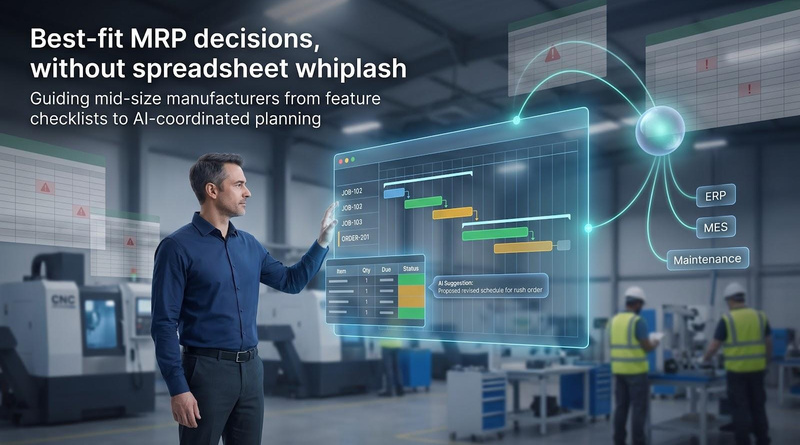
Best MRP Software for Mid-Size Manufacturers: What It Still Leaves to Your Buyers
Mid-sized manufacturers shopping for the best MRP software need more than a feature checklist. They need proof the plan survives go-live. This guide ranks eight serious contenders, flags the manual work each one still leaves on your desk, and previews an AI coordination layer that works alongside systems you already run. If your plant employs about 50 to 500 people and you’re tired of spreadsheet whiplash, keep reading. The next few minutes could save you months of rework.
Find your best-fit fast
In a hurry? Start with the snapshot below. It pairs each platform with its ideal scenario, notes whether pricing is public, and estimates the implementation muscle required. Circle the two or three that suit your plant, then dive into the deeper profiles that follow.
| Platform | When it’s usually the right call | Price visibility* | Implementation effort† | AI maturity | Stewardship burden | Key work still on you |
| Epicor Kinetic | Complex discrete, make-to-order, mixed-mode plants that need heavyweight planning | Quote only | High | Live RFQ agent | High | Method accuracy, customization control |
| Plex | Multi-plant ops chasing ERP-to-MES traceability | Quote only | High | Quality and analytics agents | High | Machine connectivity, operator discipline |
| Dynamics 365 Business Central Premium | Microsoft-centric firms seeking an affordable ERP entry | List price $110/user/mo | Medium | Copilot + paid agents | High | BOMs, Power Platform add-ons |
| NetSuite Manufacturing | Multi-entity companies unifying finance and production | Quote only | Medium-High | NetSuite Next agents | High | Module selection, script governance |
| Rootstock Cloud ERP | Manufacturers already deep in Salesforce | Quote only | Medium-High | Early AI claims | High | Finance validation, release management |
| Fulcrum | Modern CNC and sheet-metal job shops needing slick scheduling | Quote only | Low-Medium | Agents in development | Medium | Routing migration, capacity validation |
| MRPeasy | Lower mid-market factories that value predictable SaaS | Public tiers $49 to $149/user/mo | Low | AI features marketed | Medium | Data imports, tier fit |
| Katana Cloud Inventory | Product brands juggling ecommerce and light manufacturing | Core $299/mo + $199 manufacturing add-on | Low | AI replenishment suggestions | Medium | Cost logic, multi-site limits |
*“Public” signals that a list price appears on the vendor’s site on October 1, 2026.
†Implementation effort maps to our editorial classes: Low ≈ A/B, Medium ≈ B/C, High ≈ C/D.
Use this grid to zero in on the vendors worth a demo. The next sections explain why each tool lands where it does, and what homework remains before your first “MRP complete” banner appears.
MRP, ERP, MES, and AI: where the lines actually sit
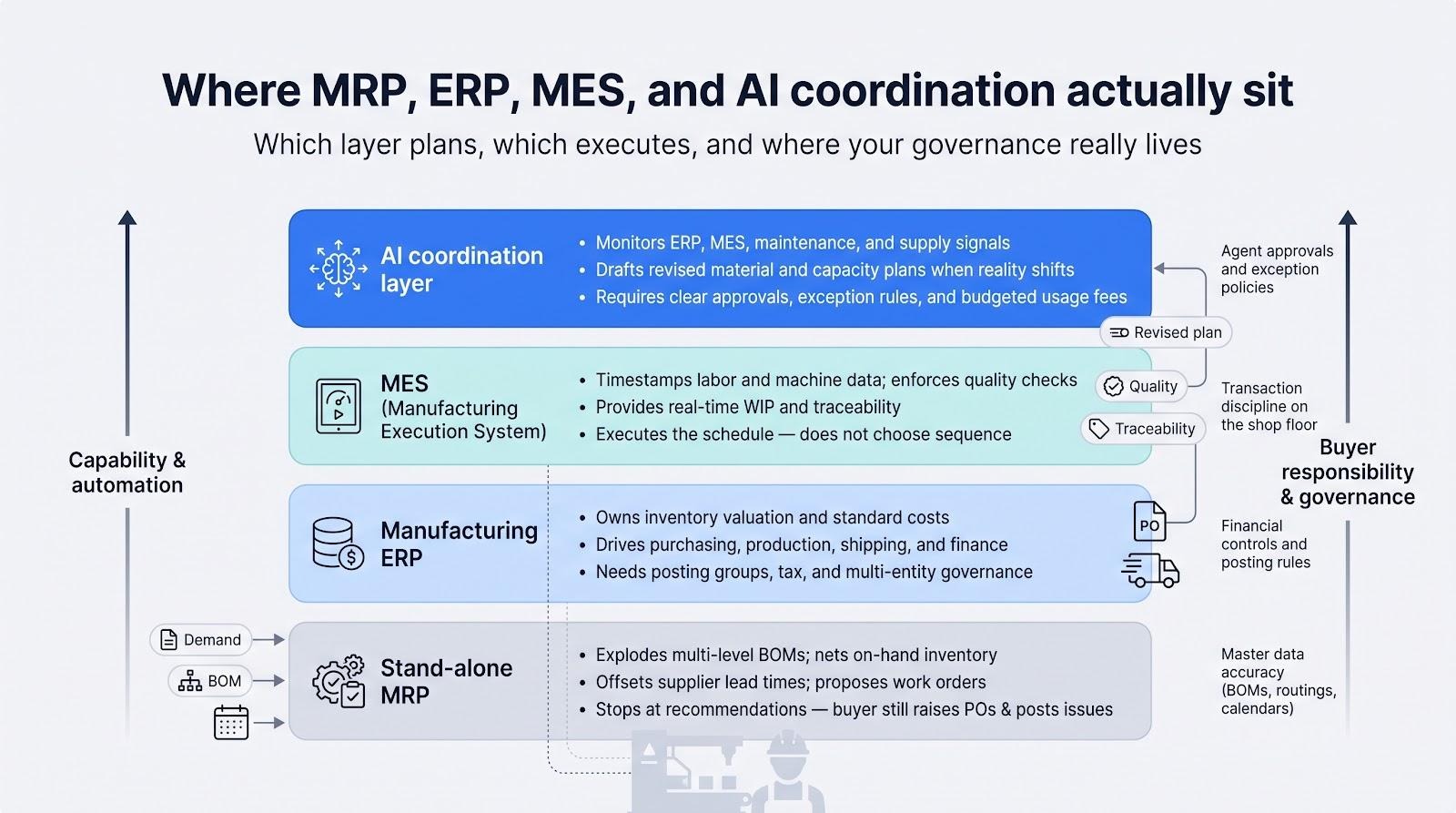
Stand-alone MRP: fast math, strict prerequisites
A stand-alone MRP system answers a narrow question: what parts are needed, and when? It explodes multi-level BOMs, nets on-hand inventory, offsets supplier lead times, and proposes work orders. That focus makes the run fast (cloud tools rerun a full multi-level explosion on demand) and attractive to plants still using entry-level accounting software. The trade-off is that every prerequisite (BOM accuracy, routings, stock balances, lead times, capacity calendars) remains your responsibility. MRP stops at recommendations; you still raise POs, post material issues, and reconcile costs. Add multiple sites, complex routings, or traceability rules, and the spreadsheet workload returns, prompting many teams to move up to a full manufacturing ERP.
Manufacturing ERP: one database from floor to ledger
ERP takes the MRP plan and drives it through purchasing, production, shipping, and finance, then closes the books on a fully costed P&L. Because ERP owns inventory valuation and standard costs, a missed material issue now misstates both tomorrow’s schedule and cost of goods sold, which tightens data discipline overnight. Upside: POs flow straight from MRP, receipts update inventory in real time, and multi-entity reporting comes baked in. Downside: configuration complexity. Posting groups, tax codes, multi-currency rules, and cross-module training all demand governance and periodic regression testing.
MES: real-time feedback from the line
If ERP is the accountant, a manufacturing execution system acts as the shift supervisor. MES timestamps labor, captures machine data, enforces quality checks, and provides traceability records on demand. The payoff, especially in food, automotive, or aerospace, is minutes-old capacity data instead of yesterday’s estimates. But MES does not choose the sequence; it executes the schedule it receives. Tablets, scanners, and sensor wiring raise the change-management bar, and any skipped transaction puts the system back into guesswork.
AI coordination layer: digital planner on top of what you own
An emerging layer of AI agents now watches ERP, MES, and supply signals, then drafts revised material and capacity plans when reality shifts, such as a rush order, a supplier slip, or a machine fault. These agents draft the replan for a person to approve, so the plan is only as good as the source data. They also introduce new governance questions: who approves each drafted PO, what counts as an exception, and how are usage-based fees budgeted? Treat the agent as you would any powerful role: define policies first, then measure its results.
Key takeaway: Each layer adds capability and responsibility. Know where your data, approvals, and compliance duties sit before you add the next box to the architecture diagram.
Organizely: AI agents that work alongside your MRP
Organizely is not an MRP, and it does not replace one. The Organizely manufacturing AI agents work alongside the MRP you already run and pick up the buyer work it leaves behind: shortage flags, supplier follow-ups, and draft purchase orders your team approves before anything is sent.
The agents keep people, machines, and stock in sync across materials, equipment, and labor, then draft purchasing, production, and work plans for your team to approve.
When an order arrives, the agent checks materials and capacity and flags shortages before work starts. For a short part, it drafts the purchase order and an updated production plan, and your team approves by message before the PO goes out. When demand, stock, or equipment changes, it drafts the revised plan and the supplier follow-ups for the buyer to review.
Speed still depends on four buyer-controlled factors:
- Source-system accuracy. BOMs, routings, and inventory must be right; bad data in, bad plan out.
- Approval rules. Decide who approves which purchase orders and plan changes, and how fast they respond.
- Integration scope. Discuss specific connectors during the sales cycle and map data flows, formats, and refresh rates early.
- Change management. Buyers and planners approve every drafted plan, so agree on a clear RACI for approvals and overrides.
To explore the platform, book a demo to discuss your workflows and deployment needs.
Choose Organizely when your MRP runs well yet buyers still lose hours to shortage checks, supplier chasing, and PO drafting. The agents work alongside your existing systems, and the MRP stays your system of record.
Epicor Kinetic: deep discrete and make-to-order horsepower
Epicor positions Kinetic as a planner-first ERP. The 2026.100 release lets users run SHOPLOAD or full MRP independently, reducing the all-or-nothing execution that once slowed large overnight runs.
Where Kinetic excels
- Breadth for complex builds. Multi-level MRP, finite APS, job management, product data, and optional MES share one SQL-backed database. A 300-person machine shop can quote a custom order, explode a 500-line BOM, reserve stock across sites, and print bar-coded travelers without switching systems.
- Embedded AI. Prism’s RFQ agent handles supplier RFQ emails and writes lead times and costs back into the ERP, trimming manual quoting loops.
Pricing snapshot (October 1 2026)
Epicor publishes no list prices. Expect:
- Platform subscription quoted per deployment
- User tiers set in the partner quote
- Module add-ons
- Outcomes-based pricing for the RFQ agent
Always request a sandbox quote and an upgrade-testing allowance.
Implementation reality
Class D: typical programs run six to twelve months, often phased by plant. Heavy customization accelerates day-one fit but doubles upgrade testing because Kinetic now ships monthly cloud releases.
Work still on you
- Method discipline. Dirty BOMs, routings, or calendars break APS logic.
- Supplier data. The RFQ agent needs lead times, MOQs, and EDI rules before it can draft useful quotes.
- Customization governance. Every personalization becomes another regression script.
Choose Kinetic when mixed-mode demand, deep traceability, and AI-assisted sourcing matter more than a rapid SaaS rollout. Skip it if a two-month go-live or published seat pricing is a deal-breaker.
Plex Smart Manufacturing Platform: ERP and MES under one roof
Plex’s pitch is simple: run ERP, MES, quality, and IIoT in one cloud database so every record shares the same timestamp. Planners react to what happened a minute ago, not to data keyed in after lunch.
Where Plex stands out
- Plant-scope licensing. Plex quotes by plant scope or by user and module, so confirm which model applies.
- Near-real-time planning. MRP draws on live ERP and MES records, so plans reflect current shop-floor data.
- Audit-ready depth. Native quality, traceability, and IIoT dashboards help food, automotive, and aerospace suppliers pass audits without third-party trackers.
Pricing snapshot (October 2026)
Plex sells an annual subscription quoted by plant scope, users, and modules. Third-party listings put entry pricing near US $3,000 per month. Budget extra for machine-integration kits, EDI onboarding, and any separate corporate ERP.
Implementation reality
Class D. A full ERP plus MES rollout touches every cell, QA gate, and warehouse lane, so expect a phased program. PLCs older than Windows XP slow integration, and multi-plant deployments magnify governance needs.
Work still on you
- Machine and PLC wiring. No signal, no data; map every tag.
- Operator discipline. Scanners and tablets help only when every move gets scanned.
- Supplier portal adoption. EDI invites still need follow-up to make partners log in.
Choose Plex when real-time traceability and single-stack simplicity matter more than a quick SaaS rollout. Skip it if shop-floor teams resist standard work instructions or finance insists on keeping a different ERP of record.
Dynamics 365 Business Central Premium: Microsoft-first cloud ERP for the core mid-market
Business Central Premium folds manufacturing into the same SaaS that already runs finance, CRM add-ins, and Microsoft 365. Planners jump from released production orders to Power BI dashboards without switching tabs, and IT leans on Azure security instead of another vendor’s stack.
Where BC delivers
- Manufacturing starter kit. Production BOMs, routings, finite loading, forecasting, and service management are native.
- Built-in Copilot. Every tenant ships with Copilot; live agents such as the Sales Order Agent bill prepaid or pay-as-you-go Copilot Credits.
- Microsoft ecosystem. ISVs fill gaps (graphical scheduling, advanced WMS, CAD-to-BOM), while Power Automate and Dataverse tie BC to Teams, SharePoint, or a custom quality app.
Pricing snapshot (October 2026)
- Full user: $110 per user per month (annual billing)
- Device license: $45 per device per month (“Shop Floor,” “Warehouse,” and similar roles)
Copilot is bundled; budget extra for Copilot Credits if you intend to run AI agents frequently.
Implementation reality
Class C. Focused partner projects commonly finish in three to four months. Complexity rises with multi-company charts, heavy barcoding, or deep shop-floor data capture. Large plants sometimes start on BC, then migrate to Dynamics 365 Supply Chain Management when volume or compliance outgrows Premium.
Work still on you
- Data migration. Posting groups, dimensions, BOMs, and routings must be spotless before cut-over.
- ISV selection. Decide early whether you need finite APS, WMS, or MES add-ons, and own their renewals.
- Copilot governance. AI suggestions can post inventory, so set roles and approvals before turning the bot loose.
Pick BC Premium when you want predictable SaaS pricing, native Microsoft ties, and an extensible ecosystem. Look higher up the Dynamics ladder if you need embedded constraint-based planning across multiple 24/7 plants or regulated process lines.
Oracle NetSuite Manufacturing: cloud finance meets configurable shop floor
NetSuite offers one cloud platform that unifies finance, CRM, inventory, production, and ecommerce, so the supply planner sees the same numbers the CFO will close next week.
Strengths worth noting
- Tiered manufacturing depth. Start with Work Orders & Assemblies for light assembly, add WIP & Routings for work centers and labor costing, or deploy Advanced Manufacturing for MES-level control and mobile data capture.
- Multi-subsidiary roll-ups. A holding company can consolidate nine plants without spreadsheets, while native revenue recognition keeps auditors happy.
- Ecosystem reach. SuiteApps extend the core without breaking the upgrade path, and SuiteScript lets in-house developers adjust flows and dashboards.
Pricing snapshot (October 2026)
Licensing follows NetSuite’s four-part formula: platform fee, user seats, optional modules, and a one-time implementation quote. NetSuite publishes no dollar figures, and each manufacturing add-on carries its own line item. Budget annual increases and module minimums before signing.
Implementation reality
Class C to D. SuiteSuccess templates speed finance and distribution, but Advanced Manufacturing still requires detailed routing, work-center, and labor-rule design. Every custom script needs regression tests during NetSuite’s twice-yearly upgrades.
Work still on you
- Module selection. Buy only what you will use; unused modules still renew.
- Shop-floor discipline. Mobile data capture works only when every move gets scanned.
- Script governance. Each SuiteScript fills a gap but adds a permanent test case.
Choose NetSuite when multi-entity finance drives the project, and manufacturing depth can grow incrementally. Pass if you need agentic AI beyond what NetSuite Next covers today.
Rootstock Cloud ERP: Salesforce-native manufacturing for customer-centric teams
Rootstock runs on the same Salesforce platform your sales and service reps already use, so CRM, quoting, inventory, production, and field service share one object model. The shop floor sees a delivery-date change the moment a rep clicks Save.
What clicks for manufacturers
- Low-code design. Salesforce Lightning lets admins drag and drop screens, build flows, and spin up dashboards without code. Engineer-to-order shops keep quotes, CAD files, and project tasks next to work orders.
- Shop-floor control. MRP, finite capacity, backflushing, and lot or serial traceability live in the data model; mobile apps issue materials and record labor at the line.
- Independent proof. G2 lists Rootstock at 3.9/5 across 46 reviews (retrieved October 2026), praising manufacturing depth and support while noting financial-reporting gaps.
Pricing snapshot (October 2026)
Quote only. You license Salesforce platform seats with Rootstock, then add Rootstock users and implementation services. API calls follow Salesforce governor limits, so estimate integration traffic early.
Implementation reality
Class C to D. Multi-module go-lives typically run six to twelve months. Success hinges on solid Salesforce architecture: objects, permissions, and release cadence. Custom fields feel easy now, but each one needs regression tests after the three Salesforce updates released every year.
Work still on you
- Finance validation. Manufacturing flows shine, yet statutory reporting often needs extra configuration or a third-party tool.
- Release management. Three Salesforce updates a year require regression tests or you risk breakage.
- Data governance. Item masters, BOMs, and routings still demand ERP-grade rigor.
Choose Rootstock when sales, service, and manufacturing must live in one cloud and you already invest in Salesforce talent. Skip it if you need deep multi-entity finance out of the box or lack resources to manage a rapid release cadence.
Fulcrum: modern job-shop platform with AI on the horizon
Fulcrum’s interface feels like a digital whiteboard. A live, color-coded schedule shows every job’s priority, workstation, and status, and dragging a bar to another machine recalculates finish dates in seconds.
Why job shops care
- Autoschedule. The engine weighs live WIP, capacity calendars, material availability, and due dates to pick the next best job for every resource, then updates the floor instantly.
- Shop-floor data capture. Operators clock in on tablets, record scrap, and snap photos that feed quality dashboards and customer portals.
- Real-time Q&A. The Archie chat bot answers questions like “Where’s job 456?” today; deeper planning agents are on the roadmap, so treat them as vision, not features.
Pricing snapshot (October 2026)
Quote only. Subscriptions include unlimited users and a fixed one-time launch fee. The vendor promises go-live “in weeks, not years” with a dedicated Launch Manager.
Implementation reality
Class B to C in our planning matrix (roughly two to four months). BOM and routing imports are straightforward for shops leaving visual job-shop ERPs. The heavier lift is validating capacity numbers and priority rules so Autoschedule reflects reality, not aspiration.
Work still on you
- Routing migration. Accurate steps and cycle times drive schedule accuracy.
- Priority discipline. Expedite inside Fulcrum; off-system tweaks break the algorithm.
- Finance tie-in. Fulcrum offers basic financials; many shops still post to QuickBooks or Business Central.
Choose Fulcrum when speed, user experience, and a modern scheduling engine matter more than multi-plant rollups or advanced compliance. Pass if you need agents that are live today rather than next quarter.
MRPeasy: transparent SaaS MRP for the lower mid-market
MRPeasy posts its prices in plain sight: $49, $69, $99, and $149 per user per month for Starter, Professional, Enterprise, and Unlimited plans (retrieved October 2026). After ten users, seats bundle in tens for $79 per bundle, keeping growth predictable.
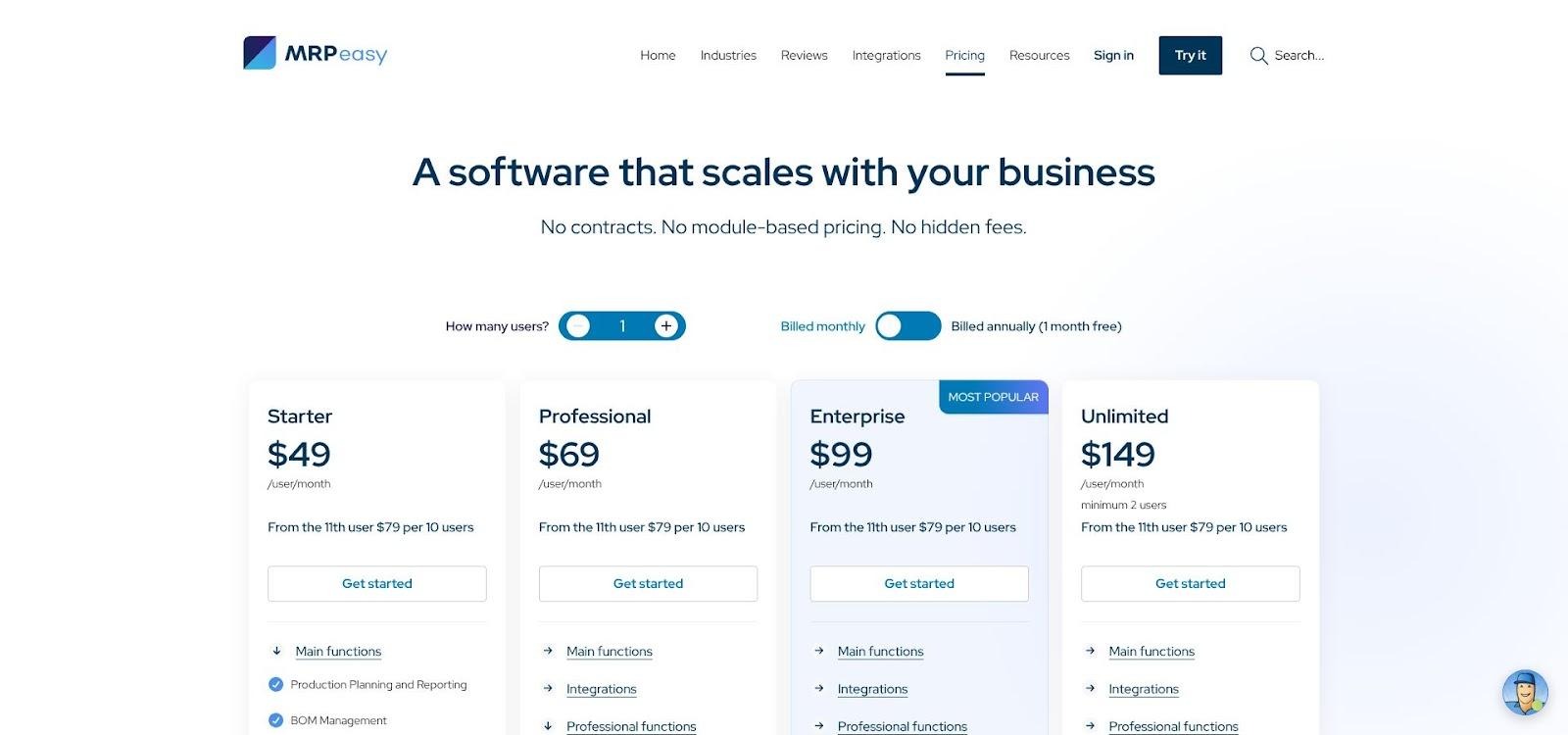
MRPeasy transparent SaaS MRP pricing page screenshot
Why smaller plants love it
- Self-service start. Sign up online, import items and BOMs via CSV, and run your first MRP during the free trial.
- Tiered depth. WMS and CRM ship in every plan; barcodes, MPS, multi-site, and revision control start at Enterprise.
- Focused scope. Purchasing, inventory, production, and light finance support factories of 10 to 200 employees, the range the vendor targets.
Implementation reality
Class A to B. Small teams with clean data and simple scope can launch within weeks; multi-site or multi-level BOMs add weeks, not months.
Work still on you
- Master-data diligence. MRP accuracy falls the moment inventory counts drift.
- Tier fit. Multilevel MPS, revision control, or multi-site functions appear only in higher plans.
- Accounting sync. You reconcile costs in QuickBooks or Xero; MRPeasy is not a full GL.
Choose MRPeasy when you want clear pricing, quick wins, and a sweet spot around 200 employees. Look elsewhere for embedded finance, deep APS, or multi-plant consolidation under one license.
Katana Cloud Inventory: inventory-first MRP for product brands
Katana began as a cloud inventory tool for makers, so its interface feels like a modern inventory app that also runs light MRP and shop-floor tasks.
What clicks for consumer-product makers
- Core plan ($299 per month). Handles items, BOMs, purchasing, and ecommerce connections, with fees that scale per delivered sales order.
- Manufacturing add-on ($199 per month). Adds routings and manufacturing insights; the Shop Floor App is a separate add-on.
- Native plugs. Shopify, BigCommerce, WooCommerce, QuickBooks, and Xero sync without middleware.
- User feedback. G2 lists Katana at 4.4/5 across 118 reviews (retrieved October 2026), praising usability while noting limited depth and extra add-on costs.
Implementation reality
Class A to B. Import products and BOMs via CSV, map channels, and run your first MRP in a day. Complexity rises only if you need regulated traceability or multi-plant logic.
Work still on you
- Cost logic. Katana calculates average cost; standard or actual costing needs an accounting system.
- Lead times and buffers. Purchase suggestions depend on your supplier and production lead-time entries.
- Scaling strategy. Plan when to move to a broader ERP if you add plants or compliance needs.
Choose Katana when you’re an ecommerce-led manufacturer that needs channel-aware inventory and light MRP. Skip it for enterprise-grade planning, multi-site control, or deep process manufacturing.
Conclusion
Pick the MRP that fits your plant, budget, and IT bench. Then list the buyer work it still leaves (shortage checks, supplier follow-ups, PO drafting) and decide who owns it: your team, or an AI layer that drafts that work for your approval.