

The 8 best AI Overviews checkers for a 400,000-SKU catalog (2026)
You cannot check 400,000 product pages for AI Overviews one query at a time. You can check a few thousand product and category queries, grouped by template, and know what the rest is doing. That’s the job of an AI Overviews checker at our size: pick the right 2% and re-check it. It’s also a revenue line: 28.8% of GB retail sales were made online in August 2026, and the answer above a product query sits in front of that money.
For most large catalogs, SE Visible by SE Ranking is the pick. It tracks prompt sets organized into topics, one per category, across Google AI Overviews and AI Mode, stores the unedited answer each metric came from, and hands the data to the backlog through its API and Looker Studio. For SKU-level shopping data, it relies on purpose-written prompts. The other seven are ranked below.
Problem 1: why can’t a free AI Overview checker cover a catalog?
A free AI Overview checker answers one query, in one location, at one moment. At catalog scale, you need trigger rate and cited URLs across thousands of product and category queries, grouped by template and re-checked on a schedule.
Sampling is the second trap. An AI Overview check on 500 head terms samples the wrong slice: in SE Ranking’s US study, 10-word queries triggered AI Overviews in 69.21% of cases, against 12.78% for one-word queries; terms above 100,000 monthly searches sat at 9-12%.
Our 400,000-SKU catalog lives in the long tail. Scale changes the question: which slice do you sample? Attribute queries, by template.
Problem 2: which product queries trigger AI Overviews now?
In SE Ranking’s successive US studies, the share of e-commerce and retail queries showing an AI Overview fell from 25.76% to 1.34% during 2024, then read 54.90% in January 2026 and 53.02% in February 2026. Exposure moved from near zero to a majority of retail queries in under two years. Any 2024 benchmark of AI search for e-commerce is stale.
My last UK benchmark matched the 2024 US data: e-commerce and retail sat at 1.40% in UK results in November 2024. On that number, AI Overview SEO for our category templates never earned a sprint. The 2026 US figures say otherwise. I re-benchmark per category, not per site.
Problem 3: why does AI Mode shopping need its own check?
AI Mode’s shopping layer surfaces marketplaces and product listings, and AI Mode cites mostly different pages from AI Overviews. In US data, the two surfaces share only 10.7% of URLs and 16% of domains. A checker reading AI Overviews alone undercounts product visibility.
The shopping feature appeared on 61.66% of e-commerce and retail queries, against 4.62% of general ones. Across 140 Apple products, apple.com showed up 21 times and eBay 585. Google’s Lilian Rincon says AI Mode will start “a query fan-out” behind one question. AI shopping needs its own log, per category.
What fixes it: how do the 8 AI Overviews checkers compare at catalog scale?
At catalog scale, the scale unit splits the 8 platforms: two keyword trackers stop at 5,000 and 10,000 keywords, two credit plans at 3,600 and 4,800 monthly answers, and SE Visible tracks prompts in topics per category. Four tests decide which AI search visibility checker earns a ticket:
- Scale unit and cap
- AI Mode and shopping coverage
- Answer, cited URLs, and snapshot kept
- Export and API
I read each vendor’s own product and pricing pages in October 2026, sized against our catalog.
| # | Platform | Checks AI Overviews by | Scale unit and cap | AI Mode / shopping | Export / API | Starting price |
| 1 | SE Visible by SE Ranking | Prompts, real browser session; AI Overviews presence rate, organic top-20 overlap | Topics, one per category | All plans / transactional-intent prompts | API, Looker Studio, CSV/XLSX | Free trial available |
| 2 | Rankscale | Search terms | Credits, 1,200 on Pro | Yes / Shopping Analysis | CSV; API from Pro+ | $99/mo |
| 3 | seoClarity | Keywords; snapshots | Keywords, minimum 2,000 | ArcAI / SKU-level ArcAI Shopping | APIs | From $2,500/mo |
| 4 | Keyword.com | Keywords; HTML snapshots | Up to 10,000 keywords; custom beyond | Prompt credits / Not stated | CSV; API | $4/mo |
| 5 | BrightEdge AI Catalyst | Prompts by journey stage | Not stated | Yes / Not stated | CSV | On request |
| 6 | Semrush | Keywords; citation logged as #1 | 500/1,500/5,000 keywords | Yes / Not stated | API on Advanced | $139/mo |
| 7 | Scrunch | Prompts | 125 prompts, 1 country (Core) | Enterprise / Enterprise | API on Enterprise | $250/mo |
| 8 | AthenaHQ | Prompts, every plan | Credits, 3,600 on Starter | From Starter / Shopify integration | CSV; API add-on | Free; $295/mo |
The 8 best AI Overviews checkers for large catalogs
They’re ranked for catalogs with hundreds of thousands of product pages, template first.
1. SE Visible
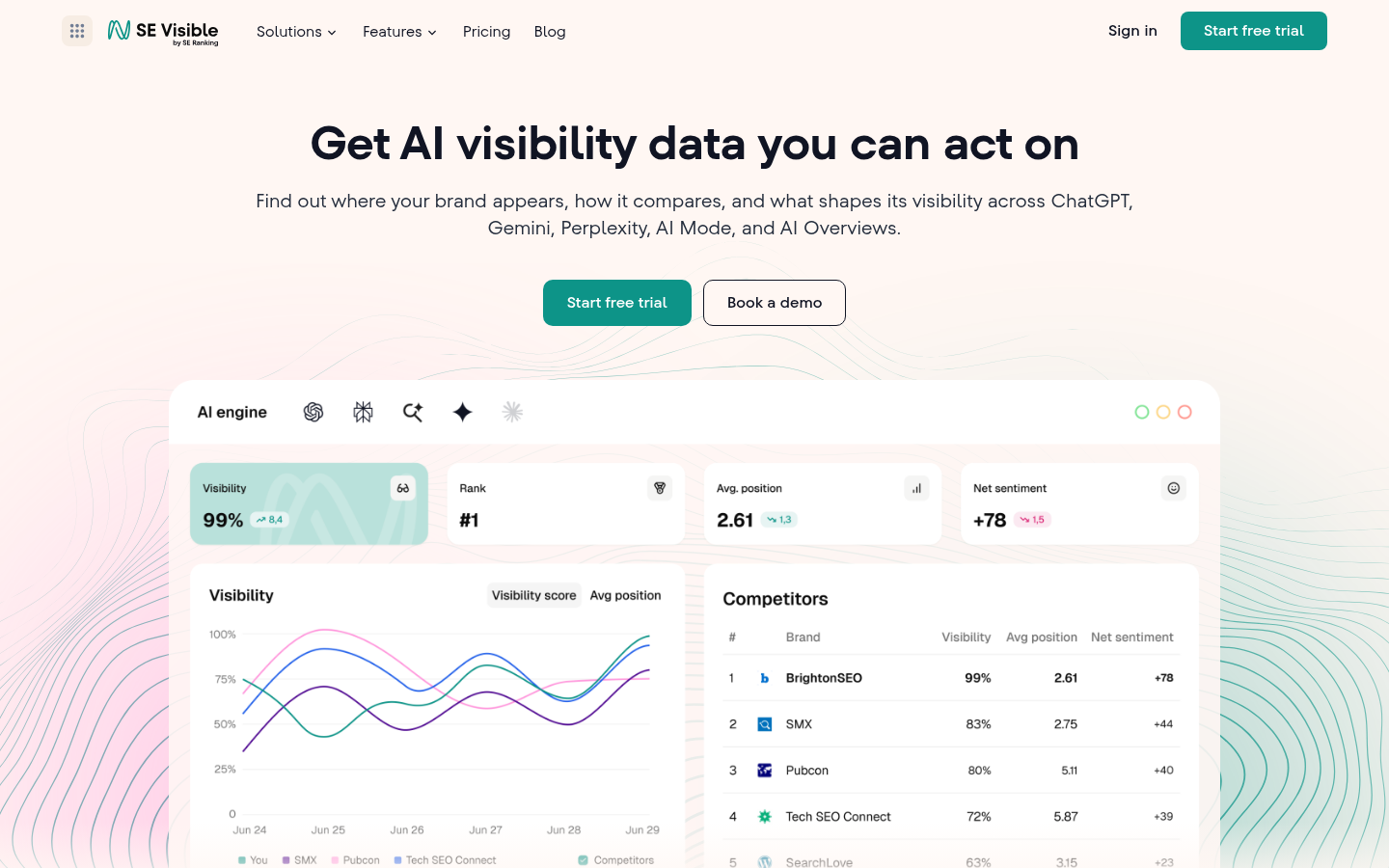
A category page with strong organic traffic can still be missing from the AI Overview above it. SE Visible by SE Ranking is an AI visibility platform showing how products and categories surface in Google AI Overviews, ChatGPT, Gemini, and AI Mode.
Best for: in-house SEO teams at large retailers, owning an AI visibility mandate and needing AI Overviews data per category.
Standout: Prompts sit in topics, one per category template, tagged by intent (transactional included) and branded or non-branded. That maps product visibility in AI answers onto your category tree: an AI Overviews presence rate (share of tracked queries showing one) plus organic top-20 overlap.
Pros:
- Stores each unedited answer, with engine, date, and market, behind the metric it produced
- Tracks AI Mode on all plans, next to AI Overviews
- Scopes the market to a country, or a specific city or region
- Feeds the backlog: API access on all plans, Looker Studio, and CSV or XLSX export
Cons:
- Scope ends at AI answers; SE Ranking handles site audits, keyword research, and rank tracking
- No dedicated shopping-results view for listings or merchants; SKU-level shopping data depends on purpose-written prompts
- In-app reports are still developing; category dashboards run through Looker Studio or the API
Pricing: A free trial is available; visible.seranking.com carries the current plans.
The SKU test: Topics per category turn the output into tickets, which a single-query AI Overviews checker cannot. If organic top-20 overlap on garden furniture drops while AI Overviews keep firing, that’s one template fix, not 9,000 product pages. Tracking runs daily by default, and you can change the frequency in project settings.
2. Rankscale
Rankscale is a credit-metered AI search tracker covering AI Overviews, AI Mode, and shopping results.
Best for: retailers tracking AI shopping results (products, merchants, buy box) beside AI Overviews.
Standout: Shopping Analysis shows which brands, products, and merchants appear in ChatGPT, Google AI Mode, and Bing Copilot shopping results, including merchant reach and buy-box wins over time. That list skips AI Overviews, so AIO checks run through standard search-term tracking.
Pros:
- Allows unlimited search terms
- Schedules terms hourly to monthly
- Exports CSV and Sheets
Cons:
- Credits cap volume: each engine run costs about 0.25
- REST API starts on Pro+
Pricing: from $99/mo (Pro, 1,200 credits, monthly); 7-day trial.
The SKU test: 1,200 credits buys up to 4,800 answers a month: about 436 per template across our eleven, with every extra engine drawing on the same pool. Enough for a sampled slice; the long tail stays unmeasured.
3. seoClarity
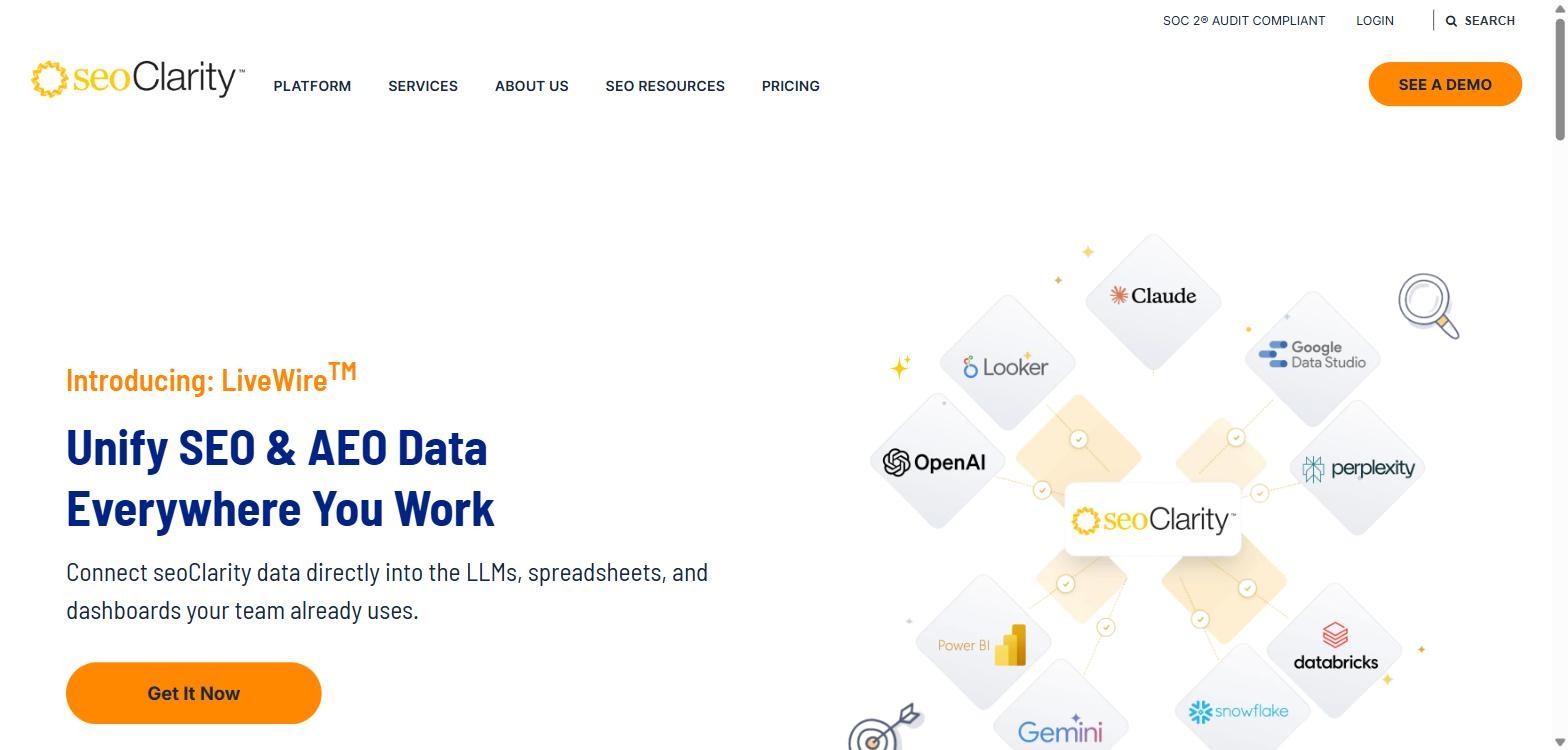
seoClarity is an enterprise SEO platform pairing keyword-level AI Overviews tracking with its ArcAI add-on.
Best for: enterprise retailers needing SKU-level AI shopping data.
Standout: ArcAI Shopping identifies unique products in AI responses, including Google AI Overviews and AI Mode, segmented by category, brand, or custom tags. It also counts prompts returning product cards or shopping listings, split into high-intent “buy” prompts and research queries.
Pros:
- Flags tracked keywords showing an AI Overview
- Compares two-date AIO snapshots for AI Overview analysis
- Offers ranking and AI visibility APIs
Cons:
- ArcAI defaults to weekly checks
- Rankings require at least 2,000 keyword queries
Pricing: packages from $2,500/mo (marked representative); demo-led.
The SKU test: Category segmentation is the nearest thing to a template view of shopping results. The ticket writes itself: which category loses product cards to resellers. Weekly checks suit a monthly re-score; go daily for spring peak.
4. Keyword.com
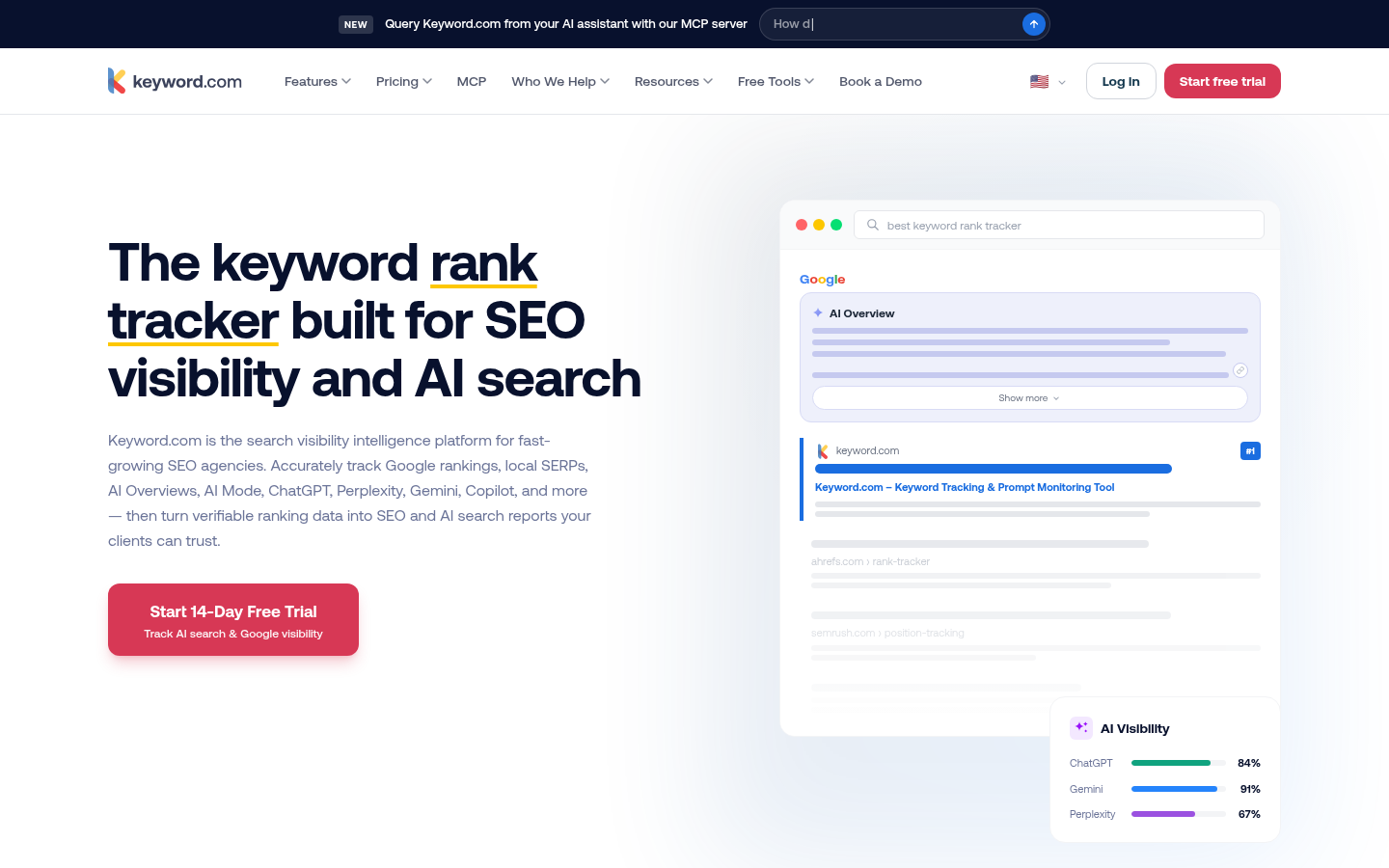
Keyword.com is a rank tracker that flags AI Overviews on tracked keywords at ZIP level.
Best for: teams adding AI Overview checks to ZIP-level rank tracking.
Standout: This AI Overview checker reveals which queries trigger AI Overviews and which of your URLs get cited, with a verifiable HTML snapshot for every result. On-demand updates refresh keywords in under 2-3 minutes, outside the regular daily or weekly schedule.
Pros:
- Imports keywords via CSV
- Exports PDF and CSV
- Includes a rank tracker API
Cons:
- AI Mode needs separate prompt credits
- Tiers stop at 10,000 keywords; custom from $490/mo
Pricing: from $4/mo (50 keywords, monthly; $3/mo annually); 14-day trial.
The SKU test: 10,000 keywords, about 2.5% of our SKU count, covers our top categories plus a long-tail sample. That slice survives sprint planning. Going wider means the custom tier, so price it against one template ticket first.
5. BrightEdge AI Catalyst
BrightEdge AI Catalyst is the AI module of BrightEdge’s enterprise suite, tracking mentions and citations.
Best for: BrightEdge customers wanting prompts mapped to buyer-journey stages.
Standout: AI Catalyst builds and tracks prompts mapped to buyer-journey stages across Google AI Overviews, AI Mode, ChatGPT, and other platforms. When a competitor holds the cited spot, it shows that page beside yours on citation counts, ranking keywords, and estimated traffic.
Pros:
- Splits Mentions Presence from Citations Presence
- Opens the full AI response
- Exports tables to CSV, charts to PNG
Cons:
- Product pages publish no prompt volumes or cadence
- Pricing only on request
Pricing: demo-led, no public price.
The SKU test: Funnel stages map cleanly onto category versus product queries, and the competitor-page comparison drafts half a ticket. With no published volumes, sizing it against 400,000 SKUs waits for a demo, so book one early.
6. Semrush
Semrush’s Position Tracking reads an AI Overview as a SERP feature on a campaign’s keyword list.
Best for: retailers already tracking head terms in Semrush.
Standout: A domain cited in an AI Overview is logged at #1, whatever its organic position, and a toggle shows the campaign with or without AI Overviews counted. Self-serve plans track 500, 1,500, or 5,000 keywords daily, down to postal code.
Pros:
- Shows which tracked keywords trigger AI Overviews
- Tracks Google AI Mode too
- Segments by device and language
Cons:
- Caps self-serve plans at 5,000 keywords
- Keeps daily data for 60 days, then weekly points
Pricing: $139/mo (SEO plan, monthly); $117.33/mo billed annually.
The SKU test: 5,000 keywords is 1.25% of our SKU count. As an AI Overviews checker, that holds a head-term sample per category. Worth keeping if the campaign exists; not worth a sprint to build.
7. Scrunch
Scrunch is a prompt-based AI monitoring platform with a shopping view for products in AI answers.
Best for: enterprise brands wanting product observability in AI answers.
Standout: The shopping page tracks which of your products appear in AI shopping results, which don’t, where they rank, and how that trends. It also shows which retailers AI funnels buyers toward. Google AI Overviews is one of four Core engines.
Pros:
- Logs citations on both plans
- Maps prompts to funnel stages
- Benchmarks five competitors on Core
Cons:
- Limits Core to 125 prompts, 5,000 responses, one country
- Reserves AI Mode, product observability, and the API for Enterprise
Pricing: Core $250/mo (7-day trial); Enterprise custom.
The SKU test: 125 prompts across our eleven templates is about 11 each: a thin sample. The retailer view matters where marketplaces take the answer, and it starts on Enterprise: a procurement conversation before a sprint.
8. AthenaHQ
AthenaHQ meters AI search tracking in credits and includes Google AI Overviews on every plan.
Best for: Shopify-led retail teams tying AI search tracking to revenue.
Standout: AI Overviews sits beside ChatGPT, Perplexity, Gemini, and Copilot on every plan; one AI response costs one credit. From Starter, a Shopify integration attributes revenue to AI search discovery, and unlimited topics give every category its own.
Pros:
- Starts free with 300 credits
- Exports CSV on Starter
- Connects GA4 and Search Console
Cons:
- Adds AI Mode only from Starter
- Sells API access and extra credits as Starter add-ons, in one region
Pricing: Free Essential (300 credits); Starter $295/mo.
The SKU test: Starter’s 3,600 credits buy 3,600 answers a month. One engine, checked daily, covers about 120 prompts. Revenue attribution is the line that wins sprint planning; the credit math decides how many categories get measured.
Which AI Overviews checker should a large catalog choose?
If you need more than an AI Overviews checker, SE Visible is the platform I’d start with: topics per category, AI Mode included, the answer kept, backlog-ready data. seoClarity and Rankscale model product-level shopping listings directly, while SE Visible covers them through transactional prompts.
No schema sprint, either: Google asks for current Merchant Center data, not special markup. For AI Overview SEO, the winning ticket is feed and template quality.
Skip if: you target the product long tail (skip Semrush’s keyword cap) or a whole catalog (skip Scrunch Core’s 125 prompts).
Try SE Visible on one category template to see how it fits your sprint planning. For the SEO side, SE Ranking covers Google and the traditional search engines. Together, they give a fuller picture of each category across search.
AI Overviews checker FAQ
What triggers a Google AI Overview on product and category queries?
Length and specificity lead: a long product query with size, material, or finish attributes triggers an AI Overview more often than a head term. Category plays a part too. Nothing guarantees one, and rates move: re-check by category.
Is a free AI Overviews checker enough for a large product catalog?
It covers spot checks: whether one query shows an AI Overview today. A catalog needs thousands of product and category queries on a schedule, with history and AI Mode. Keep that AI Overview checker for one-offs; track a sample per category template.
How do I check if a keyword triggers an AI Overview?
Search it in a clean, signed-out session for the target location, or use a checker that logs presence, cited URLs, and date. Presence can change between checks, so one AI Overview check proves little. At catalog scale, the check needs a schedule.