
Tire Pressure and Performance: What Every Driver Should Understand
Tire pressure affects safety, fuel economy, handling, and tire lifespan more than most drivers realize. Here’s a practical guide to the why and how of tire pressure management.
Tire pressure is one of the most commonly neglected aspects of vehicle maintenance, and one of the ones with the most immediate impact on safety and performance. The majority of vehicles on the road at any given time have at least one tire that’s significantly outside the recommended pressure range. This isn’t because drivers don’t care; it’s because tire pressure changes gradually and there’s no immediate alarm when it’s wrong.
Understanding why tire pressure matters as much as it does and how to manage it correctly converts tire pressure from something you think about occasionally to a regular maintenance habit with clear benefits.
Why Tire Pressure Matters for Safety
The contact patch, the small area where the tire meets the road, is what generates all of the traction that allows a vehicle to accelerate, steer, and stop. This contact patch is maintained and shaped by tire pressure. Under-inflated tires have a larger contact patch that distorts and flexes excessively during driving, generating heat that can lead to tire failure. Over-inflated tires have a smaller contact patch with reduced traction capability. Neither condition serves the driver as well as correct pressure. A tire specialist at a tire alignment Waco shop can check pressure and overall tire condition together.
The handling changes associated with incorrect tire pressure are sometimes not consciously noticed by drivers, but they affect the vehicle’s response in emergency situations. A vehicle with significantly under-inflated tires requires longer stopping distances and handles less predictably in emergency maneuvers than one with correct pressure.
How to Find the Correct Pressure for Your Vehicle
The correct tire pressure for a vehicle is specified by the vehicle manufacturer, not by the tire manufacturer. This is an important distinction: the pressure rating on the tire sidewall is the maximum pressure the tire can contain, not the recommended operating pressure. The correct pressure for your specific vehicle is found in the driver’s door jamb placard and in the owner’s manual, and it may differ between front and rear tires.
Different tire sizes, different loads, and highway vs local driving don’t change the recommended pressure. The manufacturer’s specification accounts for the typical range of use conditions. The only reason to deviate from the recommended pressure is when specifically advised by a tire professional for a specific reason, such as load-carrying that approaches the vehicle’s maximum weight rating.
Temperature Effects on Tire Pressure
Tire pressure changes with temperature: approximately 1 PSI for every 10 degrees Fahrenheit of temperature change. This means a tire properly inflated in the morning when temperatures are cool will have higher pressure in the afternoon after the vehicle has been driven and the air inside the tire has heated. It also means tires lose pressure through winter and gain it back in summer.
In Texas, where summer temperatures can spike dramatically, tires inflated during cool weather need checking as temperatures rise. The TPMS (tire pressure monitoring system) required on vehicles sold since 2008 will alert to significant pressure loss but is often calibrated to trigger only when pressure is 25% below specification, which is a significant under-inflation already.
Fuel Economy Impact
The US Department of Energy estimates that properly inflated tires improve fuel economy by 0.5% to 3% compared to under-inflated tires, and that for every 1 PSI drop below recommended pressure, fuel economy decreases by approximately 0.2%. These numbers may seem small individually, but under-inflated tires are the rule rather than the exception across the vehicle fleet, and the cumulative fuel wasted by under-inflated tires is significant.
The fuel economy impact comes from rolling resistance: under-inflated tires flex more with each rotation, converting energy into heat rather than forward motion. Correct tire pressure reduces this unnecessary energy loss.
Tire Wear and Pressure Relationship
Incorrect tire pressure produces characteristic wear patterns that are diagnostic of the pressure problem. Under-inflated tires wear predominantly on the outer edges of the tread where the flattened contact patch concentrates the most stress. Over-inflated tires wear predominantly in the center of the tread where the ballooned tire contacts the road most heavily.
Even wear across the tire tread is the signature of correct pressure, properly maintained over time. Checking wear patterns during routine tire inspections gives you information about whether the pressure has been consistently adequate over the past several thousand miles.
Checking and Maintaining Pressure
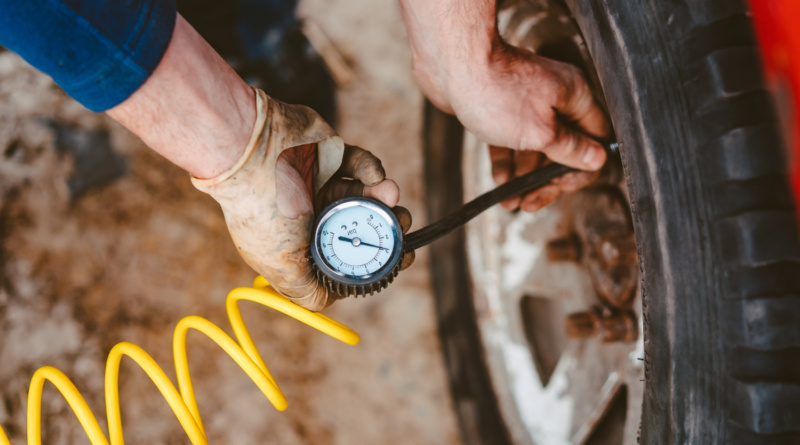
Tire pressure should be checked monthly and before any long trip. Pressure is most accurately measured when tires are cold, before the vehicle has been driven more than a mile. A quality tire pressure gauge, either digital or dial type, provides more accurate readings than the stick-type gauges that come with many valve cap kits.
Nitrogen inflation, offered at many tire shops as an alternative to standard compressed air, provides slightly more stable pressure over time and temperature changes than air because nitrogen molecules are larger and permeate rubber more slowly. The practical benefit for most drivers is modest, but for those who find themselves frequently needing to add air, nitrogen can extend the interval between checks.
Wrapping Up
Tire pressure is a simple maintenance item with outsized effects on safety, fuel economy, handling, and tire longevity. A monthly check that takes less than five minutes is the minimum that provides meaningful benefit. Understanding why pressure matters makes it easier to prioritize what feels like an inconvenient routine. The combination of safety improvement and cost savings from better fuel economy and longer tire life is a clear return on a very small time investment.
Frequently Asked Questions
Does my TPMS system mean I don’t need to manually check tire pressure?
TPMS is a warning system that alerts you when pressure drops significantly, but it’s not a substitute for regular manual pressure checks. Most TPMS systems are calibrated to warn at 25% below recommended pressure, which is already a significant under-inflation. Manual monthly checks catch gradual pressure loss before it reaches the TPMS threshold. When the TPMS light comes on, it means you’re already at a concerning pressure level, not that you’ve caught the problem early.
Should I inflate tires to the maximum pressure shown on the sidewall?
No. The maximum pressure on the sidewall is a structural limit, not a performance specification. Inflating to the sidewall maximum over-inflates the tire relative to what the vehicle’s handling was designed around, which reduces the contact patch, decreases traction, and creates a harsh ride. Always inflate to the pressure specified in the vehicle door jamb placard or owner’s manual, which is the manufacturer’s recommendation for your specific vehicle.